

Quality Control- Why it Matters Today!

In today’s fast-paced and highly competitive industrial landscape, quality control is no longer a back-office activity—it is a strategic business driver.

Customers now expect flawless products, on-time delivery, and consistent performance, regardless of where a product is manufactured. This has made quality control a critical pillar of business success. A single defect, missed quality inspection, or weak process can lead to rejected shipments, warranty claims, customer dissatisfaction, and even long-term brand damage.

The true cost of poor quality goes far beyond scrap and rework. Recalls, production delays, compliance failures, and loss of customer trust can severely impact profitability. This is why leading manufacturers rely on statistical quality control, structured techniques, and data-driven analysis to identify problems before they reach the customer. A robust method supported by clear procedures, well-defined steps and accurate qc documents ensures that defects are prevented, not just detected.

Quality Control Process

In a globalized market where companies must meet strict quality control standards and regulatory requirements, businesses cannot afford weak or inconsistent systems. Strong quality control management—including internal quality control across every process—directly supports higher productivity, reduced waste, and operational excellence. Ultimately, companies that invest in disciplined, well-structured quality systems protect their brand reputation, improve profitability, and build the foundation for sustainable growth.

What Is Quality Control?

It is a structured system used by businesses to ensure that their products meet defined performance and reliability requirements. It involves regular inspection, data-based analysis, and the use of standardized procedures to verify that products conform to specifications before reaching customers. In manufacturing, this means checking materials, processes, and finished goods to ensure consistency, safety, and compliance with quality control standards.

Quality Control vs Quality Assurance vs Quality Management

  • Quality Control focuses on detecting defects through inspection, testing, and steps for it.
  • Quality Assurance (QA) focuses on designing systems that prevent errors from happening in the first place. Read our dedicated blog on Quality Assurance to get elaborative information of it.
  • Quality Management is the broader framework that governs policies, responsibilities, and quality control management across the organization.

Each of these supports the others, but in manufacturing, it is the frontline that ensures actual product quality.

Role of Quality Control in Manufacturing

A strong internal quality control system checks every stage of production—raw materials, in-process parts, and final products. Using the right method and maintaining accurate qc documents, manufacturers can track deviations and ensure compliance with customer and regulatory expectations.

How Quality Control Protects Business

By applying data-driven quality control analysis and structured procedures, companies can:

  • Detect defects early
  • Ensure products meet technical specifications
  • Protect customer safety
  • Safeguard brand reputation

Effective management ensures that every product leaving the factory reflects reliability, precision, and trust.

Why Quality Control Is Critical for Manufacturing Companies

In today’s highly demanding industrial environment, quality control is not optional—it is a core driver of business performance. A structured process, supported by consistent inspection, detailed documents, and data-driven analysis, helps manufacturers achieve operational stability, regulatory compliance, and long-term profitability. Let us understand why quality control in manufacturing is so critical.
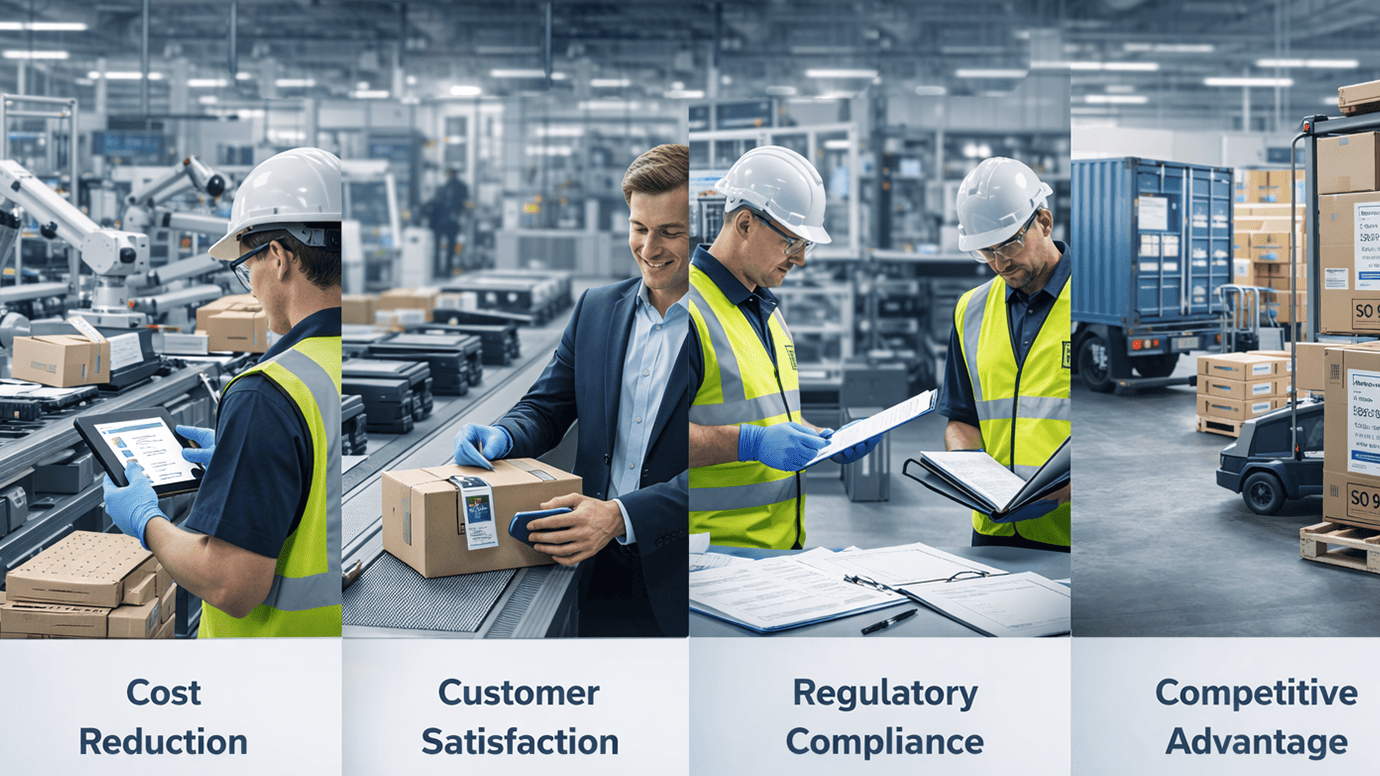
Why Quality Control Is Critical for Manufacturing Companies

Cost Reduction

Poor quality is one of the biggest hidden costs in manufacturing. Without effective internal quality control and well-defined steps, defects go unnoticed until they become expensive problems.

  • Scrap results in wasted materials and lost production time.
  • Rework increases labor and machine costs.
  • Warranty claims lead to financial losses and brand damage.
  • Product returns disrupt operations and erode customer confidence.

By using statistical quality control and proven techniques, companies can detect deviations early and apply the right method to prevent these losses.

Customer Satisfaction

Consistent product performance is built on strong quality control management. Regular inspection and disciplined procedures ensure that every product meets defined quality control standards. When customers receive reliable, defect-free products, trust grows—and that trust leads to long-term brand loyalty.

Regulatory Compliance

Manufacturers must meet ISO, safety, and industry-specific quality control standards. A robust process supported by accurate documents helps organizations demonstrate compliance, reduce legal risks, and avoid penalties.

Competitive Advantage

Companies with mature quality control in manufacturing gain export readiness, faster OEM approvals, and better pricing power. Effective analysis allows businesses to prove reliability, win premium contracts, and outperform competitors in global markets.

Types of Quality Control in Manufacturing

A well-designed quality control system in a modern factory is not limited to checking finished products. Instead, quality control in manufacturing is built on multiple layers of verification that work together to prevent defects, maintain consistency, and meet qc standards. Each layer of the quality control process plays a vital role in ensuring stable production and reliable output.
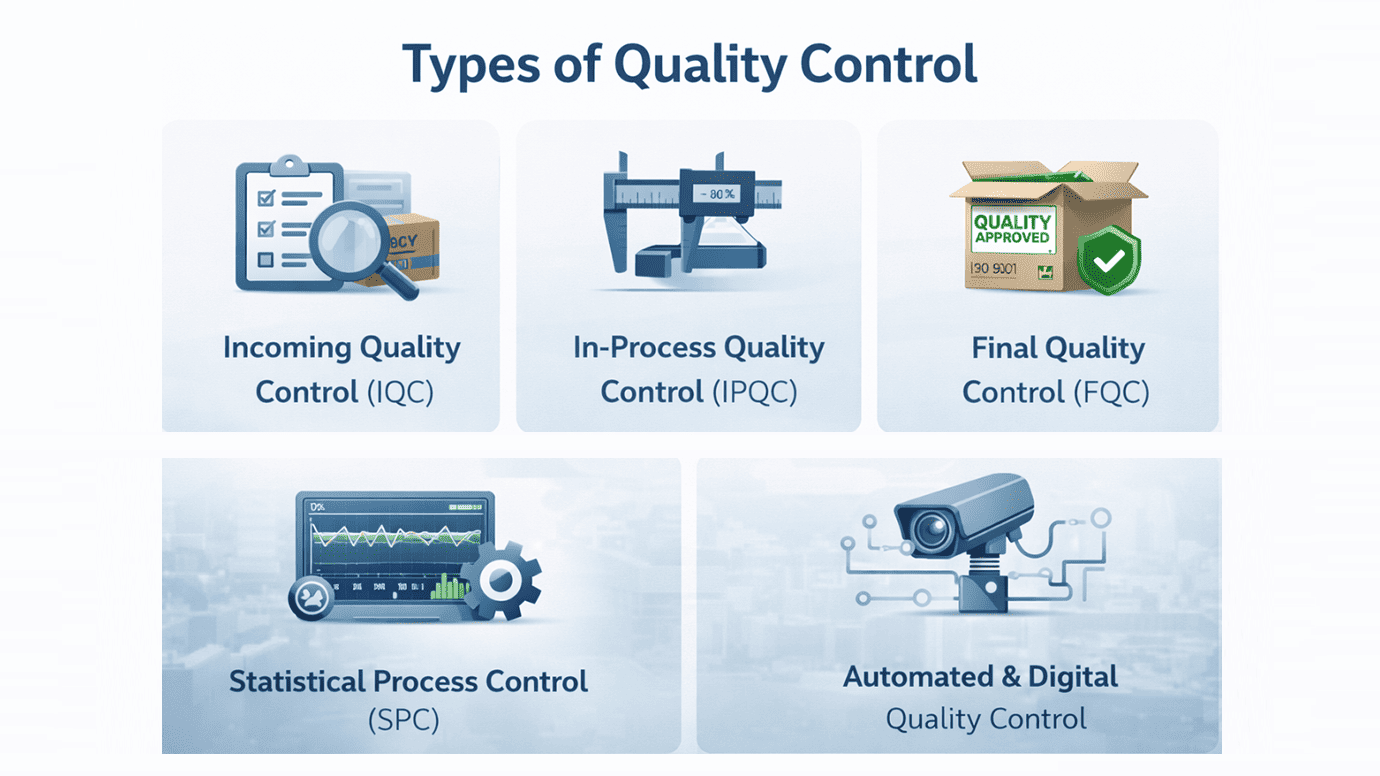
Types of Quality Control in Manufacturing

1. Incoming Quality Control (IQC)

It focuses on raw materials and components received from suppliers. Through systematic quality inspection, materials are checked against specifications before entering production. Strong internal quality control at this stage prevents defective inputs from affecting the entire production line. Using standardized qc procedures and maintaining detailed documents, companies can monitor supplier quality and ensure every delivery meets required performance and safety criteria.

2. In-Process Quality Control (IPQC)

It monitors the production process itself. Operators and machines are regularly checked using defined steps to ensure parameters remain within limits. Effective quality control techniques, such as dimensional checks and visual inspections, allow quick detection of deviations. Continuous analysis at this stage helps manufacturers correct problems before they turn into costly defects.

3. Final Quality Control (FQC)

It is performed on finished goods before shipment. This inspection verifies whether products meet customer requirements, technical drawings, and quality control standards. A clear method at this stage protects customers from receiving defective or unsafe products.

4. Statistical Process Control (SPC)

It uses data and control charts to monitor process stability. By tracking variations, SPC enables proactive quality control management and early problem detection, improving consistency and reducing waste.

5. Automated & Digital Quality Control

Industry 4.0 has transformed the quality control process through sensors, vision systems, and real-time data tracking. These digital techniques allow faster, more accurate quality inspection, enabling smarter decisions and continuous improvement across manufacturing operations.

Key Quality Control Tools and Techniques

Effective quality control in factories is driven by structured problem-solving and data-based decision-making. A strong process relies on proven techniques that help teams identify defects, remove root causes, and maintain compliance with quality control standards. These tools form the backbone of modern quality control in manufacturing.

  • Pareto Analysis helps prioritize problems by identifying the few critical causes responsible for most defects. By combining this with detailed analysis, teams can focus their improvement efforts where they will have the greatest impact.
  • Fishbone (Ishikawa) diagrams are widely used in internal quality control to visually map possible causes of defects across categories such as machines, materials, manpower, and methods. This tool supports structured qc procedures and root-cause investigations.
  • Control Charts, a core part of statistical quality control, monitor process variation over time. They allow operators to detect abnormal trends early and take corrective action before defects occur.
  • Check Sheets are simple but powerful documents used during quality inspection to collect real-time defect data and support accurate steps.
  • FMEA (Failure Mode & Effects Analysis) helps teams anticipate what could go wrong in a process and prioritize risks using a systematic quality control method.

5 Why Analysis digs deeper into problems by repeatedly asking “why,” making it a vital tool for quality control management.

  • Poka-Yoke (Mistake Proofing) prevents errors through smart design, while Process Capability (Cp, Cpk) measures how well a process meets specifications. Together, these tools reduce variation, improve consistency, and strengthen overall quality control

For detailed information, you can read our comprehensive blog on 7 QC Tools.

How Quality Control Impacts Factory Performance

In modern factories, quality control directly influences nearly every performance metric that determines profitability and competitiveness. A well-structured process supported by consistent inspection, disciplined procedures and accurate qc documents transforms quality from a cost center into a powerful business advantage.
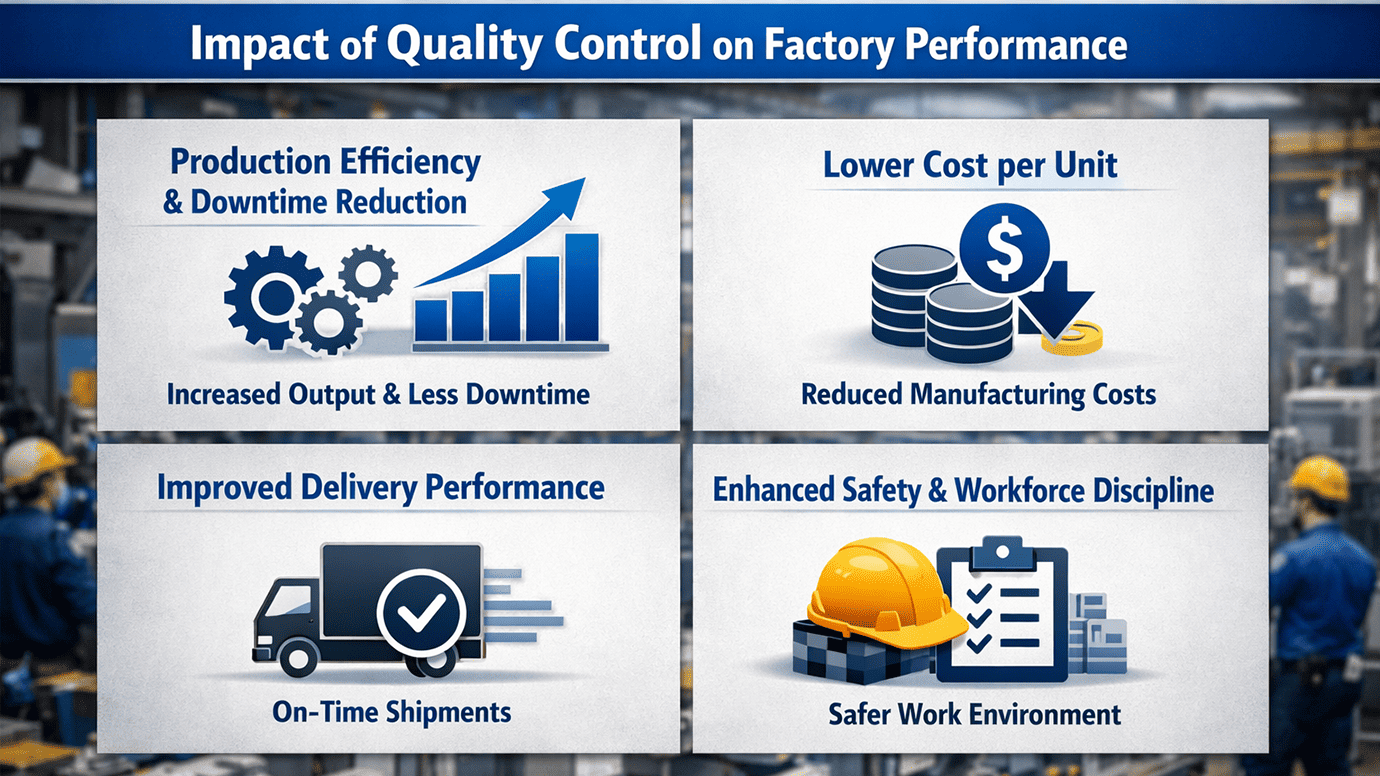
How Quality Control Impacts Factory Performance

  • Production Efficiency & Downtime Reduction: Strong quality control in manufacturing ensures machines, materials, and processes operate within defined standards. Through statistical quality control and continuous analysis, deviations are detected early, preventing breakdowns, rework, and unplanned stoppages. This leads to smoother operations, fewer line disruptions, and higher overall equipment effectiveness.
  • Lower Cost per Unit: Defects, scrap, and rework increase production costs. By applying the right techniques and a structured method, manufacturers reduce waste and improve yield. Effective internal quality control ensures that errors are corrected at the earliest stage, lowering material losses and labor costs and directly improving profit margins.
  • Improved Delivery Performance: When quality is stable, production flows without interruption. Reliable quality inspection and standardized steps help prevent last-minute rejections and rework, enabling factories to meet delivery schedules consistently and strengthen customer confidence.
  • Enhanced Safety and Workforce Discipline: Clear procedures and quality control management establish disciplined operating practices. Employees follow defined processes, machines operate within safe limits, and workplace incidents are reduced—creating a safer and more productive environment.

By integrating quality control into daily operations rather than treating it as a final checkpoint, factories use data-driven analysis to drive continuous improvement, making quality a true engine for profitability and long-term operational excellence.

Also Read: Industry 4.0 vs Industry 5.0

Common Quality Control Challenges in Indian Manufacturing

Indian manufacturing companies face several practical obstacles that limit the effectiveness of quality control systems. These challenges directly affect product consistency, costs, and customer satisfaction.
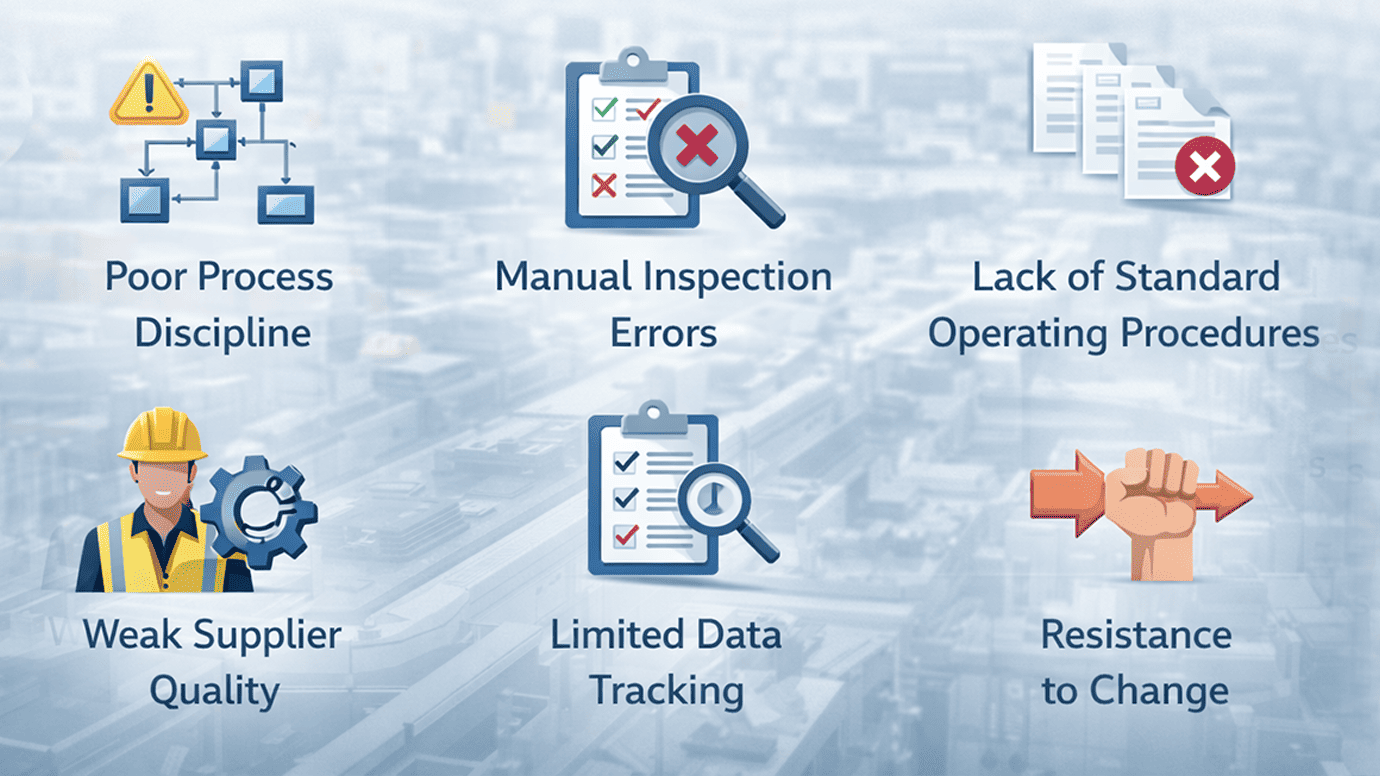
Common Quality Control Challenges in Indian Manufacturing

  • Poor Process Discipline: Many factories operate without clearly defined quality control standards, procedures, or documented steps. When processes are not standardized, workers rely on personal judgment rather than a structured process, leading to variation and defects.
  • Manual Inspection Errors: Heavy dependence on manual quality inspection increases the risk of missed defects due to fatigue, lack of training, or inconsistent methods. Without statistical quality control and strong analysis, defect trends remain invisible.
  • Lack of Standard Operating Procedures: In the absence of proper qc documents, internal quality control becomes reactive. Problems are fixed temporarily, but root causes are not eliminated, weakening long-term management.
  • Weak Supplier Quality: When suppliers are not governed by a structured method, poor-quality materials enter production, increasing scrap and rework throughout manufacturing.
  • Limited Data Tracking: Without digital records and data-driven techniques, factories struggle to monitor trends, measure performance, or improve consistency.
  • Resistance to Change: Employees often see quality control as additional work rather than a value-creating activity, making it difficult to implement new systems and sustain improvement.

Overcoming these challenges requires disciplined processes, data-driven decision-making, and a strong culture of quality.

How to Build a Strong Quality Control System

Building an effective quality control system requires more than just inspecting finished products. It must function as a complete management framework that governs how a factory operates, measures, and improves performance. A strong process integrates people, processes, data, and discipline across every stage of quality control in manufacturing.

  • Define Clear Quality Standards: The foundation of quality control begins with well-defined standards. These standards specify product requirements, tolerances, safety norms, and regulatory expectations. Every qc document and procedure must align with these standards to ensure consistency across production.
  • Standardize All Processes: Standardization is essential for reliable internal quality control. By documenting workflows and creating uniform steps, factories reduce variation and ensure that every operator follows the same approved method.
  • Train the Workforce: Employees must understand techniques, how to perform quality inspection, and how to interpret qc documents. Proper training builds ownership, improves accuracy, and strengthens quality control management on the shop floor.
  • Implement Inspection Systems: A structured inspection system must cover raw materials, in-process checks, and final products. These inspections are guided by standardized procedures and supported by digital or manual quality control analysis
  • Use Data and Statistical Process Control (SPC): Statistical quality control uses real-time data and control charts to detect process variation. This data-driven process allows early problem detection and faster corrective action.
  • Strengthen Supplier Quality Control: Suppliers must follow the same standards. Incoming materials should go through strict quality inspection and documented techniques to avoid downstream defects.
  • Drive Continuous Improvement: Regular quality control analysis, audits, and feedback loops ensure that the system evolves. When quality control is treated as a management system rather than just inspection, factories achieve higher consistency, lower costs, and sustainable operational excellence.

Quality Control in the Era of Smart Manufacturing

Industry 4.0 is redefining how quality control is performed in modern factories. Instead of relying only on periodic inspection, today’s quality control is powered by connected machines, data, and intelligent systems that ensure consistency, speed, and accuracy.

  • Real-Time Quality Data: Smart factories collect live production data from machines, sensors, and inspection systems. This data feeds into quality control analysis platforms that compare results against predefined standards. Deviations are detected instantly, allowing internal quality control teams to take corrective action before defects spread.
  • AI-Based Defect Detection: Advanced cameras and AI-driven quality control techniques now perform automated inspection with extremely high accuracy. These systems identify surface defects, dimensional errors, and assembly issues while automatically generating qc documents for traceability and audits.
  • Predictive Quality: Using statistical quality control and machine learning, manufacturers can predict when a process may go out of control. This enables teams to apply the right method early, preventing scrap, rework, and downtime within the process.
  • Smart Factories & Integrated Systems: In smart factories, quality control management is digitally connected with production, maintenance, and supply chain systems. Standardized procedures and defined steps are embedded into daily operations, ensuring continuous improvement and consistent product quality.

By combining data, automation, and analytics, smart manufacturing transforms quality control into a proactive, profit-driving system rather than just a final checkpoint.

FAQs

A. It is a structured system used to ensure that products meet defined specifications and customer expectations. It involves regular inspection, use of quality control techniques, and continuous analysis to detect defects and maintain consistency across production.

A. Quality control focuses on detecting defects through inspections and testing, while quality assurance focuses on preventing errors through process design. Both work together within a broader management framework that ensures compliance with standards.

A. Quality inspection ensures that raw materials, in-process parts, and finished goods meet defined standards. It supports internal quality control by identifying defects early and reducing costly rework and scrap.

A. It uses data, control charts, and process variation analysis to monitor production stability. It strengthens the quality control process by detecting abnormal trends before defects occur.

A. It ensures that every production stage follows approved processes and quality control standards. This leads to better consistency, lower waste, and improved delivery performance.

A. A reliable quality control process demonstrates product consistency, compliance, and reliability. International buyers and OEMs rely on analysis and documented systems before approving suppliers.

A. Manufacturers can upgrade their quality control by using statistical quality control, digital inspection, automated data capture, and continuous improvement through advanced practices.

A. Modern quality control techniques such as FMEA, control charts, and Pareto analysis help identify root causes of defects. These tools improve the quality control method by making problem-solving more systematic and data-driven.

Conclusion

For modern manufacturers, quality control is no longer just a support function—it is a powerful growth engine. When designed as a complete management system, it directly improves profitability, customer confidence, and operational stability. A disciplined quality control process, supported by structured inspection, reliable documents, and data-driven analysis, transforms quality from a cost into a competitive advantage.

In manufacturing, every defect prevented saves material, labor, time, and reputation. By applying proven techniques, statistical quality control, and a standardized method, companies reduce scrap, avoid rework, and protect their margins. Strong internal quality control also ensures compliance with global standards, making businesses ready for audits, exports, and OEM partnerships.

Scalability depends on consistency. Without clear qc procedures and defined steps, growth only multiplies errors. But when quality systems are embedded into daily operations, factories can expand production, serve global markets, and win high-value contracts with confidence.

In today’s competitive landscape, customers, regulators, and international buyers demand proof of performance—not promises. That proof comes from robust quality control systems backed by accurate data, disciplined processes, and continuous improvement.

Manufacturers who want long-term success must modernize their quality systems now. By investing in smart, structured, and digitally enabled quality control, businesses do not just improve products—they build stronger brands, healthier profits, and a future-ready manufacturing operation.

For more information, go to our Homepage.

Leave a Comment

Your email address will not be published. Required fields are marked *

Call Now Button
× Book free consultation