

Daily Work Management
Manufacturing and operations leaders today are operating in an environment that is more complex and demanding than ever before.
Volatility in demand, rising operational costs, persistent skill gaps, and poor visibility into daily performance have made it increasingly difficult to run operations in a stable and predictable manner. Despite having sophisticated systems and detailed reports, many organizations still struggle to answer a simple question at the end of each day: Did we perform as expected, and if not, why?
Traditional management approaches rely heavily on monthly reviews, dashboards, and retrospective meetings. While these tools provide historical data, they often fail to drive timely action. By the time issues appear in a report, the opportunity to correct them has already passed. This reactive approach fuels firefighting, delays decision-making, and disconnects leadership from the realities of daily operations.
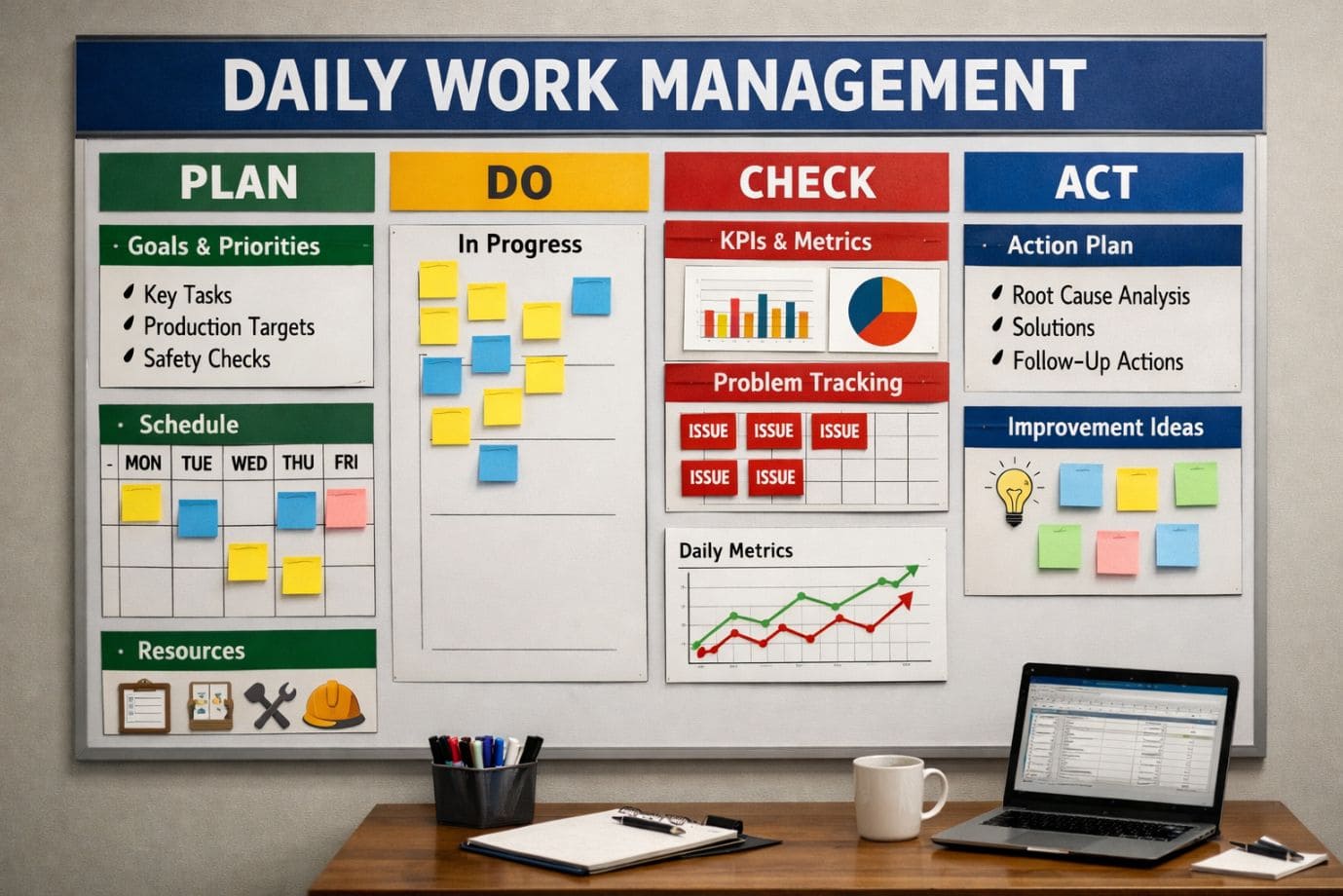
This is where Daily Work Management (DWM) becomes critically important. It is a structured and disciplined approach to managing work every day, enabling teams to track performance, identify gaps early, and take corrective action in real time. A well-designed daily work management system brings clarity to priorities, accountability to execution, and rhythm to operations through tools such as a daily work management board and an employee daily task tracker.
More than a set of meetings or visual boards, daily work management functions as a leadership system, a performance management system, and a powerful culture enabler. It empowers every DWM manager—from shopfloor supervisors to senior leaders—to connect strategic objectives with daily execution.
Whether applied in manufacturing plants, engineering organizations, or operations and supply chain teams, DWM provides the foundation for operational excellence in an increasingly unpredictable business environment.
What is DWM (Daily Work Management)?
It is a structured approach to planning, executing, monitoring, and improving work on a daily basis. At its core, daily work management ensures that organizational strategy is translated into clear, actionable priorities for teams every single day. Instead of reviewing performance after weeks or months, a daily work management system enables leaders to see deviations in real time and respond immediately.
A key strength of DWM is that it shifts the focus from merely managing results to managing the work that creates those results. While traditional management systems emphasize output metrics alone, daily work management emphasizes process discipline, problem identification, and ownership. Tools such as employee daily task tracker make work visible, clarify responsibilities, and ensure alignment across levels. For a DWM manager, this visibility enables faster decision-making and more effective coaching of teams.
Who Should Use Daily Work Management Syatem?
It is relevant for all levels of an organization, including plant leadership, functional managers, frontline supervisors, and support functions such as quality, maintenance, and supply chain. When implemented correctly, daily work management creates a shared language of performance and accountability across the organization.
Why Organizations Fail Without a Daily Management System
In the absence of a structured daily work management system, organizations struggle to maintain control over day-to-day operations. While long-term strategies and performance targets may be well defined, the lack of a daily execution framework creates gaps between planning and reality. Without daily work management system, small issues remain hidden, accountability weakenss, and operational performance becomes inconsistent.

Firefighting Culture
Without daily work management, teams are forced into a constant firefighting mode. Instead of proactively managing processes, leaders and supervisors react to urgent issues as they arise. This reactive approach consumes time and energy, leaving little room for systematic problem-solving or improvement.
Problems Detected Too Late
When there is no daily work management structure, performance issues are often identified only after they have already impacted cost, quality, or delivery. The absence of a daily work management system means deviations from targets are not visible on a daily basis, resulting in delayed corrective actions.
Meetings Without Decisions
Many organizations conduct frequent meetings but fail to drive meaningful outcomes. Without daily work management, meetings become routine status updates rather than focused decision-making sessions. The lack of visual performance tracking and structured agendas prevents teams from converting discussions into clear actions.
KPIs Reviewed but Not Acted Upon
KPIs are often reviewed weekly or monthly, but without a daily work management system, these metrics remain numbers on a dashboard. There is no clear linkage between KPI gaps and daily corrective actions. As a result, recurring issues persist without ownership or follow-up.
Lack of Shopfloor Accountability
At the shopfloor level, the absence of daily work management leads to unclear priorities and diluted responsibility. Frontline teams struggle to align daily activities without an employee daily task tracker, and supervisors lack real-time visibility. For a DWM manager, this makes coaching, tracking, and escalation extremely difficult.
Also Read our comprehensive blog on Operations Management.
Core Pillars of an Effective Daily Work Management System
A successful daily work management system is not built on meetings alone—it is built on a set of well-defined pillars that bring structure, discipline, and clarity to daily operations. When these pillars work together, DWM transforms fragmented activities into a predictable execution rhythm. The following five pillars form the foundation of an effective and sustainable daily work management approach.
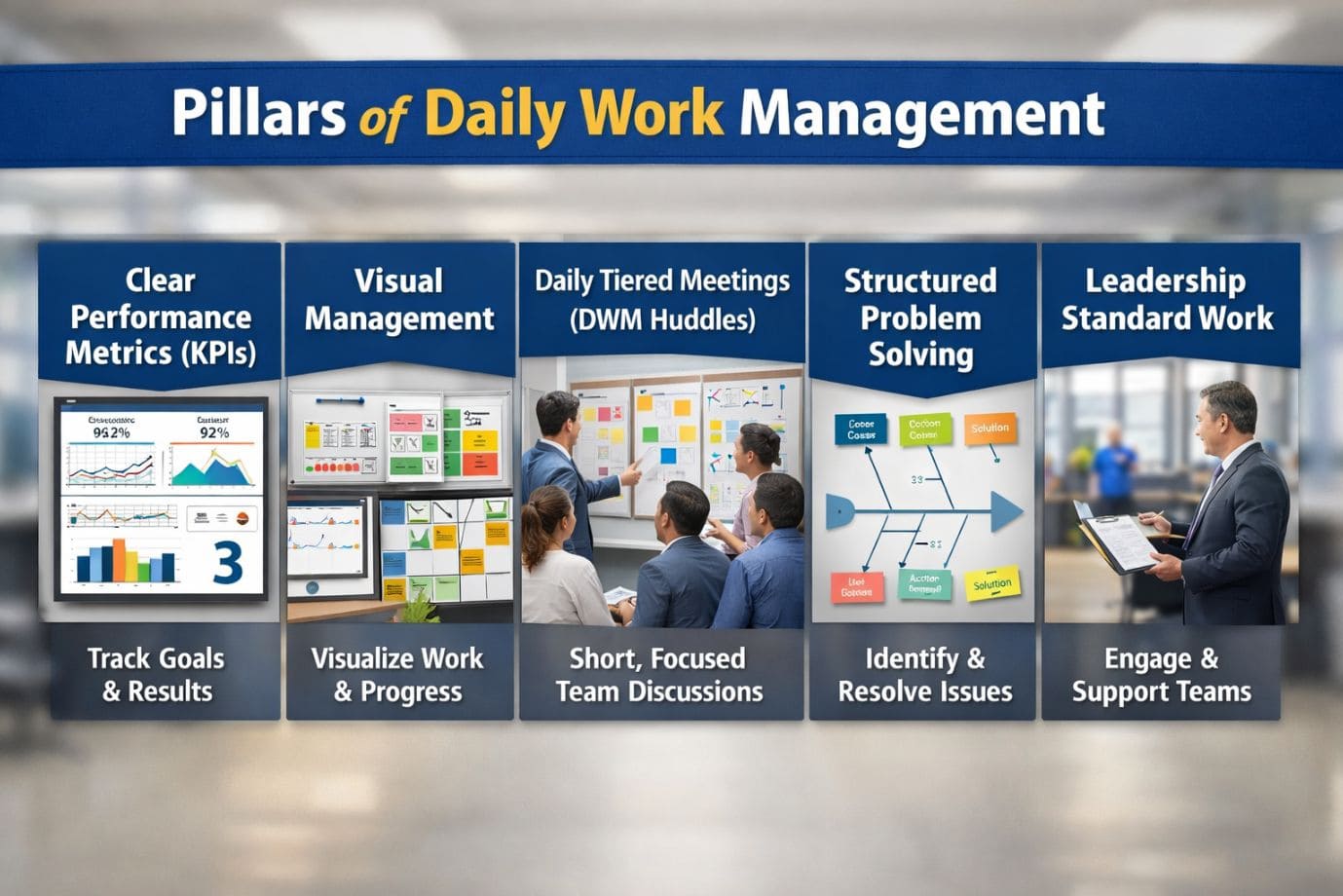
Clear Performance Metrics (KPIs)
- The first pillar of daily work management is the definition of clear and relevant performance metrics. Effective daily work management system focuses on core dimensions such as Safety, Quality, Delivery, Cost, Productivity, and Morale. These metrics provide a balanced view of operational health rather than a narrow focus on output alone.
- A robust daily work management system distinguishes between leading indicators (process adherence, equipment availability, manpower readiness) and lagging indicators (output, defects, downtime). While lagging indicators show results, leading indicators help prevent failures. Additionally, KPIs must be role-specific. A frontline supervisor, functional head, and plant leader require different metrics to drive accountability. For a DWM manager, this role-wise clarity ensures focus without overload.
Visual Management
- Visual management is the backbone of execution in daily work management. A well-designed system, whether physical or digital, makes performance transparent and actionable. It enables teams to track target vs actual performance on a daily basis and immediately highlight deviations.
- Through visual cues, problems become visible rather than hidden in reports. Action items are clearly assigned with owners and timelines, ensuring accountability. When paired with an employee daily task tracker, visual management allows supervisors to align daily tasks with operational priorities, strengthening execution discipline within the daily work management system.
Daily Tiered Meetings (DWM Huddles)
- Daily tiered meetings, commonly known as DWM huddles, create a structured communication rhythm. These meetings are short, focused, and action-oriented, typically lasting 10–15 minutes. Their purpose is to review performance, identify issues, and align actions for the day.
- Tier 1 meetings focus on frontline teams, Tier 2 aligns department-level functions, and Tier 3 enables cross-functional and leadership alignment. In an effective daily work management system, information flows upward while problem-solving responsibility flows downward. This ensures faster resolution and prevents escalation overload for the DWM manager.
Structured Problem Solving
- An essential pillar of DWM is structured problem solving. Teams are trained to identify abnormalities—any deviation from standard performance—and respond immediately. The focus is on root cause thinking, not blame.
- Clear escalation mechanisms ensure that problems beyond a team’s control are raised to the right level. Just as important is closure discipline, where every issue tracked on the daily work management board is followed through to resolution.
Leadership Standard Work
- Leadership behavior defines the success of daily work management. Leadership standard work outlines the daily routines of supervisors and managers, including review cycles, coaching interactions, and Gemba walks. Rather than controlling, leaders focus on coaching teams to solve problems independently.
- For a DWM manager, this shift from command to capability building ensures that the daily work management system becomes a habit, not a temporary initiative.
Also read our dedicated page on Industrial Engineering Services.
How Daily Work Management System Works in a Manufacturing Environment
In a manufacturing setup, execution happens across multiple levels every day—from the shopfloor to plant leadership. A well-implemented daily work management system ensures that priorities, performance, and problems are aligned across all these levels. It creates a structured operating rhythm that connects daily activities with overall plant objectives, enabling faster decision-making and disciplined execution.

Shopfloor-Level DWM
- At the shopfloor level, daily work management focuses on stability and clarity at the start of every shift. Shift handovers are conducted using a daily work management board, ensuring continuity between outgoing and incoming teams. Key information related to safety incidents, quality issues, and production status is reviewed openly.
- Daily safety and quality checks are embedded into standard work, helping teams identify abnormalities early. Output is tracked against targets in real time, making performance gaps immediately visible. Workforce allocation is also reviewed daily, ensuring the right skills are deployed at the right stations. An employee daily task tracker plays a critical role here by clearly defining individual responsibilities, enabling supervisors and the DWM manager to monitor execution without micromanagement.
Department-Level DWM
- At the department level, daily work management enables coordination across production, maintenance, quality, and logistics functions. Daily reviews focus on production plans versus actuals, material availability, and capacity constraints. Maintenance teams use daily work management routines to track equipment health, breakdowns, and preventive maintenance compliance.
- Quality concerns such as defects, rework, or customer complaints are reviewed daily rather than waiting for weekly reports. Resource constraints—including manpower, tools, or materials—are highlighted early and addressed proactively. This level of visibility allows the daily work management system to prevent disruptions before they affect overall plant performance.
Plant-Level DWM
- At the plant level, DWM ensures cross-functional alignment and strategic focus. Leadership teams review consolidated performance through structured dashboards linked to daily work management boards from lower tiers. Strategic KPIs related to safety, delivery, cost, and productivity are monitored daily to detect systemic trends.
- Escalation of recurring or cross-functional issues happens through defined daily work management channels, enabling faster resolution and ownership. For the DWM manager, this tiered structure ensures that critical issues receive attention at the right level while empowering teams to solve problems where they occur. As a result, the daily work management system becomes a powerful engine for operational excellence across the manufacturing value chain.
Benefits of Implementing Daily Work Management System
A structured daily work management system enables organizations to shift from reactive firefighting to disciplined execution. By focusing on daily performance, visibility, and accountability, daily work management creates measurable business value across all levels of the organization. When implemented correctly, it becomes a powerful driver of operational excellence and sustainable performance improvement.

Improved Operational Discipline
One of the most significant benefits of daily work management is improved operational discipline. Standard routines, daily reviews, and clearly defined expectations ensure that work is performed consistently. For a DWM manager, this discipline reduces variability and establishes control over daily operations.
Faster Problem Detection and Resolution
With daily work management, problems are identified as soon as they occur. A structured daily work management board highlights deviations from targets in real time, allowing teams to take immediate corrective action. This reduces delays, minimizes losses, and prevents small issues from becoming major disruptions.
Higher Productivity
By addressing inefficiencies on a daily basis, daily work management directly improves productivity. Clear priorities, reduced rework, and effective workforce deployment—supported by an employee daily task tracker—ensure that time and resources are used optimally throughout each shift.
Better Employee Engagement
Daily work management creates clarity and involvement at the frontline. When employees understand daily goals and see problems being addressed consistently, engagement levels improve. Teams feel empowered to contribute, and the daily work management system fosters a sense of ownership rather than compliance.
Better Employee Engagement
Daily work management creates clarity and involvement at the frontline. When employees understand daily goals and see problems being addressed consistently, engagement levels improve. Teams feel empowered to contribute, and the daily work management system fosters a sense of ownership rather than compliance.
Strong Accountability Culture
Accountability is strengthened when responsibilities are clearly defined and actions are tracked daily. Through daily work management, every issue has an owner, a timeline, and a follow-up mechanism. This visibility helps the DWM manager reinforce accountability without micromanagement.
Predictable Performance
The ultimate benefit of daily work management is predictable performance. A robust system ensures that results are not left to chance but are driven through disciplined daily execution. Over time, this consistency builds confidence, stability, and long-term operational resilience.
Common Mistakes in DWM Implementation (And How to Avoid Them)
Although daily work management is a proven approach to improving operational performance, many organizations struggle during implementation. These challenges usually arise not because it is ineffective, but because it is misunderstood or poorly executed. Recognizing common pitfalls early helps organizations build a sustainable daily work management system that delivers long-term results.

Treating DWM as a Meeting Ritual
One of the most common mistakes is reducing daily work management to a daily meeting routine. When discussions focus only on reporting status instead of solving problems, the system quickly loses value. To avoid this, every discussion should be anchored to real performance gaps visible on the daily work management board, with clear actions defined.
Tracking Too Many KPIs
Another frequent issue is the inclusion of too many KPIs in the daily work management system. Excessive metrics create confusion and dilute focus. Successful daily work management emphasizes a small set of critical, role-specific KPIs that help the DWM manager drive meaningful action.
No Action Follow-Up
In many organizations, issues are identified but never closed. Without structured follow-up, the same problems reappear repeatedly. Using clear ownership and tracking actions through an employee daily task tracker ensures that every issue identified through daily work management is taken to closure.
Management-Only Ownership
Daily work management system fails when it is owned only by management. Frontline teams must actively participate in identifying problems and executing solutions. Inclusive ownership strengthens engagement and reinforces the effectiveness of the daily work management system.
Copy-Paste Boards Without Customization
Implementing generic templates without adapting them to the organization’s context weakens effectiveness. Each daily work management board must reflect specific processes, challenges, and priorities.
Lack of Leadership Commitment
Finally, inconsistent leadership behavior undermines daily work management. Leaders must actively review, coach, and continuously improve the system. Starting simple, focusing on behavior change, training leaders, and regularly reviewing the daily work management system are key to sustaining success.
Also Read: Total Quality Management (TQM)
Steps to Implement Daily Work Management Successfully
Implementing daily work management is not a one-time activity but a structured journey that builds execution discipline over time. A well-planned rollout ensures that it becomes part of the organization’s operating rhythm rather than an additional management layer. The following steps outline a practical approach to building a sustainable daily work management system.
Assess the Current State
The first step is to understand how work is currently managed. This includes reviewing performance visibility, decision-making cycles, and problem-resolution practices. For a DWM manager, this assessment helps identify gaps where daily work management can create immediate impact.
Define Business Objectives
Clear business objectives provide direction to daily work management. Organizations must define what they want to improve—such as safety, delivery reliability, productivity, or cost. These objectives ensure that the daily work management system remains aligned with strategic priorities.
Design the KPI Framework
Once objectives are clear, a focused KPI framework should be designed. Effective daily work management uses a limited number of role-specific KPIs that drive daily action. These KPIs form the backbone of the daily work management board.
Create Visual Management Boards
Visual boards make performance transparent. A daily work management board, whether manual or digital, displays target versus actual performance, highlights gaps, and tracks actions. Supporting tools such as an employee daily task tracker help reinforce task ownership.
Train Teams and Leaders
Training is essential to ensure consistent adoption. Leaders must be trained not only on tools but also on behaviors that support daily work management. This enables the system to function effectively across all levels.
Pilot, Review, and Scale
Organizations should start with a pilot in one area, review results, and refine the approach. Once stabilized, DWM can be scaled across departments. Whether using digital platforms or physical boards, simplicity and discipline are key to sustaining the daily work management system.
FAQs
A. Daily Work Management is a structured approach to planning, executing, and reviewing work on a daily basis. A strong system helps organizations track performance, identify problems early, and take corrective actions using tools like an employee daily task tracker.
A. Daily work management is critical in manufacturing because it provides real-time visibility into safety, quality, delivery, cost, and productivity. By using a structured system, manufacturing teams can reduce firefighting, improve accountability, and ensure predictable performance under the guidance of a DWM manager.
A. A DWM manager is responsible for driving discipline, coaching teams, and ensuring consistent use of the daily work management system. Rather than micromanaging, it uses routines to remove barriers, enable problem-solving, and improve execution.
A. Traditional KPI reviews are often monthly or weekly and focus on results after the fact. Daily work management focuses on managing the work that drives results every day. With tools like employee daily task tracker, gaps are identified and acted upon immediately.
A. An employee daily task tracker clarifies individual responsibilities and priorities for each shift or day. It strengthens accountability within the system and enables supervisors and the DWM manager to monitor execution without micromanagement.
A. Common mistakes include treating DWM as a meeting ritual, tracking too many KPIs, lack of follow-up, and weak leadership commitment. Avoiding these pitfalls requires starting simple, focusing on behavior change, and continuously improving the daily work management system.
A. The timeline for implementing a daily work management system depends on organizational maturity and scope. Typically, a pilot can be stabilized within a few weeks, while full-scale adoption across functions may take several months under strong leadership and an effective DWM manager.
A. Yes. DWM can be implemented using either physical or digital tools. Digital tools like employee daily task trackers are especially useful for multi-location operations. However, regardless of format, the success of the daily work management system depends on discipline and leadership behavior.
Conclusion
Daily Work Management is often misunderstood as a set of meetings, boards, or tracking tools. In reality, it is a mindset—one that emphasizes discipline, visibility, and accountability in how work is executed every single day. Organizations that treat DWM as a short-term initiative rarely sustain results, while those that embed it into their culture unlock lasting operational excellence.
The true success of a daily work management system depends on consistent leadership behavior. Leaders must actively engage with performance data, coach teams at the shopfloor, and reinforce standard routines. Tools such as the daily work management board and the employee daily task tracker support execution, but they do not replace leadership discipline. For every DWM manager, the role is not to control work, but to create clarity, remove barriers, and develop problem-solving capability within teams.
When implemented correctly, it transforms daily chaos into controlled execution. Performance gaps are identified early, actions are tracked systematically, and decision-making becomes faster and more informed. Over time, this structured approach reduces firefighting and builds confidence across the organization.
Organizations that master daily work management develop resilient, high-performing operations capable of adapting to change without losing control. By making daily performance visible and actionable, a robust daily work management system becomes the foundation upon which sustainable growth, operational stability, and continuous improvement are built.
For more information, go to our Homepage.

