

7 QC Tools: The Foundation of Quality Control in Manufacturing

In today’s highly competitive industrial landscape, quality is no longer just a department function—it is a strategic business priority.

Modern manufacturing organizations are under constant pressure to deliver consistent quality, lower defects, and higher productivity while meeting strict regulatory requirements and ever-increasing customer expectations. As global competition intensifies, even small quality issues can lead to significant cost overruns, production delays, and loss of customer trust.

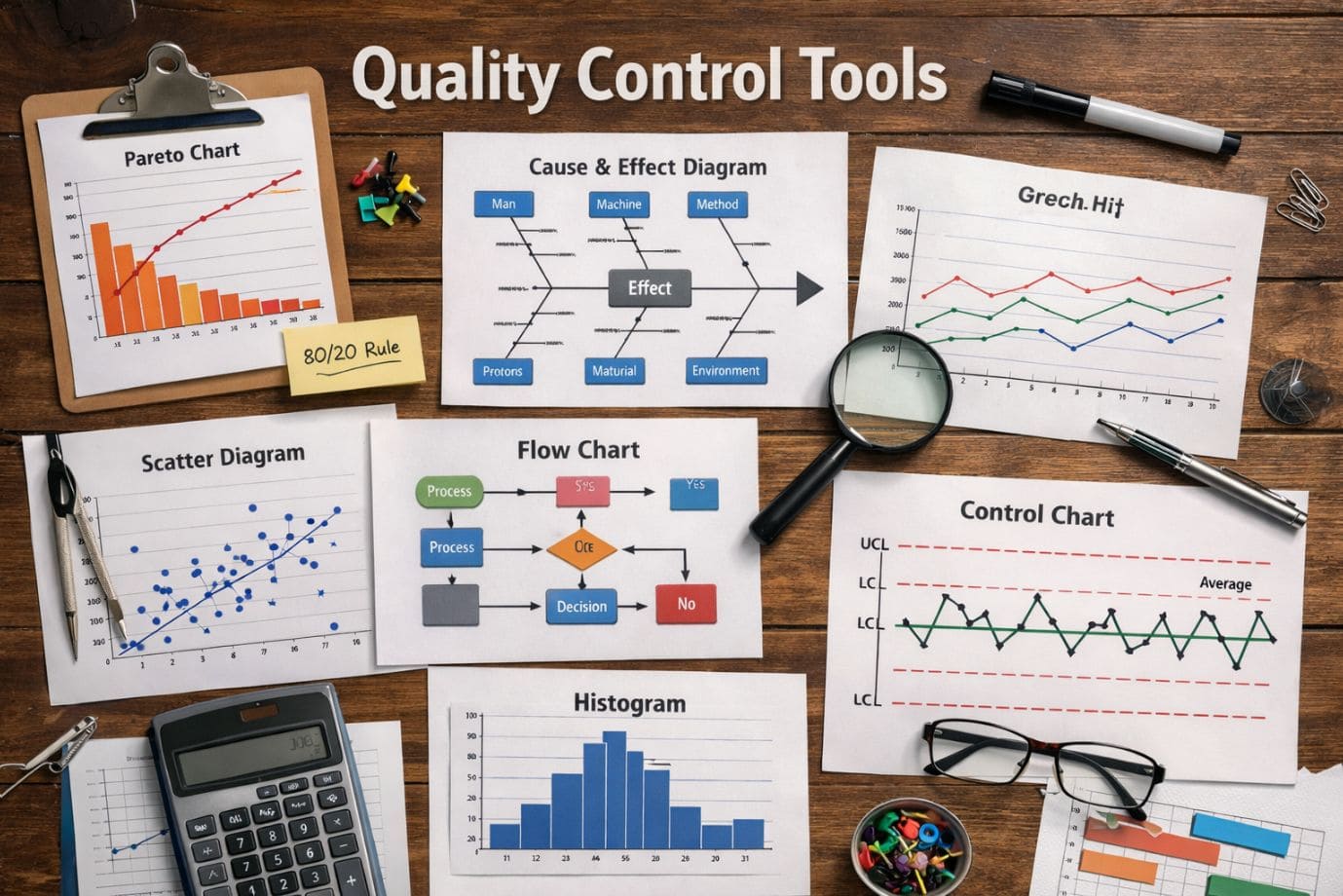
To address these challenges, organizations need structured, data-driven approaches rather than reactive problem-solving. This is where the 7 QC tools play a critical role. These tools provide a systematic framework to identify problems, analyze root causes, monitor process performance, and implement effective corrective actions. The 7 tools of quality are globally recognized as the foundation of quality control and continuous improvement practices across industries.
7 QC Tools

These basic seven tools of quality are simple to understand yet powerful in application. They help teams convert raw data into meaningful insights, reduce process variation, and prevent defects before they reach the customer. From shop-floor operations and supplier quality to service processes and project management, 7 QC techniques are widely used in manufacturing, process industries, and even service organizations.

By mastering and consistently applying the 7 QC tools, businesses can build a strong quality culture, improve operational efficiency, and achieve sustainable long-term excellence.

What Are the 7 QC Tools?

Quality Control (QC) refers to the systematic process of ensuring that products, services, and processes consistently meet defined quality standards. In manufacturing and operations, QC focuses on monitoring processes, identifying variations, and preventing defects before they impact customers or business performance. To achieve this effectively, organizations rely on structured analytical methods rather than assumptions or trial-and-error approaches.

The 7 QC tools originated from the Japanese manufacturing and quality movement that emerged after World War II. These tools were widely promoted by quality pioneers to help frontline teams solve problems using simple data analysis techniques. Over time, the 7 tools of quality became globally accepted as the foundation of quality management systems across manufacturing, process, and service industries.

These tools do not require advanced statistical knowledge, yet they provide powerful insights into process behavior and quality performance. When applied correctly, 7 QC methods support root cause analysis, help maintain process stability, and enable data-driven decision making at all organizational levels.

Collectively, the 7 QC tools provide a structured framework to collect data, analyze problems, visualize processes, and control variation. Below is a high-level overview of these essential quality tools:

  • Check Sheet
  • Pareto Chart
  • Cause and Effect Diagram
  • Histogram
  • Control Chart
  • Scatter Diagram
  • Flow Chart

Together, these tools form the backbone of effective quality control and continuous improvement initiatives. To know about QC as a whole elaboratively, read our comprehensive blog on Quality Control.

Why Are the 7 QC Tools Important in Manufacturing?

In manufacturing, quality issues rarely appear suddenly—they are usually the result of uncontrolled processes, hidden variations, or ignored warning signals. To manage quality effectively, organizations need simple yet powerful methods that support consistent analysis and continuous improvement. The 7 QC tools provide this foundation by enabling manufacturers to understand their processes, control variation, and prevent defects in a structured manner.

Why Are the 7 QC Tools Important in Manufacturing

  • Reducing Rework and Scrap: One of the most critical benefits of the seven QC tools is their role in reducing rework and scrap. Tools such as check sheets and Pareto charts help teams identify recurring defects and prioritize the most significant quality problems. By addressing these issues at their source, manufacturers can minimize waste, lower production costs, and improve overall efficiency.
  • Improving Productivity and Process Stability: The 7 tools of quality support better productivity by helping organizations maintain stable and predictable processes. Histograms and control charts allow teams to monitor process variation and detect abnormalities early. When processes remain under control, machine downtime decreases, output consistency improves, and resources are used more effectively.
  • Enhancing Customer Satisfaction: Consistent quality is directly linked to customer satisfaction. By applying the basic seven tools of quality, manufacturers can reduce defects, ensure compliance with specifications, and deliver products that meet customer expectations. Fewer quality issues translate into fewer complaints, stronger customer trust, and improved brand reputation.

⮞ From Reactive Firefighting to Proactive Quality Management

Without structured tools, factories often rely on reactive firefighting—solving problems only after defects occur. The 7 QC methods enable a shift toward proactive quality management by identifying early warning signs and root causes before issues escalate. This proactive approach strengthens preventive controls and long-term process improvement.

⮞ Alignment with ISO, Lean, and Six Sigma

The 7 QC tools are closely aligned with ISO quality management systems, Lean manufacturing principles, and Six Sigma fundamentals. They form the analytical backbone of many improvement initiatives and audits, supporting standardization, waste reduction, and defect elimination across manufacturing operations. For more information, you can go through our detailed blog on Six Sigma.

The 7 QC Tools Explained in Detail

The 7 QC tools form the backbone of effective quality control and continuous improvement in manufacturing and operations. Each of these tools serves a specific purpose, yet they work best when applied together in a structured manner. These tools help organizations collect reliable data, identify problem areas, analyze root causes, and maintain process stability. As part of the 7 tools of quality, they are widely recognized for their simplicity, practical applicability, and ability to support data-driven decision making across industries.
The 7 QC Tools Explained in Detail

Check Sheet for Quality Control

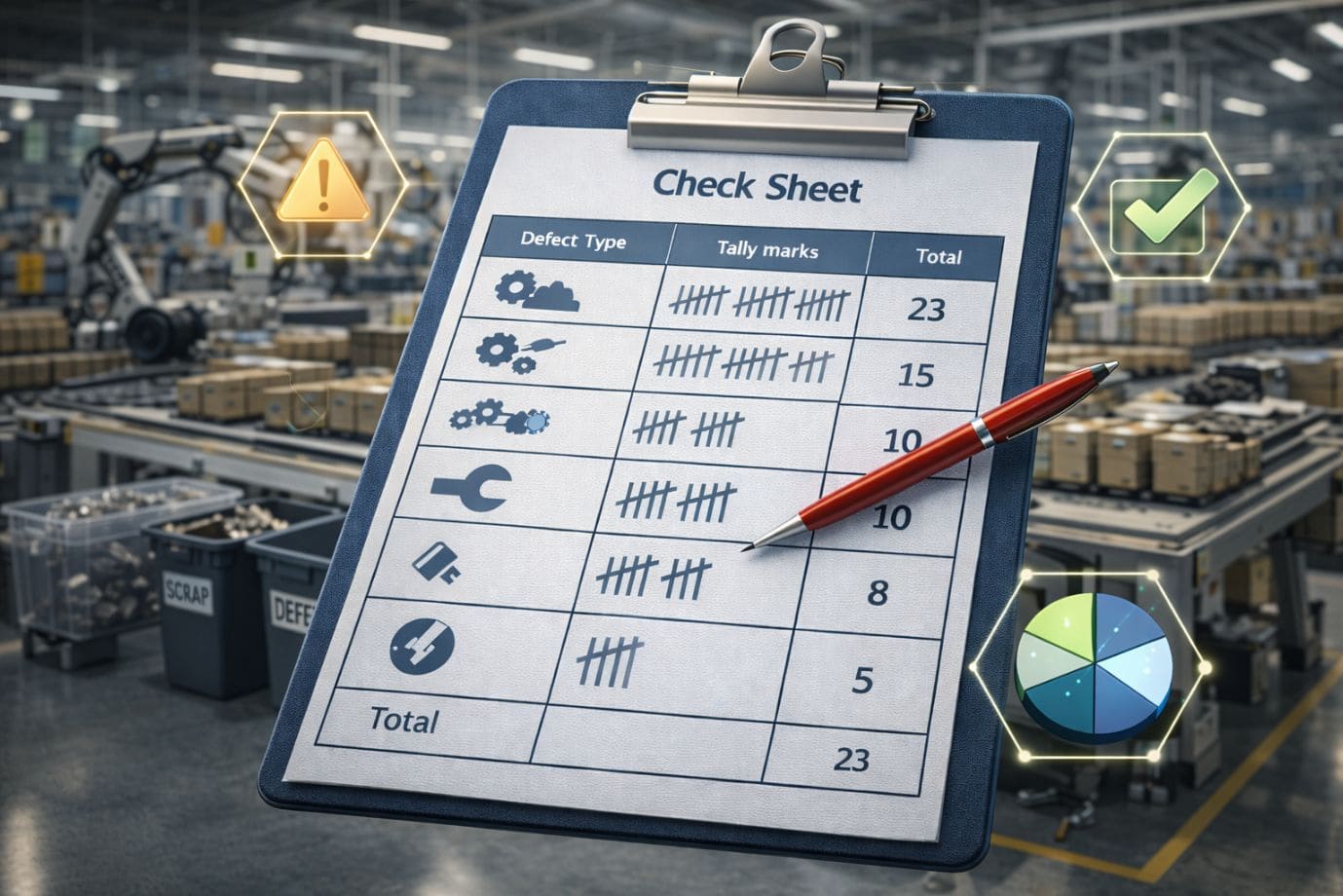
The check sheet is the first and most fundamental tool among the 7 QC tools. It acts as a starting point for quality analysis by enabling accurate and consistent data collection directly from the process.

  • Definition of a Check Sheet: A check sheet is a structured document used to record data in a systematic way. In manufacturing, a check sheet for quality control ensures that information related to defects, process variations, or inspection results is captured in a uniform format. This standardization makes the collected data reliable and easy to analyze.
  • Purpose: The primary purpose of a check sheet is to support structured data collection. Instead of relying on assumptions or verbal feedback, teams use predefined fields to record observations in real time. This approach strengthens the effectiveness of other seven QC tools, as accurate data is the foundation of meaningful analysis.
  • Types of Check Sheets: Different types of check sheets are used based on the quality objective. A defect type check sheet records various defect categories to identify common quality issues. A defect location check sheet captures where defects occur on a product or within a process. A frequency check sheet tracks how often a particular defect or event happens over a defined period. In many cases, a check sheet also functions as a checklist for quality control, ensuring inspection steps are consistently followed.
  • Benefits of Using Check Sheets: Check sheets are easy to use and require minimal training, making them accessible at the shop-floor level. They provide real-time visibility into quality issues and serve as a foundation for applying other 7 tools of quality, such as Pareto charts and histograms. As part of 7 QC practices, check sheets enable better decision making and effective quality improvement.

Pareto Chart in Quality Control

Among the 7 QC tools, the Pareto chart in quality control is a powerful analysis tool used to identify and prioritize the most significant quality problems.

  • Definition and the 80/20 Rule Concept: A Pareto chart is a bar graph that visually represents problems or defects in descending order of frequency or impact. It is based on the 80/20 rule, which states that roughly 80% of problems are caused by 20% of the causes. In pareto chart in quality control, this principle helps organizations distinguish between the “vital few” issues and the “trivial many.”
  • Prioritizing Quality Issues Using Pareto Charts: By arranging defect data from highest to lowest occurrence, Pareto charts allow teams to quickly identify which quality issues demand immediate attention. This structured approach enables 7 QC practices to move away from guesswork and focus on data-driven decision making.
  • Steps to Create a Pareto Chart: Creating a Pareto chart typically involves collecting data, categorizing defects, counting frequencies, arranging data in descending order, and plotting cumulative percentages. These steps make the tool simple yet effective within the basic seven tools of quality.
  • Key Benefits of Pareto Charts: The Pareto chart helps teams focus on high-impact problems, ensuring efficient use of time, manpower, and resources. As part of the 7 QC tools, it supports faster problem resolution and more effective quality improvement initiatives.

Cause and Effect Diagram (Fishbone / Ishikawa Diagram)

The cause and effect diagram is one of the most widely used tools within the 7 QC tools for identifying the root causes of quality problems. It helps organizations move beyond surface-level symptoms and uncover the underlying factors that lead to defects.
Cause and Effect Diagram (Fishbone - Ishikawa Diagram)

  • Purpose: The primary purpose of a cause and effect diagram is to support root cause analysis. Instead of reacting to visible defects, teams use this tool to systematically explore all possible reasons behind a problem. Within the 7 tools of quality, it plays a critical role in ensuring that corrective actions address true causes rather than temporary fixes.
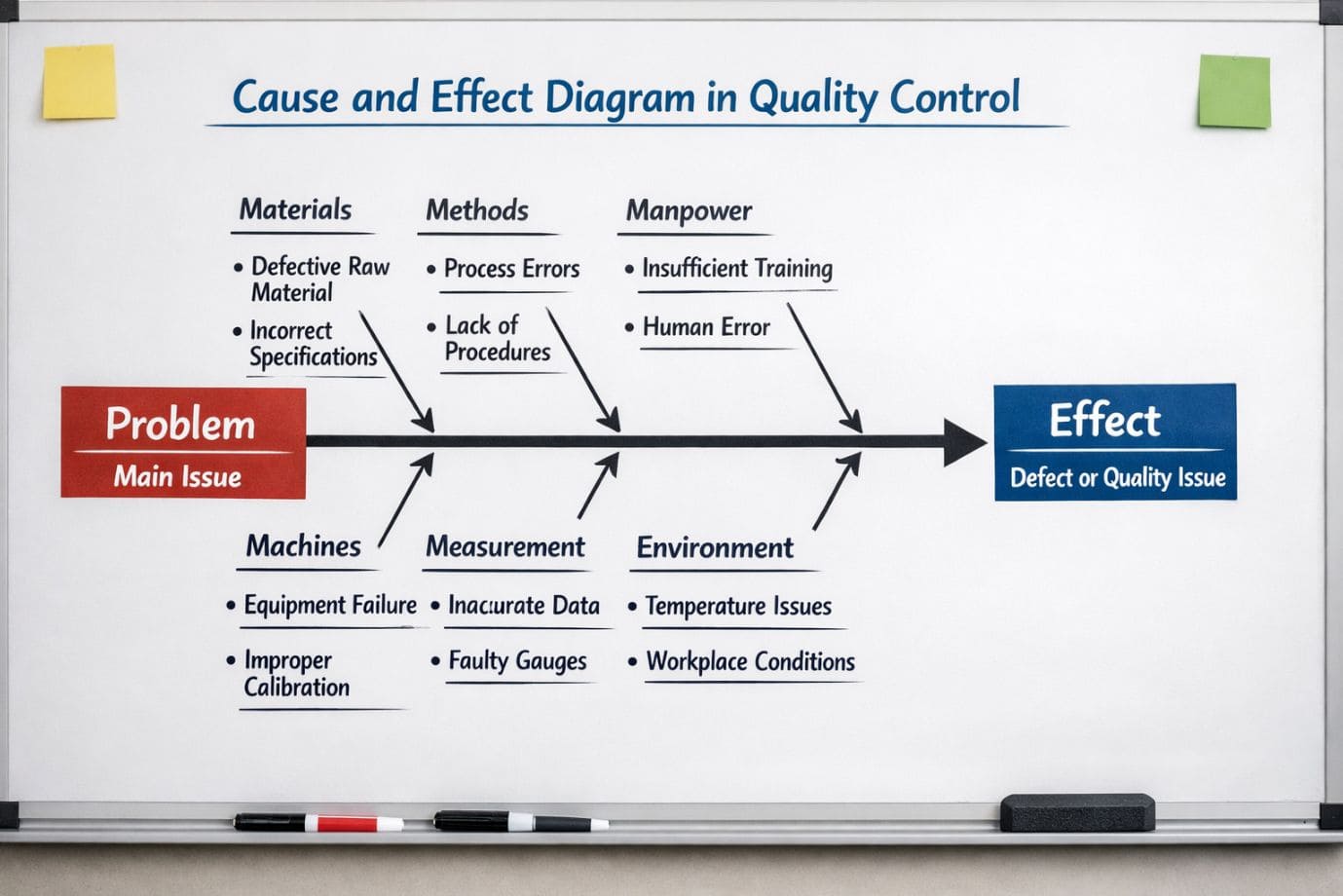
  • Structure of the Fishbone Diagram: The diagram is structured like a fish skeleton, where the “head” represents the problem statement and the “bones” represent major cause categories. This visual format makes it easier to organize ideas logically and identify relationships between different contributing factors, reinforcing effective 7 QC
  • Common Cause Categories: In manufacturing, the basic seven tools of quality commonly use six standard categories: Man, Machine, Method, Material, Measurement, and Environment. These categories ensure a comprehensive analysis of people, equipment, processes, inputs, controls, and workplace conditions.
  • Example- High Rejection Rate Analysis: When analyzing a high rejection rate, a fishbone diagram for quality control helps teams examine operator skills, machine condition, process methods, material quality, measurement accuracy, and environmental factors.
  • Key Benefits: The cause and effect diagram encourages team brainstorming, supports visual problem-solving, and prevents symptom-based fixes by driving long-term quality improvement.

⮞ Histogram in Quality Control

A histogram is a fundamental analytical tool within the 7 QC tools that helps organizations understand process behavior through data visualization.

  • Definition and Purpose: A histogram is a graphical representation that displays the frequency distribution of continuous data. In quality control, it is used to show how often specific measurement values occur within a defined range. The primary purpose of a histogram is to help teams understand the spread, central tendency, and variation present in a process.
  • Histogram vs Bar Chart: Although histograms and bar charts may look similar, they serve different purposes. A bar chart compares discrete categories, while a histogram represents continuous data grouped into intervals. This distinction is critical in the basic seven tools of quality, as histograms focus on process variation rather than simple category comparison.
  • Understanding Process Variation: Histograms clearly illustrate whether a process is centered, skewed, or widely spread. Within 7 QC practices, this visualization helps teams detect abnormal variation and potential process instability.
  • Manufacturing Example and Benefits: For example, a histogram showing the distribution of component dimensions reveals whether measurements fall within tolerance limits. As part of the 7 QC tools, histograms identify process spread, detect unusual variation, and support effective process capability analysis.

⮞ Control Chart in Quality Control

The control chart is one of the most critical analytical tools within the 7 QC tools, designed to monitor process stability over time. As part of the seven QC tools, it plays a central role in ensuring that manufacturing processes remain consistent and predictable. Among the 7 tools of quality, the control chart is essential for maintaining control and preventing defects before they reach the customer.

  • Process Control and Stability: Process control refers to the ability of a process to operate within a stable range without unexpected variation. In control chart in quality control, data points are plotted over time to identify whether a process is stable or influenced by special causes. This helps organizations maintain consistent output and reliable performance.
  • Control Limits vs Specification Limits: A key concept in control charts is the difference between control limits and specification limits. Control limits reflect the natural variation of a process, while specification limits define customer or design requirements. Understanding this distinction is fundamental within the basic seven tools of quality, as a process can be in control but still fail to meet specifications.
  • Types of Control Charts: There are several types of control charts used in manufacturing, including charts for variables and attributes. Each type is selected based on data characteristics and measurement methods, supporting effective 7 QC
  • Manufacturing Example and Benefits: For example, monitoring machine output consistency using a control chart allows early detection of process drift. As part of the 7 QC tools, control charts reduce defects before they occur and are a cornerstone of statistical process control (SPC).

⮞ Scatter Diagram in Quality Control

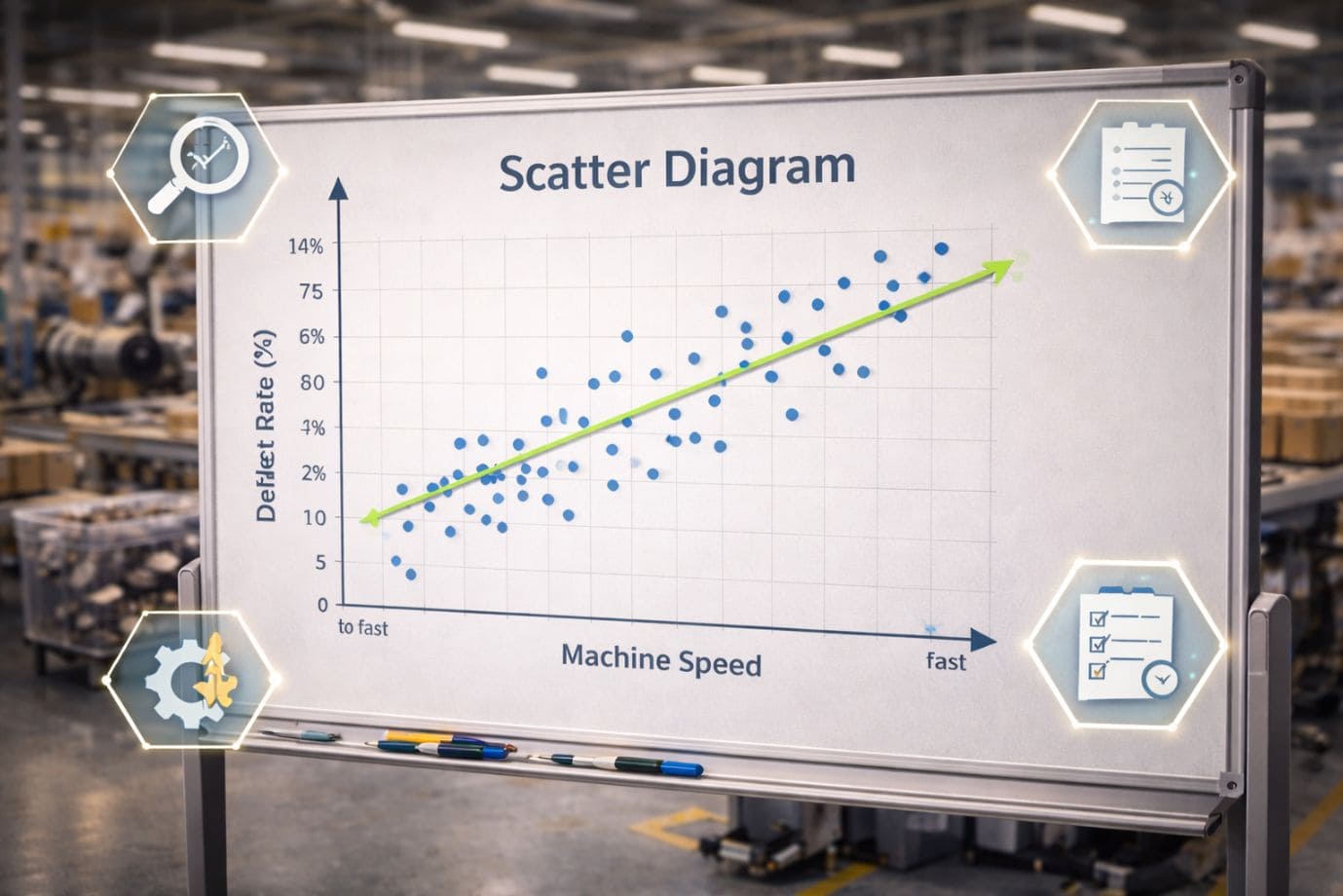
The scatter diagram in quality control is a simple yet powerful analysis tool used to examine the relationship between two variables. As part of the seven QC tools, it helps manufacturing teams understand whether changes in one factor influence another. Among the 7 tools of quality, scatter diagrams are especially useful for validating assumptions with real data rather than intuition.
Scatter Diagram in Quality Control

  • Identifying Relationships Between Variables: The primary purpose of a scatter diagram is to identify correlations between variables. In scatter diagram in quality control, data points are plotted on a graph to determine whether a relationship exists. The pattern of points may show a positive correlation, negative correlation, or no correlation, each providing valuable insight into process behavior.
  • Understanding Correlation Types: A positive correlation indicates that as one variable increases, the other also increases. A negative correlation shows that one variable decreases as the other increases. No correlation suggests that the variables are unrelated. Understanding these patterns strengthens effective 7 QC
  • Manufacturing Example and Benefits: For example, plotting temperature against defect rate can reveal whether higher temperatures lead to increased defects. As part of the basic seven tools of quality, scatter diagrams support data-driven decisions, help validate assumptions, and guide process optimization initiatives by focusing improvement efforts on truly influential variables.

⮞ Flow Chart for Quality Control

A flow chart is a visual representation of a process that shows the sequence of steps, decisions, and interactions involved in completing a task. Within the 7 QC tools, the flow chart plays a critical role in helping organizations clearly understand how a process actually operates. As part of the seven QC tools, it is widely used to document, analyze, and improve workflows across manufacturing and service environments.

  • Process Visualization and Clarity: The primary purpose of a flow chart is process visualization. A flowchart for quality control transforms complex processes into simple, easy-to-follow diagrams. This visual clarity allows teams to identify unnecessary steps, delays, and deviations from standard procedures. Among the 7 tools of quality, flow charts are especially effective in revealing gaps that are often overlooked in written instructions.
  • Manufacturing Example: In manufacturing, a flow chart can map the end-to-end production or inspection process—from raw material receipt to final quality checks. By visualizing each step, teams can clearly see handoffs, inspection points, and decision paths, strengthening effective 7 QC
  • Key Benefits: Flow charts help identify bottlenecks that slow down operations and increase costs. As part of the basic seven tools of quality, they improve overall process understanding and support standardization. Additionally, flow charts are valuable training tools, enabling consistent execution and sustained quality improvement across the organization.

Also Read: Quality Assurance

How to Implement the 7 QC Tools Effectively

Implementing the 7 QC tools effectively requires a disciplined and systematic approach rather than ad-hoc problem solving. The 7 tools of quality control are most powerful when they are integrated into daily operations, supported by leadership, and applied using accurate data. When used correctly, QC tools help organizations achieve sustainable improvements instead of temporary fixes.
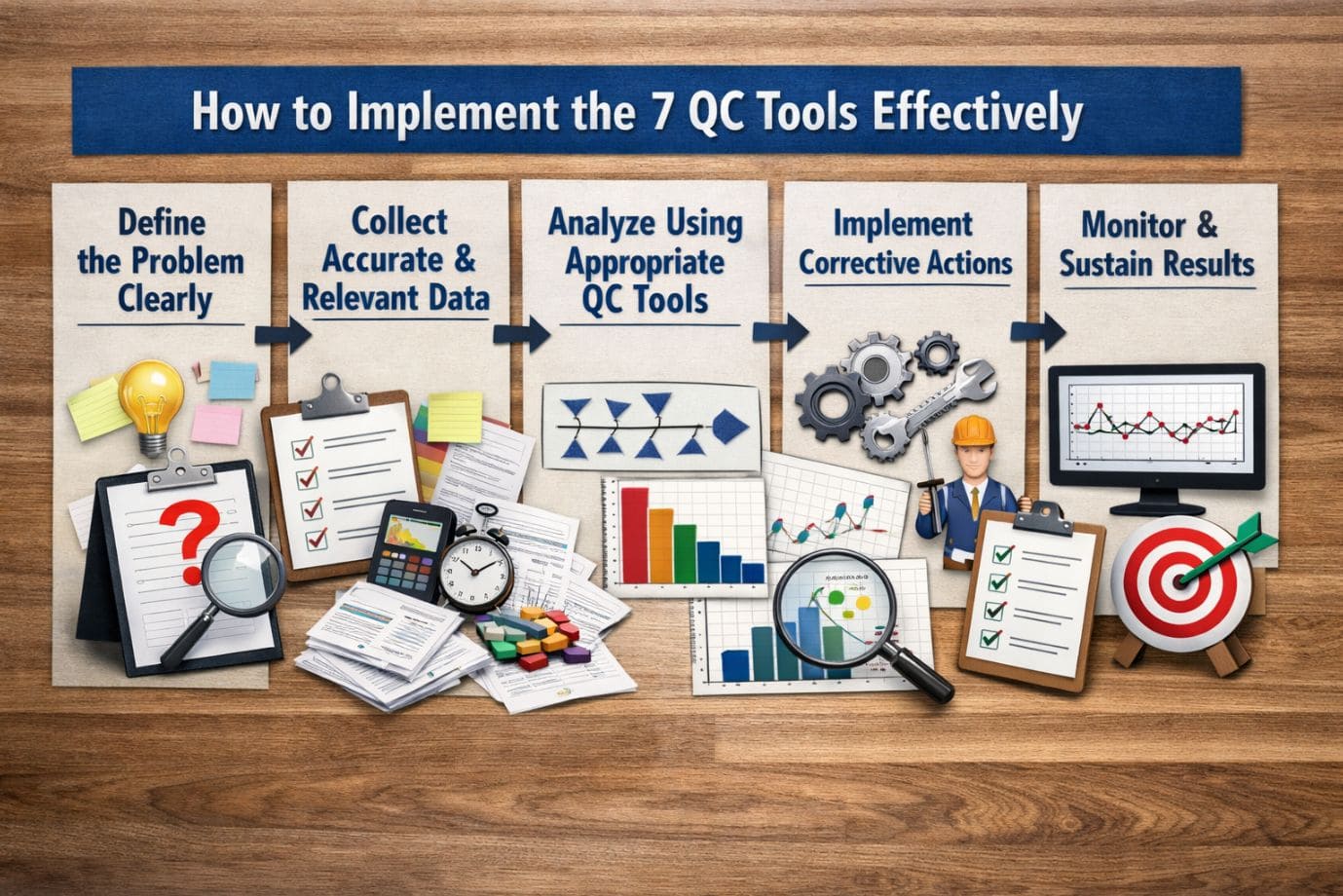
How to Implement the 7 QC Tools Effectively

⮞ Define the Problem Clearly

The first step in applying 7 QC methods is to clearly define the problem. Teams should focus on specific, measurable quality issues such as high rejection rates, delays, or process variation. A well-defined problem sets the direction for effective analysis and prevents wasted effort.

⮞ Collect Accurate and Relevant Data

Once the problem is defined, data must be collected directly from the process. Accurate data is essential for the successful use of QC tools, as unreliable information can lead to incorrect conclusions. Standardized data collection ensures consistency and credibility in analysis.

⮞ Analyze Using Appropriate QC Tools

After collecting data, teams should select the most suitable 7 QC tools based on the nature of the problem. Tools such as Pareto charts, cause-and-effect diagrams, or histograms help identify root causes and process patterns systematically.

⮞ Implement Corrective Actions

Based on analysis, corrective actions should be developed to address root causes rather than symptoms. Effective implementation of 7 tools of quality control requires clear ownership, timelines, and defined performance targets.

⮞ Monitor and Sustain Results

Monitoring results is critical to ensure that improvements are sustained. Control charts and tracking metrics help verify whether corrective actions are delivering long-term benefits through 7 QC practices.

⮞ Key Success Factors and Common Mistakes

Strong management involvement ensures resources and accountability, while employee training builds confidence in using QC tools. Common mistakes include poor data quality, lack of follow-up, and improper tool selection. Engaging expert consultants can accelerate implementation and maximize the impact of 7 QC initiatives.

7 QC Tools and Operational Excellence

Operational excellence is not achieved through isolated quality efforts—it requires a systematic approach that connects process improvement with business goals. The 7 QC tools provide a practical framework to achieve this connection by enabling data-driven analysis, consistent execution, and continuous improvement. When used effectively, the 7 tools of quality control become essential enablers of long-term operational excellence rather than standalone quality techniques.

⮞ Supporting Lean Manufacturing

In Lean manufacturing environments, QC tools help identify waste, process variation, and inefficiencies that disrupt flow. Tools such as flow charts and Pareto charts enable teams to visualize processes, locate bottlenecks, and prioritize improvement actions. These applications strengthen Lean initiatives by ensuring improvements are based on facts rather than assumptions through 7 QC practices.

⮞ Enabling Continuous Improvement (Kaizen)

Continuous improvement, or Kaizen, relies on small, incremental changes driven by employee involvement. The 7 QC tools support Kaizen by providing simple methods to analyze problems, test improvements, and measure results. This structured approach helps teams sustain improvement efforts over time. For more information, you can read our dedicated blog on Kaizen.

⮞ Driving Cost Reduction Initiatives

Cost reduction is a natural outcome of effective quality management. By using QC tools to reduce defects, rework, and scrap, organizations can significantly lower operational costs. Improved process stability also leads to better resource utilization and reduced downtime.

⮞ Linking Quality to Business Performance and Customer Satisfaction

Effective use of the 7 tools of quality control improves business performance by enhancing productivity, consistency, and delivery reliability. At the same time, stable processes and reduced defects improve customer satisfaction and build long-term trust.

⮞ QC Tools as a Strategic Advantage

When integrated into business strategy, 7 QC methods go beyond quality control. They become a strategic advantage that supports sustainable growth, competitive positioning, and operational excellence.

FAQs

A. The seven QC tools support continuous improvement by providing simple and structured methods to collect data, analyze issues, and monitor results. They enable teams to move from reactive problem-solving to proactive and preventive quality management.

A. A cause and effect diagram helps teams identify all possible reasons behind a specific problem by organizing causes into structured categories. It ensures that corrective actions address root causes instead of symptoms.

A. A Pareto chart in quality control helps prioritize improvement actions by identifying the few causes responsible for most defects. This enables efficient use of resources and faster quality improvement results.

A. A check sheet for quality control is used to collect data in a structured and consistent manner directly from the process. It provides reliable input for further analysis using other quality tools.

A. The Ishikawa diagram is used to systematically analyze quality problems by examining factors related to manpower, machines, methods, materials, measurement, and environment. It supports team-based root cause analysis and long-term quality improvement.

Conclusion

In an increasingly competitive manufacturing environment, quality can no longer be treated as a corrective activity—it must be embedded into the organization’s culture. The 7 QC tools provide a strong foundation for achieving this by enabling structured analysis, consistent problem-solving, and data-driven decision making. As the seven QC tools are simple yet powerful, they can be effectively applied across all levels of an organization, from the shop floor to senior management.

The true value of the 7 tools of quality lies in their long-term impact. When used consistently, these tools help organizations reduce defects, stabilize processes, improve productivity, and enhance customer satisfaction. Tools such as the cause and effect diagram, also known as the Ishikawa diagram, ensure that problems are addressed at their root rather than being temporarily corrected. This shift from reactive fixes to preventive quality management is essential for sustainable operational excellence.

Adopting the 7 QC tools is not just about improving individual processes—it is about building a mindset of continuous improvement. Structured quality practices empower employees to identify issues early, collaborate on solutions, and take ownership of process performance. Over time, this creates a strong quality culture where improvement becomes a daily habit rather than a special initiative.

For manufacturers aiming to remain competitive, resilient, and customer-focused, embracing the seven QC tools is a strategic step toward long-term success and consistent quality excellence.

For more information regarding other services, explore our Homepage.

Leave a Comment

Your email address will not be published. Required fields are marked *

Call Now Button
× Book free consultation