

High Performance Teams
In today’s hyper-competitive business landscape, organizations are under immense pressure to move faster, operate smarter, and deliver flawless execution.
Markets shift rapidly, customer expectations evolve continuously, and operational complexity is higher than ever before. To thrive in this environment, companies must build agility, speed, and resilience into their core operations. This requires more than traditional structures—it requires high performing teams capable of consistently delivering excellence.
Conventional hierarchical and function-based models often fall short because they create silos, slow down decision-making, and restrict collaboration. Such outdated systems make organizations reactive rather than proactive. This is why many companies today struggle to achieve the agility required to become truly high performing organizations. To remain competitive, businesses need teams that can adapt quickly, solve problems effectively, and take ownership of results.
This is where high performance teams become the foundation of sustainable Operational Excellence. These teams demonstrate the attributes of high performing teams, such as accountability, trust, and cross-functional alignment. They reflect their characteristics by integrating disciplined execution with continuous improvement. Organizations that invest in creating high performance teams and adopt a strong team model gain the ability to innovate faster, reduce inefficiencies, and consistently deliver superior outcomes.
Whether your goal is to build high performance teams, enhance high performing leaders, or strengthen organizational capability, understanding high performance teamwork is essential. Leading high performance teams is not just a management practice—it is a strategic advantage. As more companies embrace the high performing team qualities required for modern execution, the ability to apply a proven model becomes a decisive factor in long-term success.
What Are High Performance Teams?
These are cross-functional, value-stream–aligned groups that work collaboratively to deliver superior business outcomes. Unlike traditional teams structured around departments, high functioning teams are designed around the entire flow of value—ensuring every member contributes directly to customer-focused execution. This alignment is one of the key attributes of high performing teams, enabling them to act with agility, speed, and precision.
How High Performance Teams Differ From Traditional Teams
Shared Outcomes vs. Individual Tasks: Traditional teams often prioritize personal KPIs, leading to siloed efforts. In contrast,
- High performance teamwork revolves around collective goals.
- Team members take ownership of results together.
- This fosters stronger accountability and collaboration.
Empowerment vs. Command-and-Control: Legacy organizational structures rely heavily on top-down leadership.
However, high performing leaders:
- Provide autonomy and decision-making authority,
- Encourage innovation,
- Build trust—an essential high performing team trait.
Daily Problem-Solving vs. Firefighting: Conventional teams react to problems after they escalate.
Meanwhile, high performing teams practice:
- Daily reviews,
- Rapid issue resolution,
- Continuous improvement cycles—core characteristics of high functioning teams.
A Model Built for End-to-End Accountability
A strong high performance team model ensures that teams:
- Own the full value stream from start to finish,
- Maintain transparency and alignment,
- Stay focused on customer value.
Organizations aiming to scale effectively must invest in creating high performance teams. By adopting a proven model, leaders can consistently build teams that elevate execution and drive long-term success for truly high performing organizations.
Why High Performance Teams Matter Today
In today’s rapidly evolving business landscape, organizations face unprecedented pressure to deliver value faster, better, and more efficiently. Customers expect immediate responses, flawless quality, and competitive pricing—all at once. To meet these demands, companies increasingly rely on high performance teams that can operate with agility, precision, and unity. These teams embody the attributes that make them indispensable in modern operations.

Rising Customer Expectations: Faster, Better, Cheaper
Customers today expect:
- Shorter delivery cycles
- Higher-quality products
- Lower costs
Traditional structures cannot keep pace, but high functioning teams excel because they: - Solve problems quickly
- Collaborate effectively
- Maintain high standards consistently
Increasing Operational Complexity Across Sectors
Globalization, digital transformation, and supply chain disruptions add layers of complexity.
High performing teams address this by:
- Making faster decisions
- Adapting to change with minimal friction
- Leveraging shared expertise across functions
These are core high performing team traits that help organizations stay stable in dynamic environments.
Need for Seamless Collaboration Instead of Silos
Siloed departments slow down execution and create inefficiencies. A strong high performance team model:
- Breaks silos
- Enhances transparency
- Enables cross-functional alignment
Such qualities fuel more effective teamwork.
Survival, Scalability, and Innovation
In competitive markets, high performing organizations depend on leaders committed to build and lead them. These efforts support:
- Faster innovation
- Stronger resilience
- Consistent Operational Excellence (OPEX)
Ultimately, creating high performance teams is a strategic necessity for long-term success.
Core Attributes of High Performance TeamsCore Attributes of High Performance Teams
High performance teams excel because they operate with structural clarity, behavioural discipline, and a shared commitment to value creation. Their distinctiveness lies in their attributes, which combine collaboration, accountability, and continuous improvement. Below are the core characteristics that differentiate high functioning teams from traditional workgroups.
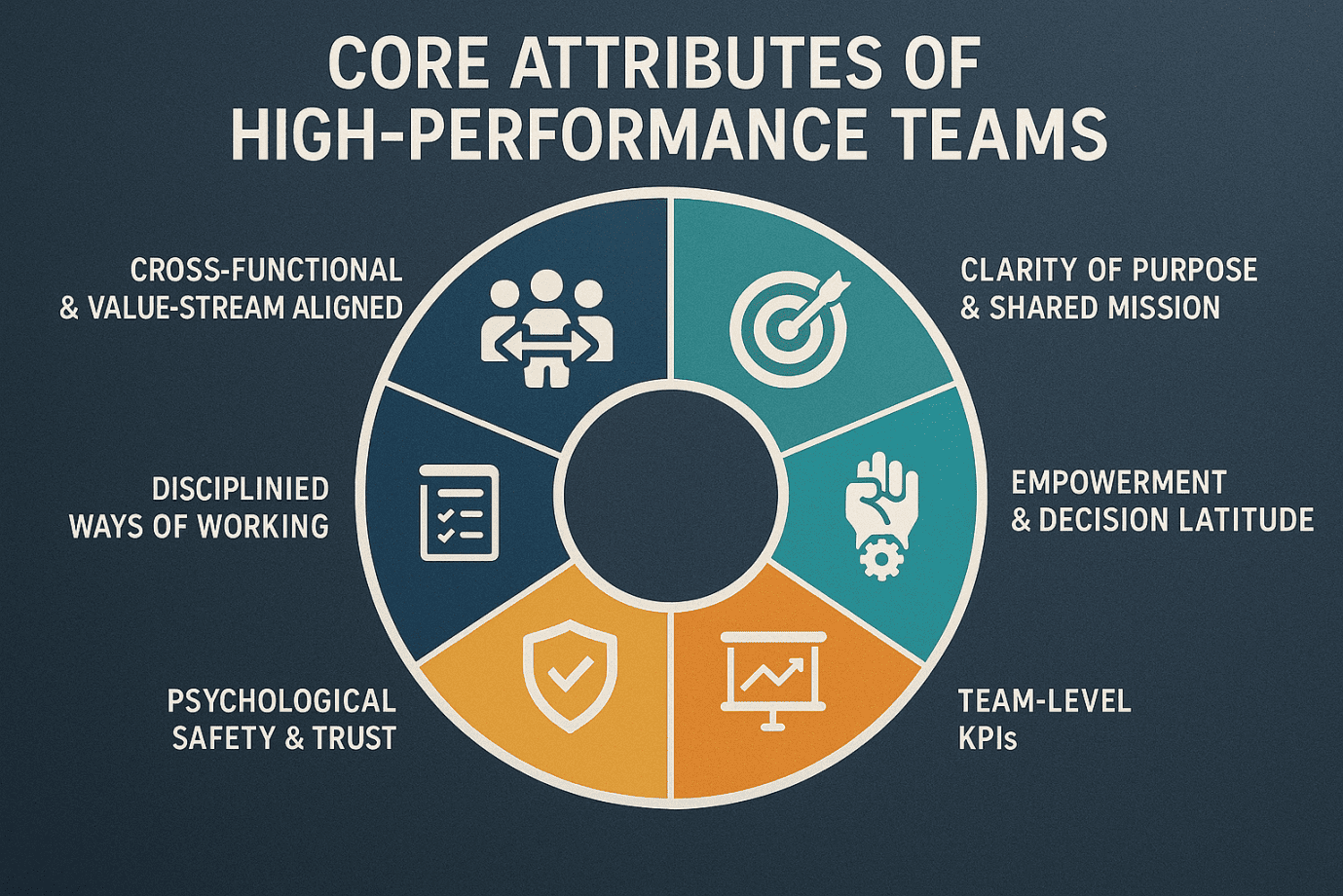
Cross-Functional & Value-Stream Aligned
One of the strongest attributes of high performing teams is their alignment around the entire value stream rather than isolated functions.
This matters because:
- It eliminates handoff delays
- Enhances problem-solving
- Ensures end-to-end ownership
This is why organizations striving to build high performance teams prioritize cross-functional design—it accelerates flow and improves customer outcomes.
Clarity of Purpose & Shared Mission
High performing teams have absolute clarity on the “why.”
A shared mission:
- Strengthens alignment
- Reduces conflicts
- Enhances intrinsic motivation
This clarity is a defining trait that enables consistent execution.
Empowerment & Decision Latitude
A hallmark of the high performance team model is empowering team members to make decisions close to the point of action.
This results in:
- Faster resolutions
- Increased accountability
- Higher confidence among team members
Such empowerment is essential for leading high performance teams effectively.
Disciplined Ways of Working (DWM)
A hallmark of the high performance team model is empowering team members to make decisions close to the point of action.
This results in:
- Faster resolutions
- Increased accountability
- Higher confidence among team members
Such empowerment is essential for leading high performance teams effectively.
Team-Level KPIs
Unlike traditional teams, high performing organizations track KPIs at the team level. These include:
- Lead time
- Quality metrics
- Cross-functional issue closure
- SLA adherence
These metrics embody the attributes of high performance teams by reinforcing shared accountability.
Psychological Safety & Trust
Trust forms the foundation of creating high performance teams. When psychological safety exists, team members:
- Share ideas freely
- Take initiative
- Innovate without fear of failure
This enables high performing leaders to cultivate teams that grow stronger over time.
Together, these characteristics create the structural and cultural backbone of the most effective high performance teams, enabling them to deliver excellence repeatedly.
The 7 Parameters of Team Effectiveness
For organizations striving to build high performance teams, seven core parameters consistently determine how well a team collaborates, executes, and grows. These elements form the backbone of the high performance team model and shape the everyday behaviours seen in these teams.
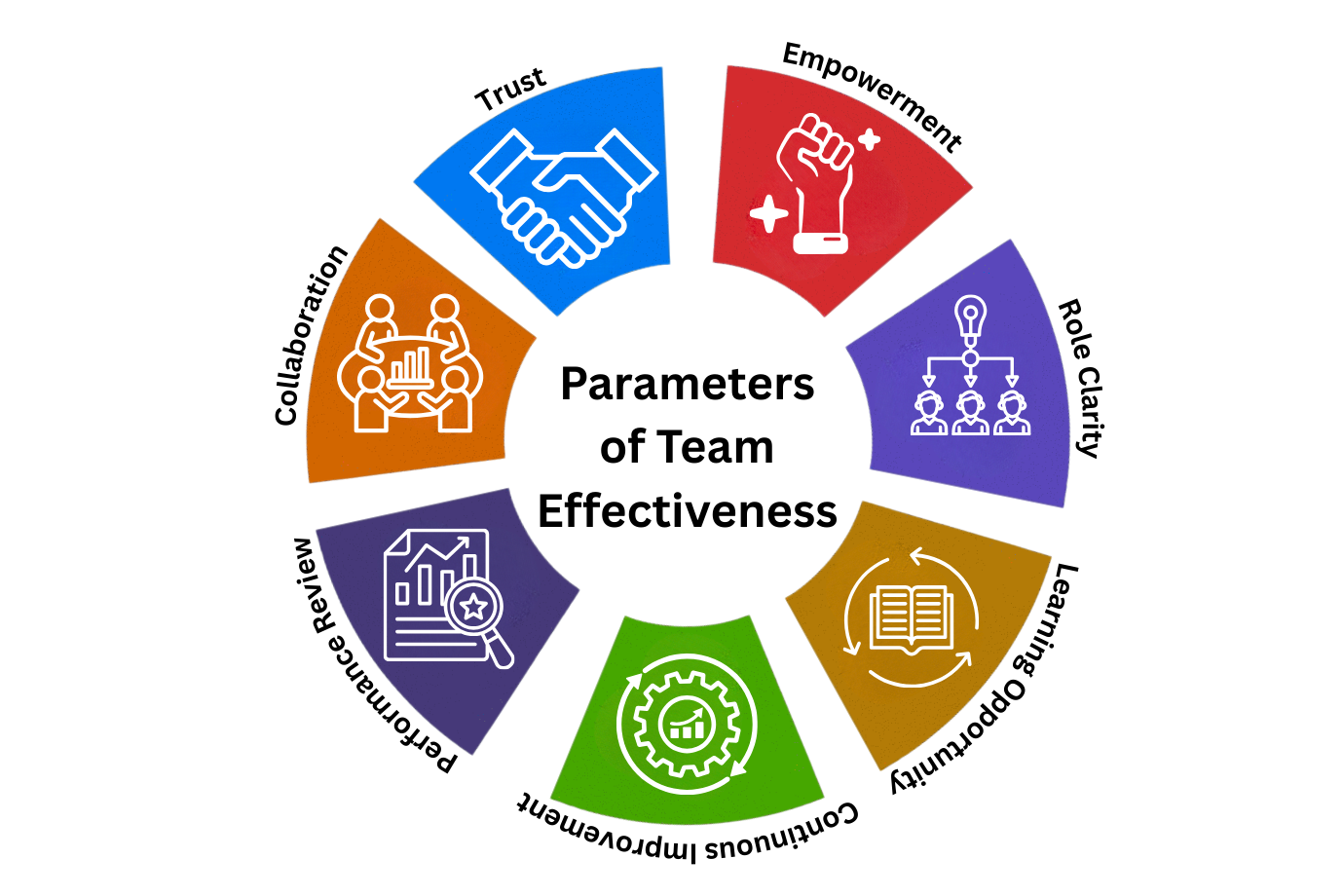
Trust:
It is the foundation of all high performance teams. When team members feel safe sharing concerns or proposing ideas, they collaborate more openly. For example, in manufacturing environments, teams with strong trust report issues faster—preventing defects and improving quality.
Collaboration:
A hallmark of high performing teams is seamless collaboration. Teams share information proactively, support each other’s work, and operate with a unified mission. In real-world settings, this boosts cycle-time efficiency and reduces cross-functional delays.
Empowerment:
It enables decisions at the frontline. High performing leaders give autonomy while maintaining alignment. Empowered teams respond faster to customer needs, demonstrating key qualities like accountability and initiative.
Role Clarity:
Clear roles reduce confusion and ensure smooth execution. In high performing organizations, every member knows their responsibilities and boundaries, enabling efficient task handovers and minimizing rework.
Learning Opportunity:
Creating high performance teams requires continuous skill development. Teams that learn together adapt better to new systems and technologies. This aligns with the characteristics of high performance work system practices.
Continuous Improvement:
A defining high performing team trait is a commitment to ongoing improvement. Through daily problem-solving, root-cause analysis, and kaizen practices, teams elevate performance over time.
Performance Review:
Regular reviews help assess progress, realign goals, and reinforce shared accountability. Effective reviews support leading teams for high performance by making success measurable and transparent.
Together, these seven parameters strengthen the attributes of high performance teams, enabling organizations to build these teams that execute with consistency, confidence, and excellence.
Common Barriers That Stop Teams from Becoming High Performance Teams
Despite the growing need for high performance teams, many organizations—especially in Indian and Asian industrial environments—struggle to reach this level of maturity. Several cultural, structural, and behavioural barriers prevent companies from adopting the attributes of high performing teams.
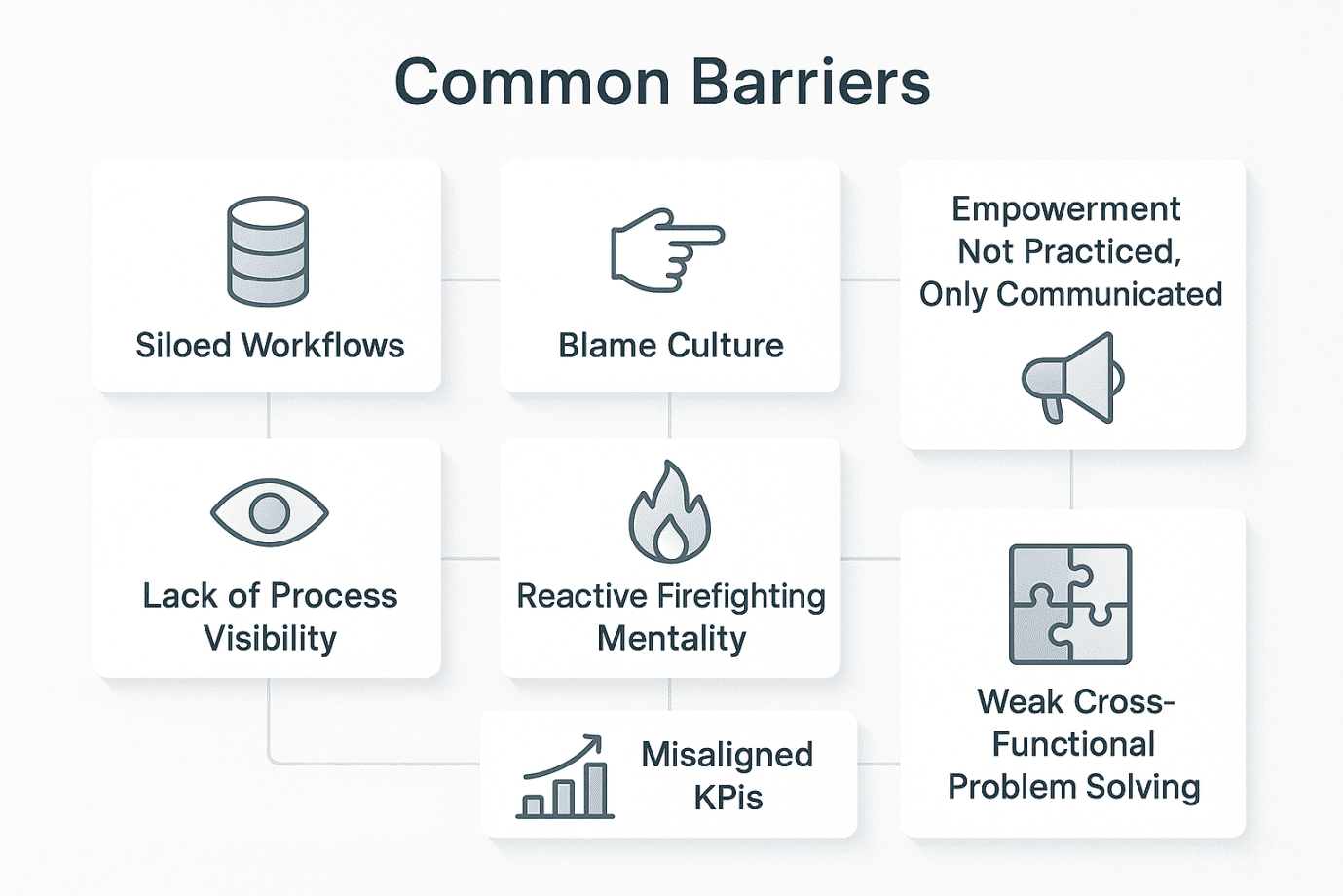
Siloed Workflows:
Traditional manufacturing setups often operate in isolated departments. This makes collaboration difficult and slows decision making. Such fragmentation contradicts the high performance team model, which thrives on cross-functional synergy.
Blame Culture:
Instead of focusing on solutions, teams often look for someone to blame. This suppresses openness, hinders learning, and weakens the high performing team qualities needed for trust and collective accountability.
Empowerment Not Practiced, Only Communicated:
Many leaders speak about empowerment but still follow command-and-control behaviors. Without real authority, teams cannot demonstrate high performing team traits such as initiative, ownership, and confidence.
Lack of Process Visibility:
Poor data availability and limited transparency disrupt decision-making. High performance teamwork requires real-time visibility into issues, performance, and progress.
Reactive Firefighting Mentality:
Poor data availability and limited transparency disrupt decision-making. High performance teamwork requires real-time visibility into issues, performance, and progress.
Misaligned KPIs (Individual > Team):
KPIs often reward individual output instead of collective performance. This is the opposite of what high performance teams need, where shared goals drive results.
Weak Cross-Functional Problem Solving:
Limited collaboration across departments means issues escalate unnecessarily. Mature high performing organizations prioritize structured, team-based problem-solving.
Overcoming these barriers is essential to build high performance teams, strengthen capability, and enable leaders committed to leading teams for high performance.
How High Performance Teams Drive Operational Excellence
High performance teams are the driving force behind sustainable Operational Excellence (OPEX). Their structure, behaviours, and discipline enable organizations to operate with precision, speed, and consistency. By embodying their attributes, they create a system where efficiency and quality become built-in outcomes rather than one-time achievements.
Faster Decision-Making:
Because high functioning teams work close to the point of action, they make faster and more accurate decisions. This eliminates bottlenecks and reflects the team model, where empowered teams respond swiftly to operational challenges.
Higher Operational Stability:
Through standardized routines and cross-functional coordination, these teams reduce variability in daily operations. This aligns with the characteristics of high performance work system practices, ensuring predictable and stable outcomes.
Reduced Escalations:
With stronger ownership and collaborative problem-solving, high performing teams resolve most issues at the team level. This minimizes the load on leadership and supports smoother workflows.
Improved Cycle Times & Quality:
By continuously refining processes, high performance teamwork helps reduce lead times, eliminate waste, and enhance quality. These improvements demonstrate essential traits such as discipline and accountability.
Stronger Ownership:
Members of high performing organizations take end-to-end responsibility for outcomes. This ownership strengthens alignment with customer needs and business goals.
Continuous Improvement Routines:
Daily huddles, visual management, and structured problem-solving form the backbone of creating high performance teams. These routines foster a culture of ongoing learning and optimization.
KPIs Linked Directly to Business Priorities:
The most impactful high performing leaders ensure that team-level metrics—such as cycle time, quality, and on-time delivery—are aligned with strategic objectives.
Together, these mechanisms enable organizations to build high performance teams that deliver consistent excellence, scale efficiently, and maintain competitive advantage.
The HPT–OPEX Framework: 3 Pillars
Operational Excellence (OPEX) is not achieved through isolated initiatives—it is sustained through a robust framework that integrates people, processes, and performance. High performance teams are central to this transformation, and their effectiveness can be understood through a three-pillar model known as the HPT–OPEX Framework. This framework reflects the core attributes of high performing teams across industries.
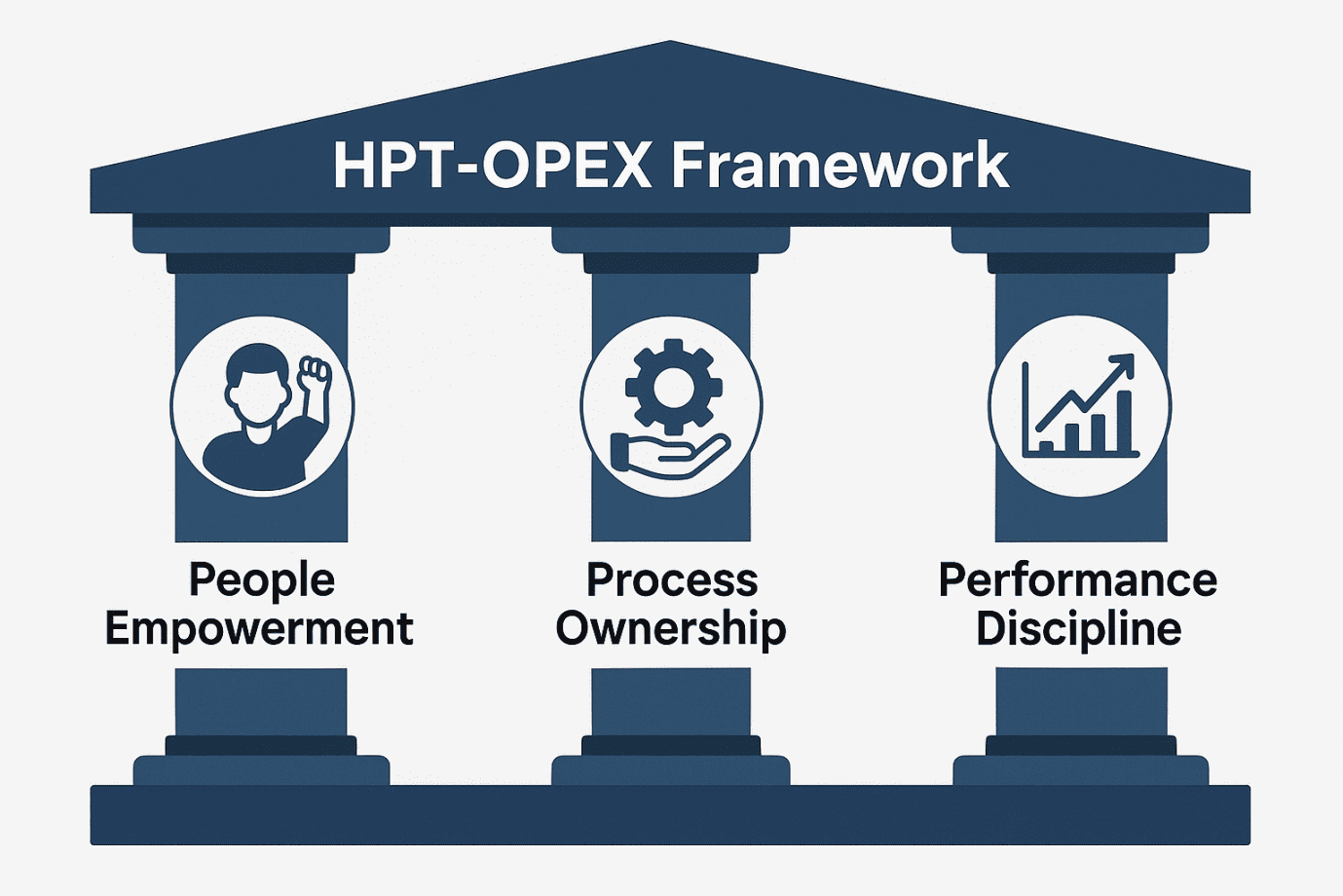
Pillar 1: People Empowerment
At the heart of high performing organizations is empowered talent.
This pillar focuses on:
- Leadership across all levels
- Autonomy in daily operations
- Ownership of outcomes
- Confidence to make decisions at the frontline
Empowerment strengthens high performing team qualities by fostering accountability, initiative, and engagement. When teams feel trusted, they exhibit stronger performing traits, enabling them to solve problems faster and contribute more meaningfully. This is why high performing leaders play a crucial role in leading teams.
Pillar 2: Process Ownership
Process Ownership brings structure and clarity—key requirements of any high performance team model.
This includes:
- SOPs for consistent execution
- Team charters for defining roles, boundaries, and goals
- Clear escalation matrices
- Standardized workflows that reduce ambiguity
Such practices reflect the characteristics of high performance work system design. When teams own their processes, they naturally evolve into high functioning teams that operate with precision and reliability.
Pillar 3: Performance Discipline
Discipline ensures that improvements are sustained rather than temporary.
This pillar includes:
- Daily reviews and stand-ups
- Scorecards tied to business goals
- Visual dashboards for transparency
- PDCA (Plan–Do–Check–Act) loops for continual enhancement
These elements reinforce the attributes of high performance teams and make it repeatable, measurable, and scalable.
Together, these three pillars create a cohesive system that enables organizations to build high performance teams, strengthen capability, and embed Operational Excellence into their DNA. This is not a one-time project—it is a continuous journey of creating high performance teams that lead the organization toward long-term success.
What Success Looks Like: KPIs for High-Performance Teams
Measuring success is essential for organizations aiming to build and sustain high performance teams. Clear, objective KPIs help leaders understand whether teams are exhibiting the attributes and advancing toward Operational Excellence. These metrics reflect the true behaviour of high functioning teams and align closely with the team model practiced in organizations.
Key KPI Categories for High-Performance Teams
Collaboration
- Cross-functional issues resolved at team level
- Reduction in handoff delays
These reflect critical qualities such as trust and teamwork.
Accountability
- Adherence to SOPs
- On-time completion of commitments
Quality
- Defect rate
- Rework percentage
These are core traits essential for consistency.
Responsiveness
- SLA adherence
- Average time to resolve issues
Cost Efficiency
- Cost per unit or transaction
- Waste reduction metrics
Engagement & Learning
- Multi-skilling index
- Participation in problem-solving
Measuring Impact in 3–6 Months
Organizations that build high performance teams can typically observe measurable improvements such as:
- 10–20% faster cycle times
- Significant reduction in defects
- Smoother workflows and fewer escalations
With disciplined leading teams, these KPIs validate progress and reinforce a culture aligned to their characteristics.
What Happens When Teams Are Not High Performing?
Organizations that lack high performance teams often face operational, financial, and cultural consequences that weaken long-term competitiveness. Without the attributes of high performing teams, work becomes fragmented, reactive, and inconsistent—dramatically reducing efficiency and effectiveness.
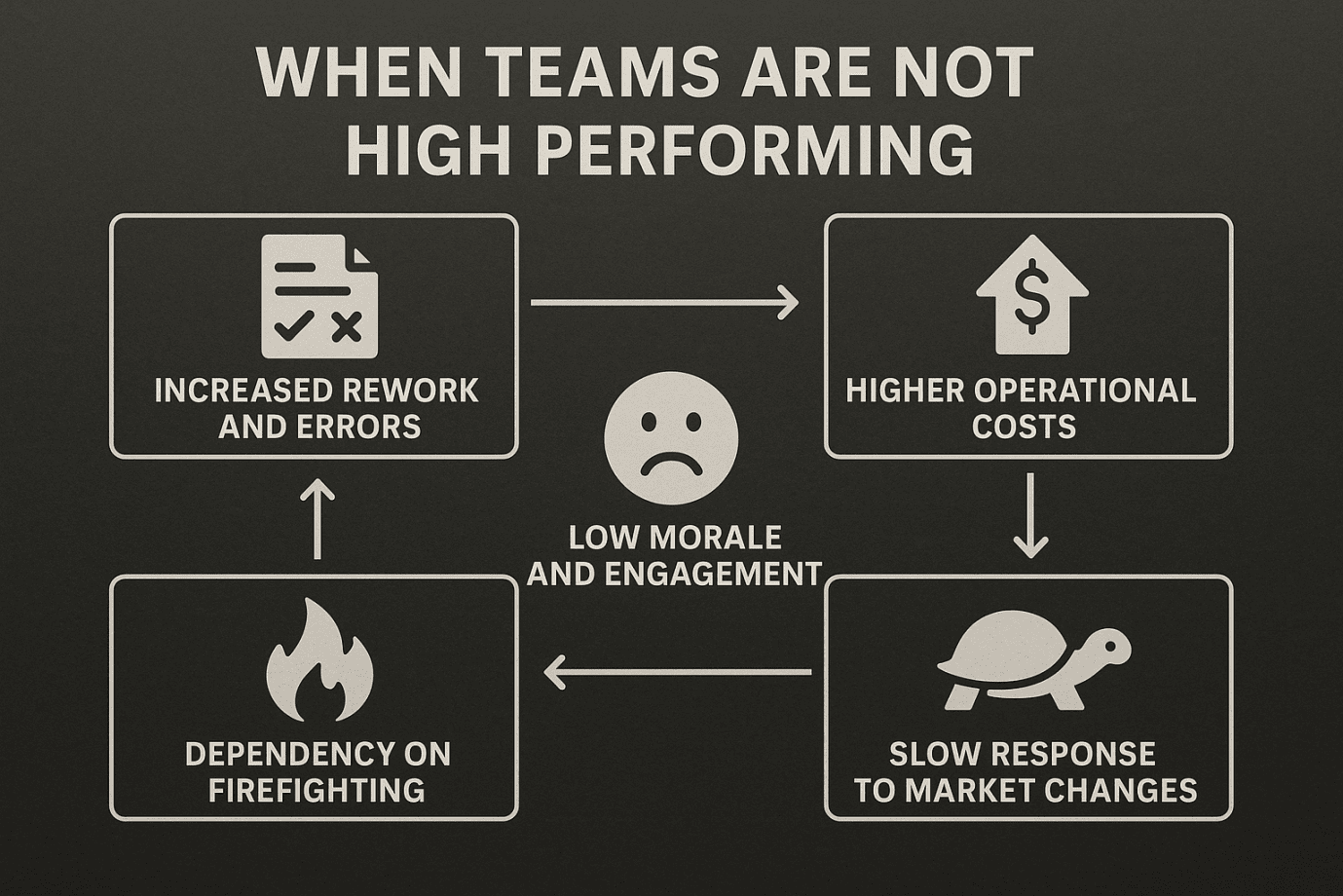
Increased Rework and Errors:
Teams that do not operate as high functioning teams struggle with coordination and clarity. Miscommunication leads to frequent rework, defects, and delays. This undermines the qualities required for quality and precision.
Higher Operational Costs:
Inefficient workflows, repeat work, and poor planning increase operating costs. Organizations that fail to build high performance teams often experience waste, overtime, and resource misalignment.
Low Morale and Engagement:
When teams lack empowerment, support, and direction, morale drops. Low engagement prevents employees from demonstrating traits such as ownership, initiative, and collaborative spirit.
Dependency on Firefighting:
Without the discipline of high performance teamwork, teams remain stuck in reactive mode. Leaders spend time solving avoidable problems rather than driving strategic improvements—opposite of what leading teams should achieve.
Slow Response to Market Changes:
Non-agile teams struggle to adapt to customer needs or competitive shifts. In contrast, high performing organizations leveraging a strong team model respond faster and more effectively.
These consequences prove that creating high performance teams is not optional—it is essential. The leaders who drive transformation understand that the characteristics of high performance work system must be embedded to ensure resilience, efficiency, and sustained success.
FAQs
A. A high performance team is a cross-functional, empowered group that delivers consistent, superior results through collaboration, accountability, and continuous improvement. These teams are vital for high performing organizations because they enhance agility, improve quality, and accelerate decision-making in competitive markets.
A. The effectiveness of high performance teams depends on several factors, including trust, collaboration, empowerment, and clear role definition. These are the core attributes of such teams that enable teams to operate with speed and precision.
A. High performing leaders empower teams, remove bottlenecks, encourage transparency, and promote problem-solving at the frontline. Effective managing requires coaching, data-driven decision-making and consistent reinforcement of shared goals.
A. High performing teams demonstrate strong communication, shared accountability, disciplined routines, and proactive issue resolution. These are the attributes of such teams that contribute to operational excellence across industries.
A. To build high performance teams, organizations must redesign workflows around value streams, establish team charters, train team members, and create psychological safety. This approach supports developing high performing teams that consistently deliver on business outcomes.
A. A high performance team model provides the structure for autonomy, performance tracking, and disciplined routines such as daily stand-ups and PDCA cycles. This model is essential for leading teams for high performance and sustaining long-term excellence.
A. Clear KPIs aligned with team goals help in motivating high performance teams by creating visibility, encouraging accountability, and rewarding progress. When KPIs include quality, responsiveness, collaboration, and cost metrics, they strengthen the attributes of high performance teams.
A. Common challenges include siloed workflows, blame culture, lack of real empowerment, and misaligned KPIs. Overcoming these barriers is crucial for creating high performance teams and adopting their characteristics.
A. Leaders can promote high performance teamwork by fostering cross-functional collaboration, establishing clear communication channels, and encouraging shared outcomes. This strengthens team alignment and supports high performing team activities that drive excellence.
A. Continuous improvement ensures that teams remain adaptable and process-driven. It empowers high performing teams to refine workflows, reduce waste, and enhance customer value—making it a critical element of high performing organizations striving for operational excellence.
Conclusion
In a world where speed, precision, and adaptability determine competitiveness, high performance teams have become indispensable. They are not merely an operational choice—they are a strategic advantage. Organizations that embrace the attributes of high performing teams unlock agility, collaboration, and innovation at every level. These capabilities separate struggling companies from truly high performing organizations that consistently deliver superior results.
Building high functioning teams is not a one-time project. It is a transformation journey that involves shifting mindsets, redesigning processes, and empowering people. The journey requires discipline, clarity, and commitment. When organizations build high performance teams, they embed the qualities that drive sustained excellence. Whether it’s reducing lead times, improving quality, or strengthening customer responsiveness, the impact is measurable and lasting.
Leaders play a crucial role in this evolution. High performing leaders must champion empowerment, transparency, and continuous improvement—core principles reflected in the high performance team model and their characteristics. By leading teams, they cultivate a culture where ownership thrives and execution becomes seamless.
The key is to start—not with massive restructuring, but with small, consistent steps. Begin with one pilot team, refine the practices, and then scale. The sooner organizations commit to creating high performance teams, the faster they unlock operational excellence, resilience, and long-term competitiveness.
The future belongs to those who choose to build high performance teams today.
For detailed information regarding our services for different sectors, you can explore our Homepage.

