

Standard Operating Procedures (SOPs)
SOPs are clearly defined, written instructions that describe how routine and critical tasks should be performed within an organization.
In simple terms, it act as a standardized roadmap that ensures every activity is executed in a consistent, efficient, and compliant manner—regardless of who performs it. For manufacturing units, factories, and complex business operations, standard operating procedures are not optional documents; they are a fundamental requirement for achieving operational excellence.
At their core, operating procedures define the best and safest way to complete a task. Whether it is machine operation, quality inspection, maintenance, or project management, a well-defined standard operating process eliminates ambiguity and reduces dependency on individual experience. When processes are not standardized, organizations often face inconsistent output, higher error rates, quality issues, safety risks, and delays—especially in multi-shift or high-volume environments.
The importance of SOPs lies in their ability to transform knowledge into a repeatable system. A structured format ensures clarity, accountability, and compliance, while a well-documented SOP supports training, audits, and continuous improvement initiatives. From creating to implementing it across departments, SOPs directly impact productivity, quality, safety, and scalability.
In today’s competitive landscape, organizations that prepare SOPs systematically experience measurable benefits—including reduced downtime, improved efficiency, faster onboarding, and sustainable growth. Simply put, SOPs are the backbone of disciplined, resilient, and future-ready operations.
Why Standard Operating Procedures Are Critical for Businesses Today
In today’s dynamic and competitive business environment, organizations must operate with speed, accuracy, and consistency. Relying on informal knowledge or individual experience is no longer sustainable. This is where SOPs become critical. The purpose is to define a clear, repeatable, and reliable way of performing tasks so that operations remain stable, efficient, and scalable.
Below are the key reasons why it is essential for modern businesses:
Ensuring Consistency and Repeatability
- Well-defined standard operating procedures ensure that tasks are performed uniformly across shifts, teams, and locations.
- Clearly documented procedures help maintain a consistent process, reducing variation in output and performance.
Reducing Errors, Rework, and Operational Risks
- Lack of standardization often leads to mistakes, rework, and avoidable delays.
- By creating it, organizations minimize dependency on individuals and reduce process-related risks.
- A structured SOP improves accuracy and accountability across operations.
Improving Quality and Compliance
- A comprehensive SOP document acts as a single source of truth for quality and compliance requirements.
- From safety protocols to administrative SOPs, it support audits and certifications such as ISO, ESG, and statutory standards.
- Implementing it ensures adherence to best practices and regulatory guidelines.
Supporting Faster Onboarding and Training
- When organizations prepare SOPs, training new employees becomes systematic and efficient.
- Creating it reduces learning curves and ensures that employees follow approved methods from day one.
Enabling Scalability and Business Growth
- SOPs provide a strong foundation for expansion, multi-location operations, and digital transformation.
- Whether it is for project management or shopfloor execution, standardized processes allow businesses to scale without losing control.
Delivering Measurable Business Value
- The long-term importance of SOPs lies in their measurable benefits, including higher productivity, improved quality, lower risks, and sustainable growth.
- Businesses that focus on disciplined implementation of it, gain a competitive advantage in efficiency and execution excellence.
By creating standard operating procedures and focusing on their effective implementation, organizations build resilient operations that are prepared for growth, compliance, and continuous improvement.
Types of Standard Operating Procedures
To achieve consistency, efficiency, and compliance across an organization, Standard Operating Procedures must be clearly categorized and structured. Different business functions require different types of operating procedures, each designed to support a specific process. Understanding the types help organizations design focused, effective, and scalable systems.
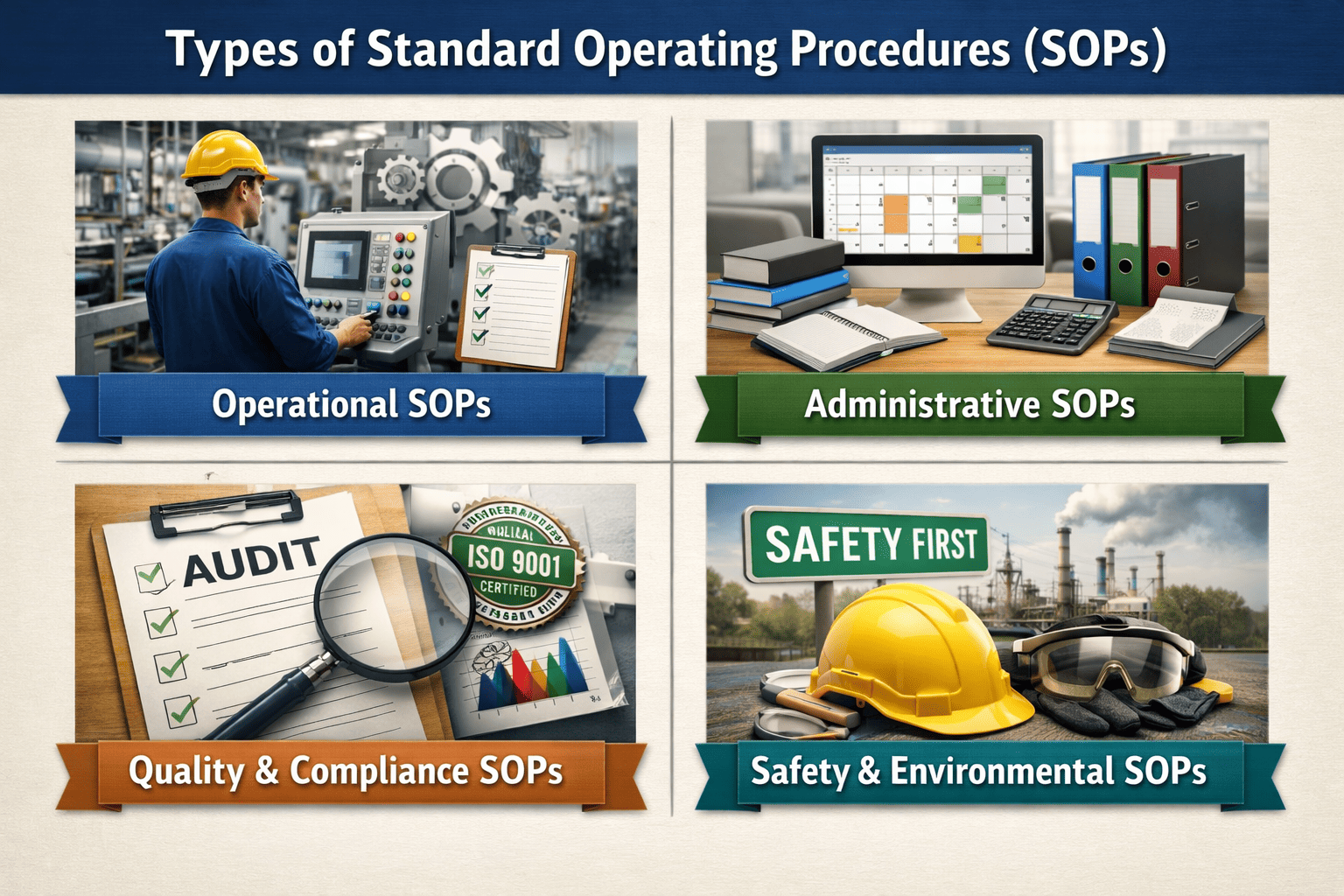
Operational SOPs
It defines how core business and shopfloor activities are executed on a daily basis. These are critical for ensuring smooth, repeatable operations.
- Production Processes: SOPs that outline step-by-step manufacturing activities to maintain productivity and consistency.
- Machine Operation: Detailed operating procedures covering machine setup, operation, changeovers, and shutdowns.
- Material Handling: SOPs for raw material movement, storage, and inventory control to avoid damage and delays.
Well-documented operational SOPs form the backbone of manufacturing excellence and deliver measurable benefits such as reduced downtime and improved efficiency.
Administrative SOPs
It governs support functions that enable smooth business operations.
- HR Processes: SOPs for recruitment, onboarding, performance management, and employee exits.
- Procurement: Procedures for vendor selection, purchasing, and approvals.
- Documentation and Approvals: Standardized SOP format for record-keeping, authorization, and reporting.
A clear SOP document in administrative areas reduces delays, ensures accountability, and supports effective implementation.
Quality & Compliance SOPs
Quality-focused standard operating procedures ensure products and processes meet defined standards.
- Quality Checks: QA and QC SOP for inspections, testing, and defect control.
- ISO Compliance: SOPs aligned with ISO requirements and regulatory frameworks.
- Audit Procedures: Documented processes for internal and external audits.
These SOPs reinforce the importance in quality assurance and compliance readiness.
Safety & Environmental SOPs
These protect people, assets, and the environment.
- Workplace Safety: SOPs for safe work practices and hazard control.
- Emergency Response: Procedures for fire, accidents, and crisis management.
- ESG & Sustainability: SOPs supporting environmental responsibility and governance goals.
Whether creating or implementing standard operating procedures across functions—including project management—a structured classification ensures clarity, control, and long-term operational success.
Key Elements of an Effective SOP
Well-designed SOPs are practical tools that drive consistent performance, not just documents created for compliance. The purpose is to clearly define what needs to be done, how it should be done, and who is responsible, ensuring the standard operating process is followed correctly every time. To deliver real benefits, certain key elements must be built into every effective document.
- SOP Title and Unique Identification: Every SOP should have a clear title and a unique identification number. This helps differentiate between its types, including operational, administrative, QA and QC SOP, and supports easy tracking during it’s implementation and audits.
- Objective and Scope: The objective explains why the SOP exists, reinforcing the importance, while the scope defines where and when the operating procedures This clarity prevents misuse or misinterpretation.
- Roles and Responsibilities: Clearly defined roles ensure accountability. Whether it is shopfloor execution or project management, assigning ownership is critical for successful implementation.
- Step-by-Step Procedures: This is the core of the SOP. Detailed, sequential steps describe the approved process. While creating it, steps should be simple, logical, and easy to follow to support consistent execution.
- Tools, Forms, and References: An effective SOP template should list all required tools, checklists, and reference documents, ensuring employees have everything needed to perform the task correctly.
- Safety, Quality, and Control Mechanisms: Incorporating safety precautions, quality checkpoints, and approval authorities strengthens compliance and reduces risk. Version control ensures SOPs remain current and effective.
Best Practices for SOP Effectiveness
- Use clear, concise language when you prepare SOPs
- Include visual aids such as flowcharts and diagrams
- Maintain standard formatting across all procedures
By focusing on these elements, organizations ensure their SOPs truly support performance, compliance, and continuous improvement.
How to Create Standard Operating Procedures: Step-by-Step Guide
Creating effective SOPs requires a structured and practical approach. The purpose is not just to document tasks, but to ensure consistent execution, improved performance, and measurable benefits. Below is a step-by-step section to create standard operating procedures that truly work across manufacturing and business environments.
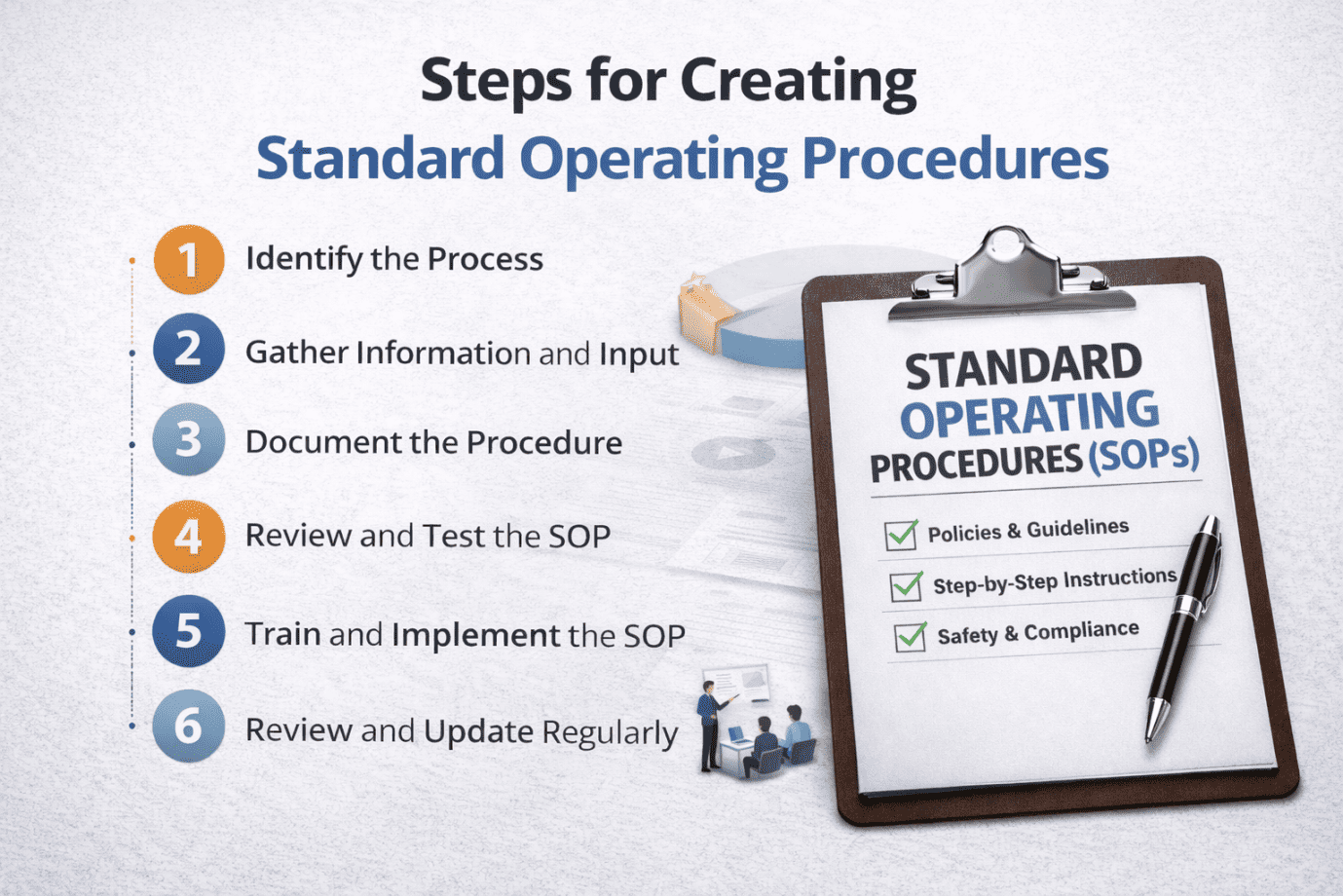
Step 1: Identify Critical Processes
Begin by identifying processes that directly impact productivity, quality, safety, or customer satisfaction. These may include operational, administrative, QA, QC SOP or SOP for project management. Prioritizing high-impact areas highlights the importance of SOPs in business success.
Step 2: Map Current Processes (As-Is Analysis)
Before defining the ideal standard operating process, document how work is currently performed. Mapping existing procedures helps uncover inefficiencies, variations, and risks that SOPs are meant to eliminate.
Step 3: Engage Process Owners and Operators
Successful implementation of SOP depends on involving the people who perform the tasks daily. Process owners, supervisors, and operators provide practical insights that improve clarity and acceptance while creating an SOP.
Step 4: Define Best-Practice Steps
Using process insights, define the most efficient, safe, and compliant way of working. Clearly outline the approved standard operating process, ensuring steps align with quality, safety, and regulatory requirements.
Step 5: Document Procedures Clearly
This is where the SOP takes formal shape. Use a standardized format to create a clear and consistent SOP document. Include objectives, scope, step-by-step instructions, roles, tools, and checkpoints to ensure usability.
Step 6: Validate Through Pilot Runs
Before full rollout, test the SOP in a controlled environment. Pilot runs help verify whether the operating procedures are practical and achievable, reducing issues during wider implementation.
Step 7: Train Employees
Effective training ensures employees understand and follow the SOP correctly. When organizations prepare SOPs along with structured training, adherence and performance improve significantly.
Step 8: Implement and Monitor Compliance
Finally, roll out the SOP across the organization. Continuous monitoring, audits, and reviews ensure sustained implementation and long-term benefits. Regular updates keep SOPs relevant as processes evolve.
By following this structured approach to create standard operating procedures, organizations build disciplined systems that support consistency, compliance, and scalable growth.
Common Challenges in SOP Implementation (And How to Overcome Them)
While SOPs are essential for consistency and control, many organizations struggle during its implementation. The gap between creating and successfully implementing standard operating procedures often lies in people, processes, and governance. Understanding these challenges—and addressing them systematically—ensures that these deliver their intended value.
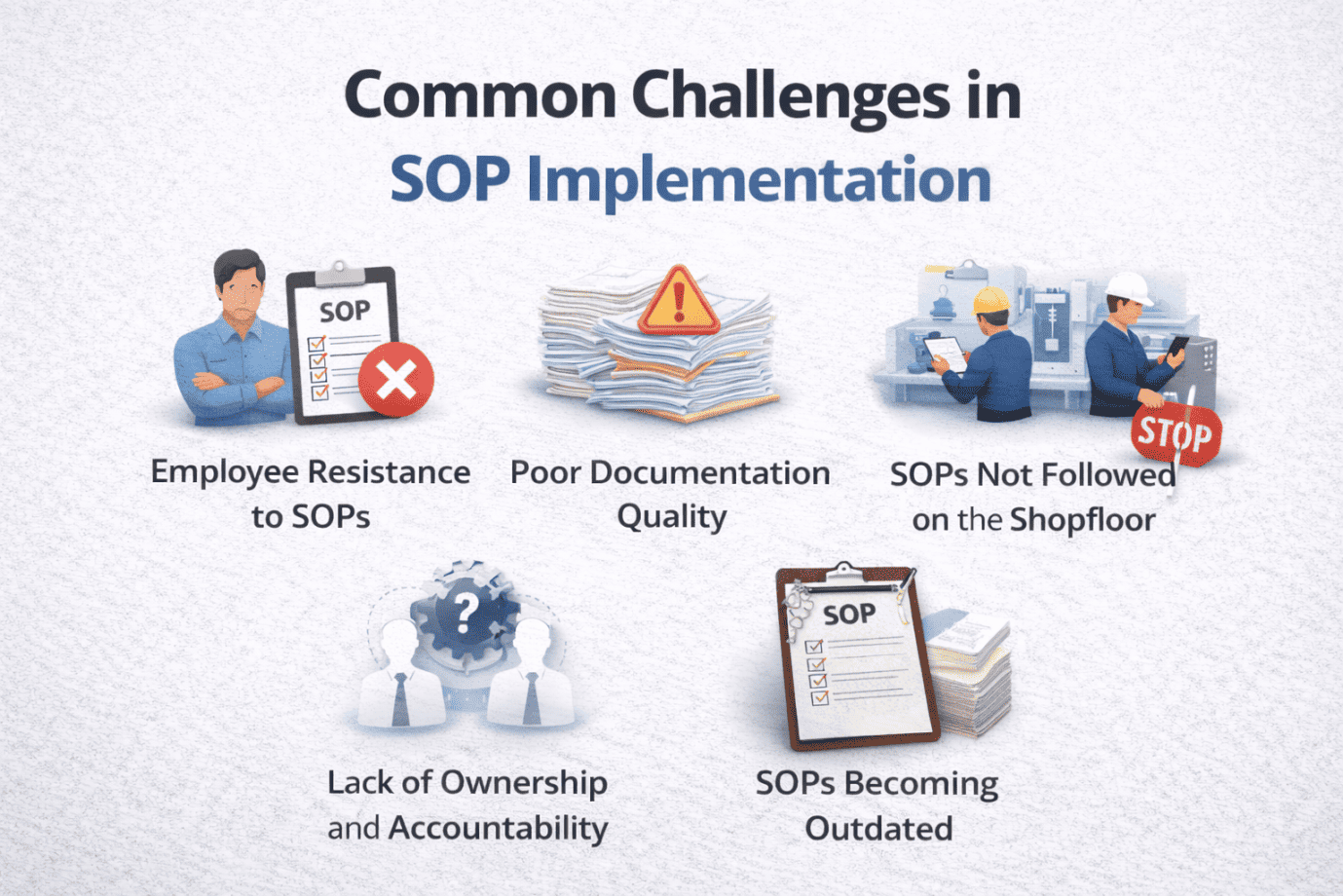
Employee Resistance to SOPs
One of the most common challenges is resistance from employees who view SOPs as restrictive or unnecessary. When the purpose is not clearly communicated, SOPs are seen as extra paperwork rather than performance enablers.
Solution:
- Use structured change management
- Involve operators during SOP creation
- Communicate the long-term benefits clearly
Poor Documentation Quality
An unclear SOP document, inconsistent format or complex language can render even well-designed operating procedures ineffective.
Solution:
- Use a standardized template
- Keep language simple and task-focused
- Add visuals to support the standard operating process
SOPs Not Followed on the Shopfloor
Many operational SOPs exist on paper but are ignored during daily operations due to practicality issues or lack of monitoring.
Solution:
- Validate SOPs through pilot runs
- Integrate QA and QC SOP checks
- Track compliance as part of performance metrics
Lack of Ownership and Accountability
Without defined ownership, SOP implementation loses momentum. This is common across administrative SOPs and SOP for project management.
Solution:
- Assign process owners
- Link SOP adherence to roles and KPIs
- Ensure leadership involvement
SOPs Becoming Outdated
As processes evolve, outdated standard operating procedures lose relevance and credibility.
Solution:
- Conduct regular reviews and audits
- Maintain version control within the SOP document
- Use digital SOP platforms for updates and training
By addressing these challenges proactively, organizations reinforce the importance of SOPs and ensure it remains practical, relevant, and performance-driven.
SOP Review, Control & Continuous Improvement
To remain effective over time, Standard Operating Procedures must be treated as dynamic, evolving systems rather than one-time documents. The purpose is not only to standardize work but also to support continuous improvement as business conditions, technologies, and customer expectations change. Regular review and control ensure that standard operating procedures continue to deliver long-term benefits.
SOP Review Frequency
- These should be reviewed at defined intervals based on process criticality.
- Operational, QA and QC SOPs require more frequent reviews due to their direct impact on quality and safety.
- Administrative SOPs may follow longer review cycles but should still be assessed regularly.
Version Control and Document Management
- Every SOP document must include a clear version number, revision date, and approval authority.
- Using a standardized format helps maintain consistency across different types of standard operating procedures.
- Proper version control prevents outdated operating procedures from being used in operations.
Structured Change Management
- Any update to a standard operating process should follow a formal change management approach.
- Changes must be evaluated for risk, approved by process owners, and communicated clearly.
- Training should accompany updates to support smooth implementation.
Continuous Improvement Integration
- Lean and Kaizen principles help identify gaps and improvement opportunities within standard operating procedures.
- Feedback from operators is critical when creating or refining existing ones.
Linking SOPs to Performance Metrics
- SOP adherence should be linked to KPIs and performance metrics.
- This strengthens accountability and reinforces the importance of SOPs in achieving operational excellence.
By focusing on review, control, and continuous improvement, organizations ensure that implementing standard operating procedures results in sustainable performance, compliance, and long-term business success.
Role of SOPs in Digital Transformation & Industry 4.0
In the era of Industry 4.0, SOPs are no longer viewed as static manuals but as strategic enablers of digital transformation. The purpose of a standard operating procedure today is to create a stable, repeatable, and clearly defined process that can be seamlessly supported by digital technologies. Modern SOPs form the foundation on which automation, data analytics, and smart systems operate effectively.
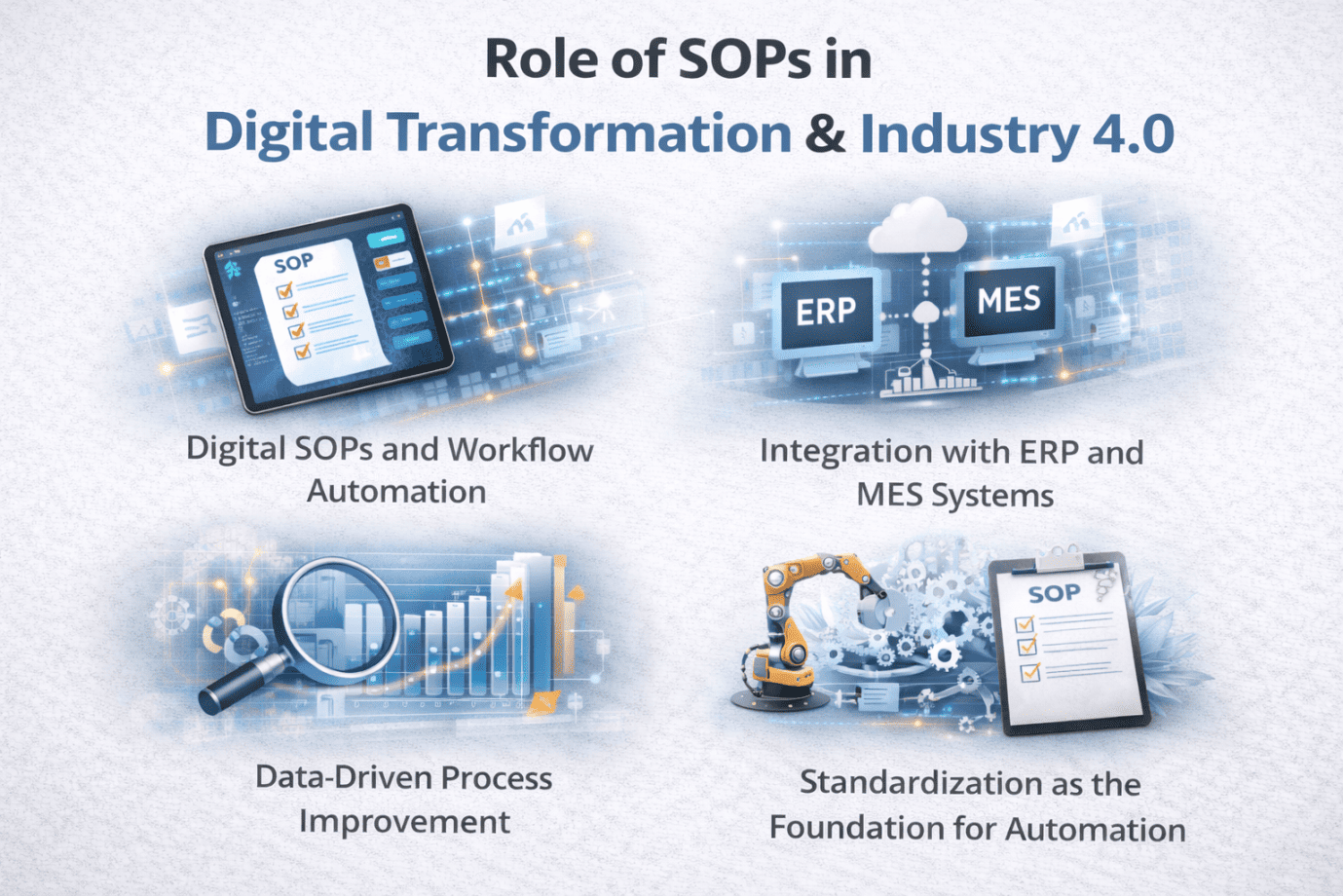
Digital SOPs and Workflow Automation
It transforms traditional operating procedures into interactive and accessible workflows. By using a consistent template, organizations can embed operational SOPs, QA and QC SOPs directly into digital platforms. These digital SOPs provide real-time guidance, automated approvals, and alerts, reducing manual intervention and human error. As a result, SOP implementation becomes more effective, ensuring that procedures are followed correctly and consistently across shifts and locations.
Integration with ERP and MES Systems
A structured and well-maintained SOP document plays a crucial role in integrating processes with ERP and MES systems. Clearly defined steps within the standard operating process allow digital systems to capture accurate execution data at each stage. Whether applied to production planning, quality management, maintenance, or for project management, standardized procedures enable seamless data flow and visibility. This integration enhances control, traceability, and coordination across departments.
Data-Driven Process Improvement
When organizations focus on creating standard operating procedures in a digital environment, SOPs become a powerful source of operational data. Metrics such as cycle time, deviations, rework, and downtime can be tracked against defined SOP steps. These insights highlight improvement opportunities and strengthen continuous improvement initiatives. The resulting SOP benefits include improved decision-making, reduced inefficiencies, and higher operational performance.
Standardization as the Foundation for Automation
Automation can only succeed when processes are standardized. The importance of SOPs lies in their ability to eliminate variation and define a consistent way of working that technology can replicate. Without standardized operating procedures, automation efforts often fail or deliver limited value. Effective implementation ensures alignment between people, machines, and digital systems.
By consistently preparing SOPs and strengthening its implementation, organizations position it as future-ready tools that drive digital excellence, scalability, and long-term competitiveness in the Industry 4.0 landscape.
FAQs
A. These are documented operating procedures that define the approved method for performing routine and critical tasks. A well-defined standard operating process ensures consistency, quality, and efficiency across business and manufacturing operations.
A. The importance lies in their ability to improve productivity, quality, safety, and compliance. Well-defined SOPs reduce errors, support audits, and enable scalable growth, making them essential for manufacturing excellence.
A. An effective SOP format includes a clear objective, scope, step-by-step instructions, roles and responsibilities, safety and quality checkpoints, and version control. Using a standard template ensures consistency across all SOPs.
A. Creating an SOP involves identifying critical processes, mapping the current workflow, defining best practices, and documenting them clearly in a document. Organizations should also train employees and monitor compliance for successful implementation.
A. QA and QC SOPs help standardize inspection, testing, and audit processes. By implementing it, organizations ensure regulatory compliance, consistent quality, and readiness for ISO and other certifications.
A. Major benefits include improved consistency, reduced rework, faster onboarding, better safety, and enhanced operational control. Effective implementation of standard operating procedures also supports long-term scalability and performance improvement.
A. An SOP document should be reviewed periodically based on process criticality. Operational SOPs and quality-related procedures require more frequent reviews to ensure they remain relevant and effective.
A.Standardized operating procedures form the foundation for automation and digital workflows. A well-defined SOP improves planning, execution, and control, while digital SOP implementation enables data-driven decision-making and Industry 4.0 readiness.
Conclusion
Standard Operating Procedures are far more than documented instructions—they are strategic enablers of sustainable and scalable business growth. The true purpose is to convert organizational knowledge into a disciplined standard operating process that delivers consistent results, regardless of people, shifts, or locations. When designed and executed effectively, standard operating procedures become powerful performance tools rather than administrative paperwork.
Across manufacturing and service organizations, SOPs drive consistency, quality, and control. Clearly defined and well-structured operating procedures ensure that critical activities are performed the right way, every time. From production lines to QA and QC and administration, SOPs create a common operating language that improves efficiency and reduces risk. This consistency is the foundation of manufacturing excellence and operational reliability.
The long-term importance of SOPs lies in their ability to support scalability and competitive advantage. When organizations focus on creating standard operating procedures using a uniform template, they enable faster training, easier replication of processes, and smoother expansion. A robust SOP document supports audits, compliance, and performance measurement while strengthening its implementation across the organization.
Whether creating an SOP, prepare for new operations, or deploying it for project management, the resulting benefits include higher productivity, better quality, and sustained performance. Ultimately, implementing standard operating procedures is not about documentation—it is about building resilient systems that empower people, support continuous improvement, and drive long-term business success.
For detailed information regarding our services for different sectors, you can explore our Homepage.

