

Root Cause Analysis- A Structured Approach to Solving Business Problems
Across manufacturing and service organizations, recurring operational challenges are a clear indication that root cause analysis is either missing or not applied effectively.
Issues such as frequent machine breakdowns, inconsistent product quality, delayed deliveries, rising operational costs, and repeated customer complaints often appear to be isolated events. However, in reality, these problems usually occur from the same underlying issue that remains unresolved. When organizations focus only on immediate symptoms, the actual root cause continues to impact performance, causing the same problems to resurface over time.

In many businesses, day-to-day operations are driven by a reactive firefighting culture rather than structured problem solving. Teams rush to restore production or service levels without conducting proper root cause analysis, leading to short-term fixes that fail to deliver sustainable improvement. This approach results in hidden and recurring costs such as quality losses, increased rework, unplanned downtime, safety risks, and declining customer satisfaction. Without a defined root cause analysis methodology, organizations struggle to understand why problems occur and are unable to eliminate the root cause of the issue permanently.
Adopting a systematic approach through RCA analysis allows organizations to shift from reaction to prevention. A structured methodology helps teams identify factual causes instead of assumptions, enabling data-driven corrective and preventive actions. By consistently applying root cause analysis, businesses can break the cycle of recurring problems, improve process stability, and build a culture of continuous improvement that supports long-term operational excellence and sustainable growth.
What is Root Cause Analysis?
It is a structured and logical approach used to identify the fundamental reason behind a problem or failure. Instead of addressing surface-level symptoms, root cause analysis focuses on uncovering the actual root cause of the issue so that effective and permanent solutions can be implemented. A systematic RCA analysis helps organizations understand why a problem occurred and ensures that corrective actions eliminate the source rather than temporarily suppressing the outcome.
Root Cause vs. Symptom
Understanding this distinction is critical for effective problem solving:
- Symptoms are the visible or measurable effects of a problem, such as defects, downtime, delays, or customer complaints.
- The root cause is the underlying factor within processes, systems, methods, or controls that leads to these symptoms.
Addressing symptoms provides short-term relief, while eliminating the root cause of the issue prevents recurrence.
Purpose and Philosophy of Root Cause Analysis
The core objectives of root cause analysis include:
- Identifying factual causes based on data rather than assumptions
- Preventing repeat occurrences of problems
- Encouraging system-level thinking instead of individual blame
- Supporting continuous improvement and long-term stability
A well-defined root cause analysis methodology promotes disciplined thinking, structured investigation, and sustainable corrective actions.
Root Cause Analysis in Improvement Frameworks
Root cause analysis is a core element of widely adopted improvement methodologies:
- Lean Manufacturing – Eliminates waste by addressing process inefficiencies at their source
- Six Sigma – Reduces variation and defects through data-driven analysis
- Total Quality Management (TQM) – Embeds root cause analysis into organizational quality culture
When Should RCA Be Used?
Organizations should apply root cause analysis methodology in:
- Reactive situations – After failures, defects, safety incidents, or customer complaints
- Proactive situations – To identify potential risks and prevent future issues
When applied consistently, root cause analysis becomes a powerful tool for achieving operational excellence and sustainable business improvement.
Why Root Cause Analysis is Critical for Manufacturing & Operations
In manufacturing and operations, recurring problems often indicate that the root cause of the issue has not been properly identified or eliminated. This is why root cause analysis plays a critical role in achieving stable, efficient, and predictable operations. A structured methodology allows organizations to move away from temporary fixes and implement long-term solutions that deliver sustainable results.

Impact of Root Cause Analysis on Manufacturing Performance
The consistent application of RCA analysis delivers measurable benefits across key operational areas:
- Productivity Improvement: By identifying the actual root cause of machine stoppages, process inefficiencies, or labor imbalance, root cause analysis helps reduce downtime and improve throughput.
- Quality Consistency: Defects and variations are often symptoms of deeper process issues. Using a disciplined methodology, organizations can eliminate the root cause of the issue, leading to stable and repeatable quality outcomes.
- Cost Reduction: Rework, scrap, warranty claims, and emergency maintenance increase operational costs. Root cause analysis directly supports cost reduction by preventing recurring losses at their source.
- Delivery Performance: Production delays frequently occur due to unresolved root cause, such as poor planning, equipment failure, or material shortages. RCA analysis ensures timely delivery by addressing these causes systematically.
Common Operational Problems Requiring RCA
Typical manufacturing challenges that demand root cause analysis include:
- Repeated machine breakdowns
- High rejection and scrap rates
- Safety incidents and near misses
- Delays in production and dispatch
RCA as the Foundation of Continuous Improvement
Without root cause analysis, organizations remain stuck in a reactive firefighting mode. In contrast, embedding a strong methodology creates a culture of continuous improvement. It encourages learning from failures, strengthens problem-solving capability at all levels, and ensures that improvements are sustained—making root cause analysis a cornerstone of operational excellence and long-term business success.
Key Principles of Effective Root Cause Analysis
For root cause analysis to deliver sustainable results, it must be applied using a disciplined and structured approach. Following key principles ensures that RCA analysis identifies the true cause of the issue rather than addressing symptoms or assumptions.
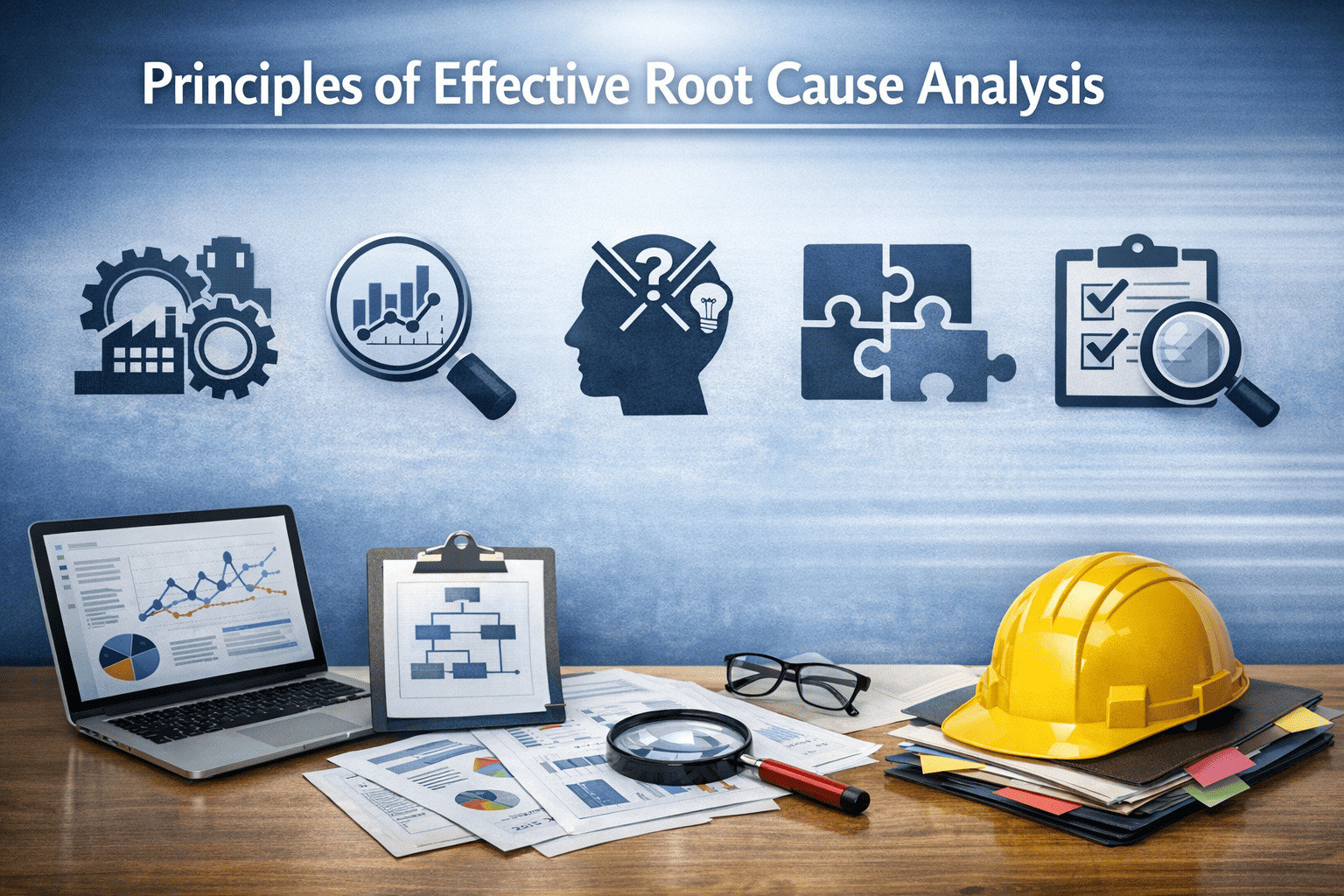
- Focus on systems, not people: Effective root cause analysis examines process design, systems, methods, and controls instead of assigning blame to individuals. Most failures occur due to weaknesses in the system, not human intent. This principle encourages open discussion and accurate identification of the root cause.
- Use data-driven analysis: Decisions in RCA analysis should be based on facts, process data, and evidence. A strong root cause analysis methodology relies on measurable inputs rather than opinions, ensuring objectivity and credibility in problem solving.
- Avoid assumptions and bias: Jumping to conclusions can lead teams to overlook the actual cause of the issue. Effective analysis requires questioning assumptions, validating hypotheses, and maintaining a neutral perspective throughout the investigation.
- Address multiple contributing causes: Problems rarely have a single cause. A robust root cause analysis methodology identifies all contributing factors—technical, process-related, and organizational—so that solutions are comprehensive and sustainable.
- Validate causes before implementing solutions: Before corrective actions are deployed, the identified root cause must be tested and verified. This ensures that solutions directly eliminate the root cause of the issue, making the analysis a reliable foundation for long-term improvement.
Step-by-Step Root Cause Analysis Process
A well-defined root cause analysis methodology provides a structured path for identifying, validating, and eliminating the root cause of the issue. Following clearly defined steps ensures consistency, objectivity, and long-term effectiveness in problem solving, especially in manufacturing and operations.
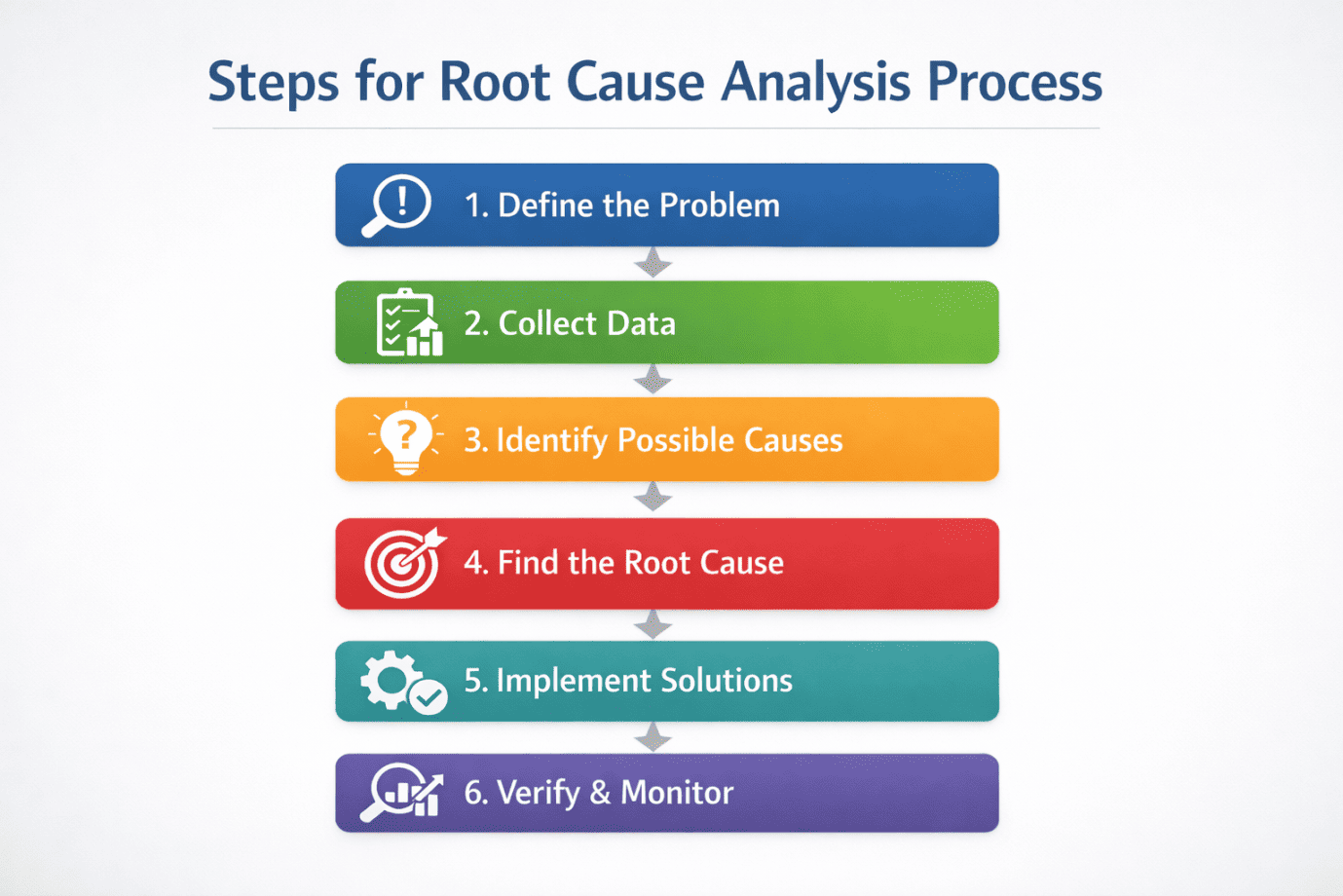
Step 1: Problem Identification & Definition
The foundation of effective root cause analysis lies in clearly defining the problem. Vague problem statements often lead to incorrect conclusions.
- Develop SMART problem statements (Specific, Measurable, Achievable, Relevant, Time-bound)
- Clearly describe what is happening, where, when, and how often
- Use factual data instead of opinions to avoid misinterpretation
A well-defined problem directs RCA analysis toward identifying the root cause, not just the visible symptoms.
Step 2: Data Collection
Accurate data is essential for reliable root cause analysis in quality and operations.
- Collect process data, machine logs, quality inspection reports, maintenance records, and production data
- Analyze historical trends to understand problem patterns
- Conduct Gemba walks to observe the process at the source and validate real operating conditions
This step ensures that root cause analysis tools are applied to real-world conditions rather than assumptions.
Step 3: Cause Identification
Once data is available, teams identify potential causes contributing to the problem.
- Use structured brainstorming techniques involving cross-functional teams
- Apply fish bone diagram for root cause analysis to categorize causes related to Man, Machine, Method, Material, Measurement, and Environment
- Establish clear cause-and-effect relationships
This step helps differentiate symptoms from the root cause of the issue and highlights multiple contributing factors.
Step 4: Root Cause Validation
Not every identified cause is the root cause. Validation is critical.
- Test assumptions using data and controlled trials
- Verify cause-and-effect relationships through evidence-based confirmation
- Eliminate causes that lack factual support
Validated causes ensure that RCA analysis leads to effective solutions.
Step 5: Corrective & Preventive Actions
Effective root cause analysis methodology focuses on sustainable solutions.
- Design corrective actions that eliminate the root cause, not just reduce impact
- Implement preventive measures to avoid recurrence
- Standardize improved processes through SOPs, visual controls, and training
Step 6: Monitoring & Review
The final step in root cause analysis steps ensures sustainability.
- Track performance using KPIs related to quality, productivity, and delivery
- Establish a continuous feedback loop to review effectiveness
- Update standards and controls based on results
When applied rigorously, this step-by-step root cause analysis process transforms problem solving into a continuous improvement system, strengthening operational excellence and long-term performance.
Common Root Cause Analysis Tools & Techniques
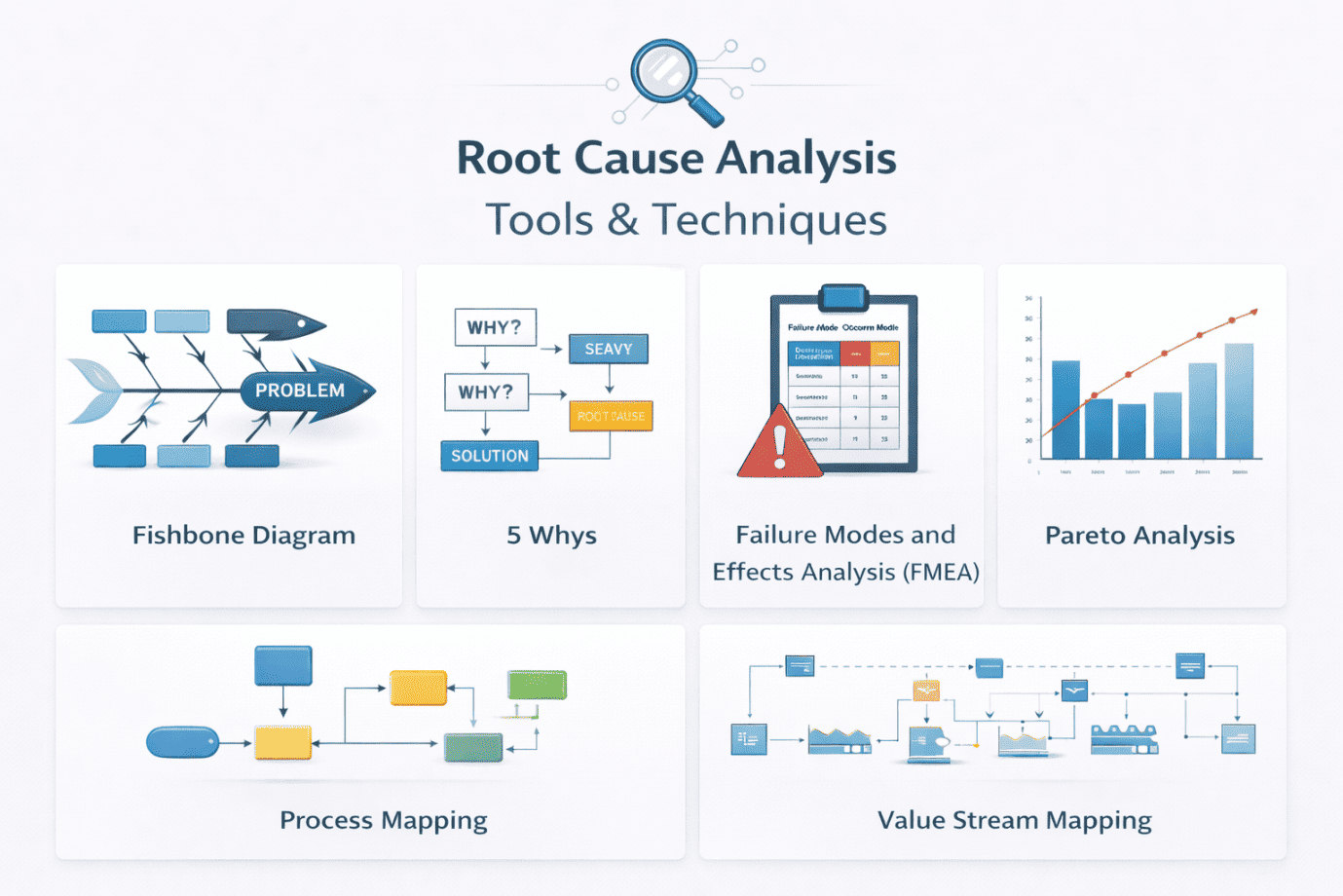
Effective problem solving requires selecting the right root cause analysis tools based on the nature and complexity of the problem. A structured methodology combines multiple techniques to identify, validate, and eliminate the root cause rather than treating symptoms. Below are some of the most widely used tools in RCA analysis, especially in manufacturing and operations.
Five Whys Technique
The five whys of root cause analysis is one of the simplest yet most powerful tools for identifying the root cause of the issue. The concept involves repeatedly asking “Why?”—typically five times—until the underlying cause is revealed.
- Concept and example: If a machine stops unexpectedly, asking why it stopped may reveal overheating. Asking why it overheated may uncover poor lubrication, and further questioning may point to an ineffective maintenance system—highlighting the root cause.
- When to use it: The 5 whys technique is best suited for straightforward problems with clear cause-and-effect relationships.
- Limitations: It relies heavily on team knowledge and may oversimplify complex issues if not supported by data or other tools.
Fishbone Diagram (Ishikawa Diagram)
The fish bone diagram for root cause analysis, also known as Ishikawa root cause analysis, visually maps potential causes contributing to a problem.
- Categories: Causes are grouped under standard headings—Man, Machine, Method, Material, Measurement, and Environment—to ensure comprehensive analysis.
- Visual cause mapping: This tool helps teams see relationships between causes and identify patterns that may lead to the root cause of the issue, making it highly effective for root cause analysis in quality problems.
Pareto Analysis
Pareto Analysis applies the 80/20 rule, which states that a small number of causes often account for the majority of problems.
- 80/20 rule: By analyzing defect data or downtime reasons, teams can identify the few critical causes responsible for most losses.
- Prioritizing major causes: This approach ensures RCA analysis focuses on high-impact areas, accelerating improvement and supporting informed decision-making within the root cause analysis methodology.
Failure Mode and Effects Analysis (FMEA)
FMEA is a proactive and risk-based root cause analysis tool used to prevent failures before they occur.
- Risk-based RCA: Potential failure modes are evaluated based on severity, occurrence, and detection.
- Preventive approach: FMEA strengthens root cause analysis steps by identifying weaknesses early, making it a cornerstone of root cause analysis in quality and safety-critical processes.
Process Mapping & Value Stream Mapping
These tools visualize workflows to identify inefficiencies and waste.
- Identifying bottlenecks and waste: By mapping each process step, teams can uncover delays, redundancies, and non-value-added activities linked to the root cause.
Process mapping and value stream mapping complement other root cause analysis tools by providing a holistic view of operations. When combined effectively, these techniques enable organizations to identify the root cause, implement sustainable solutions, and embed continuous improvement into daily operations.
Common Mistakes to Avoid During Root Cause Analysis
Although root cause analysis is a proven problem-solving approach, its effectiveness is often reduced due to common implementation mistakes. Avoiding these errors is essential to ensure that analysis identifies the root cause of the issue and delivers sustainable results.
- Jumping directly to solutions: Many teams implement corrective actions before completing all steps. Skipping a structured root cause analysis methodology leads to quick fixes that fail to eliminate the root cause.
- Treating symptoms as causes: Visible problems such as defects, downtime, or delays are symptoms, not causes. Without deeper investigation using tools, teams often miss the actual root cause of the issue.
- Blaming individuals instead of systems: Effective root cause analysis in quality focuses on process, system, and control failures—not people. Tools such as Ishikawa root cause analysis and the fish bone diagram help identify system-level weaknesses objectively.
- Inadequate data collection: Whether applying the five whys of root cause analysis with other tools, conclusions must be supported by facts and data, not assumptions.
- Not sustaining corrective actions: Even when the root cause is correctly identified, lack of monitoring, standardization, and follow-up allows problems to reoccur. Sustaining improvements is a critical part of effective root cause analysis.
Avoiding these mistakes ensures root cause analysis becomes a reliable driver of continuous improvement rather than a one-time exercise.
FAQs
A. It is a structured approach used to identify the root cause of the issue rather than treating symptoms. It is important because it helps organizations prevent recurring problems, improve operational stability, and achieve long-term performance improvement through a disciplined methodology.
A. The core root cause analysis steps include problem definition, data collection, cause identification, root cause validation, corrective and preventive actions, and ongoing monitoring. Following these steps ensures that solutions address the issue effectively.
A. A root cause analysis methodology should be used both reactively—after defects, failures, or incidents—and proactively to prevent future risks. This approach supports sustainable improvement, especially in manufacturing and operations.
A. Popular root cause analysis tools include the five whys, the fish bone diagram, Pareto Analysis, FMEA, and process mapping. These tools help systematically uncover the root cause behind recurring problems.
A. Accurate data ensures that RCA analysis is based on facts rather than assumptions. Without sufficient data, teams risk misidentifying the main cause, leading to ineffective solutions that fail to resolve the issue.
A. Root cause analysis in quality helps identify process variations, defects, and systemic failures. By eliminating the root cause, organizations can achieve consistent quality, reduce rework, and strengthen customer satisfaction.
A.Leadership commitment is essential for embedding root cause analysis methodology into daily operations. When leaders promote structured problem solving and accountability, teams consistently follow root cause analysis steps and sustain improvements by addressing the main cause of the issue.
A.If the root cause of the issue is not eliminated, problems will continue to recur in different forms. Even if symptoms are temporarily resolved, the underlying cause will eventually impact cost, quality, delivery, or customer satisfaction.
Conclusion
In today’s complex business environment, root cause analysis must be viewed as a mindset rather than just a problem-solving tool. Organizations that consistently apply RCA analysis move beyond short-term fixes and focus on identifying the root cause of the issue, ensuring that problems are eliminated at their source. This disciplined way of thinking strengthens decision-making and drives sustainable performance improvement across operations.
The long-term benefits of adopting a structured root cause analysis methodology are significant. Improved quality, reduced operational costs, enhanced productivity, and reliable delivery performance are all outcomes of addressing the true cause instead of recurring symptoms. When supported by proven tools such as the five whys, Pareto analysis, fish bone diagram for root cause analysis etc., organizations can systematically investigate failures and prevent recurrence. These approaches are especially valuable in root cause analysis in quality, where consistency and prevention are critical.
Strong leadership commitment plays a decisive role in embedding root cause analysis steps into daily operations. Leaders must encourage data-driven thinking, cross-functional collaboration, and accountability for sustaining improvements. When leadership actively supports structured problem solving, teams feel empowered to challenge assumptions and uncover the main cause of the issue.
Ultimately, organizations that embrace root cause analysis as a cultural practice build resilience, foster continuous improvement, and create a strong foundation for long-term business success.
For detailed information regarding our services for different sectors, you can explore our Homepage.

