

Strategic Management- Transforming Strategy into Business Success
Business success is no longer determined
by how well an organization responds to change, it's determined by how well it prepares for it. In today's rapidly evolving business landscape, companies must embrace strategic management to remain competitive, adopt effective strategic planning to prepare for future opportunities and strengthen their overall management and strategy approach to achieve sustainable growth. With market disruptions, digital transformation, global competition, supply chain uncertainty, changing customer expectations and economic volatility reshaping industries, organizations need a structured approach to stay ahead.
While operational efficiency helps improve productivity and reduce costs, it is no longer enough to secure long-term success. Businesses need a clear vision, defined objectives and the flexibility to adapt as market conditions change. This is where strategic management becomes essential. It provides a systematic framework for aligning business goals with resources, identifying opportunities, minimizing risks and building resilience in an increasingly competitive environment.

At its core, strategic management is a continuous process that combines strategy formulation, effective strategy implementation, and informed strategic decision making. Together, these elements help organizations transform vision into measurable actions while ensuring every function works toward shared objectives. The importance of strategic management lies in its ability to connect long-term planning with day-to-day execution, enabling businesses to improve performance, optimize resources and drive growth.
Whether you’re leading a manufacturing company, scaling an industrial enterprise or transforming an established business, strategic management provides the roadmap to sustainable growth, operational excellence and long-term competitive advantage. Organizations that make strategy an integral part of their culture are better equipped to adapt, innovate and succeed in a constantly evolving business landscape.
What is Strategic Management?
It is the continuous process of planning, executing, monitoring and improving business strategies to achieve long-term organizational goals. It helps businesses align their vision, resources and capabilities with changing market conditions while creating a sustainable competitive advantage. By combining strategic planning, strategy formulation, strategy implementation and strategic decision making, organizations can make informed decisions, manage risks and drive sustainable growth.
Difference between Management, Strategic Planning and Strategic Management
- Management: It focuses on overseeing day-to-day business operations, managing people and resources and ensuring short-term objectives are achieved efficiently.
- Strategic Planning: It involves defining the organization's long-term vision, setting priorities through strategic goal setting, and developing a roadmap to achieve future business objectives. It focuses on deciding what the organization wants to accomplish.
- Strategic Management: Unlike planning alone, strategic management is an ongoing process that transforms plans into action. It includes planning, execution, performance monitoring and adapting strategies to changing business needs. Through effective strategic planning and management, organizations continuously evaluate performance and refine their strategies to stay competitive.
For modern organizations, strategic management is not a one-time initiative but a continuous cycle of improvement. Many companies also leverage strategy and management consulting to strengthen execution, improve alignment and support long-term business success.
Importance of Strategic Management in Today's Business Environment
Today’s business environment is more dynamic and unpredictable than ever before. Organizations face constant change, making it difficult to rely on traditional management approaches or short-term decisions. To remain competitive and achieve sustainable success, businesses need a clear direction, informed strategic decision making and a well-defined approach. This is why the importance of strategic management has grown significantly across industries.
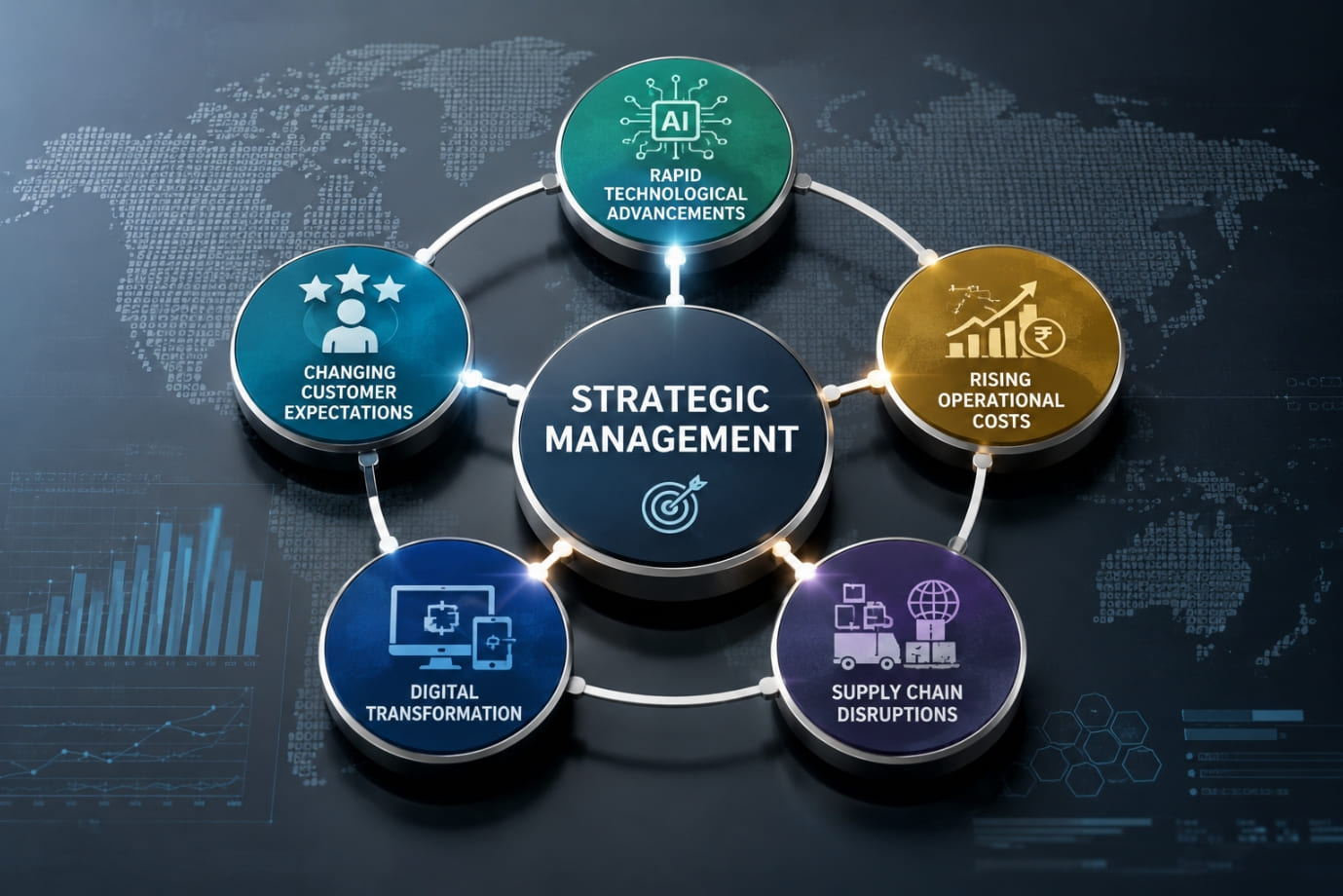
Some of the key factors driving the need for strategic management for business include:
- Rapid technological advancements that require continuous innovation and digital adoption.
- Global competition, making it essential for businesses to differentiate and strengthen their business level strategy.
- Rising operational costs, encouraging organizations to optimize resources and improve efficiency.
- Changing customer expectations, where personalized experiences, quality and faster delivery have become the norm.
- Growing focus on Environmental, Social and Governance (ESG) practices to meet regulatory and stakeholder expectations.
- Accelerating digital transformation, requiring businesses to modernize operations and embrace new technologies.
- Talent shortages that demand better workforce planning and employee development.
- Ongoing supply chain disruptions, highlighting the need for resilient and adaptable business models.
By integrating strategic planning, strategy formulation, strategy implementation and strategic decision making, organizations can respond proactively to change instead of reacting to it. A well-defined strategic management process strengthens management and strategy, helping businesses drive growth while remaining competitive in an ever-changing business environment.
Levels of Strategic Management
Every successful organization follows a structured approach to decision-making, but not all strategic decisions are made at the same level. Different departments and leadership teams focus on different priorities, yet they all work together to achieve common business goals. Understanding the levels of strategic management helps organizations align long-term vision with day-to-day operations, ensuring that every decision contributes to sustainable growth and improved performance.

A well-defined framework divides strategy into four key levels, each with a unique role in supporting effective strategic planning and management and successful implementation.
⮞ Corporate Level Strategy
It focuses on the overall direction of the organization. It involves making long-term strategic decisions that determine where the business wants to grow and how it will create value. This includes business portfolio management, diversification, mergers and acquisitions, expansion into new markets and capital allocation. Strong strategic leadership at this level ensures that every major investment and initiative aligns with the company’s long-term vision. It also lays the foundation for the process of formulating strategy that supports future growth.
⮞ Business Level Strategy
It defines how an organization will compete successfully within a specific market or industry. It focuses on creating a competitive advantage by adopting approaches such as cost leadership, product differentiation or niche market focus. Businesses also develop a strong customer value proposition to attract and retain customers. Effective business strategy and management enables organizations to respond to market changes, strengthen brand positioning and support long-term business development strategies. For more information, you can also read our blog on Business Strategy Consulting.
⮞ Functional Level Strategy
It translates high-level business objectives into actionable plans for individual departments such as Operations, Supply Chain, Manufacturing, Human Resources, Finance, Sales & Marketing and Procurement. Each function develops strategies that support overall business objectives while improving efficiency and collaboration. This alignment between management and strategy ensures that every team contributes to successful strategic implementation and organizational performance.
⮞ Operational Strategy
It focuses on executing business plans effectively through daily activities. It emphasizes continuous improvement, Lean Manufacturing, Quality Management, productivity enhancement, process optimization and KPI monitoring. Regular strategy evaluation at this level helps organizations measure performance and identify areas for improvement. The benefits of strategic management are realized only when operational excellence supports consistent execution across the organization.
When these four levels work together, strategic management for business becomes more effective. From strategic planning and formulation to execution and evaluation, every level contributes to better decision making, stronger competitiveness and sustainable business growth. This integrated approach highlights the importance of strategic management and enables organizations to achieve long-term success through effective leadership.
The Strategic Management Process
It is a structured and continuous approach that helps organizations achieve long-term success. It involves analyzing the business environment, setting clear objectives, developing effective strategies, executing them efficiently and evaluating results. Rather than being a one-time activity, strategic management enables businesses to adapt to changing market conditions and make informed decisions that support sustainable growth.
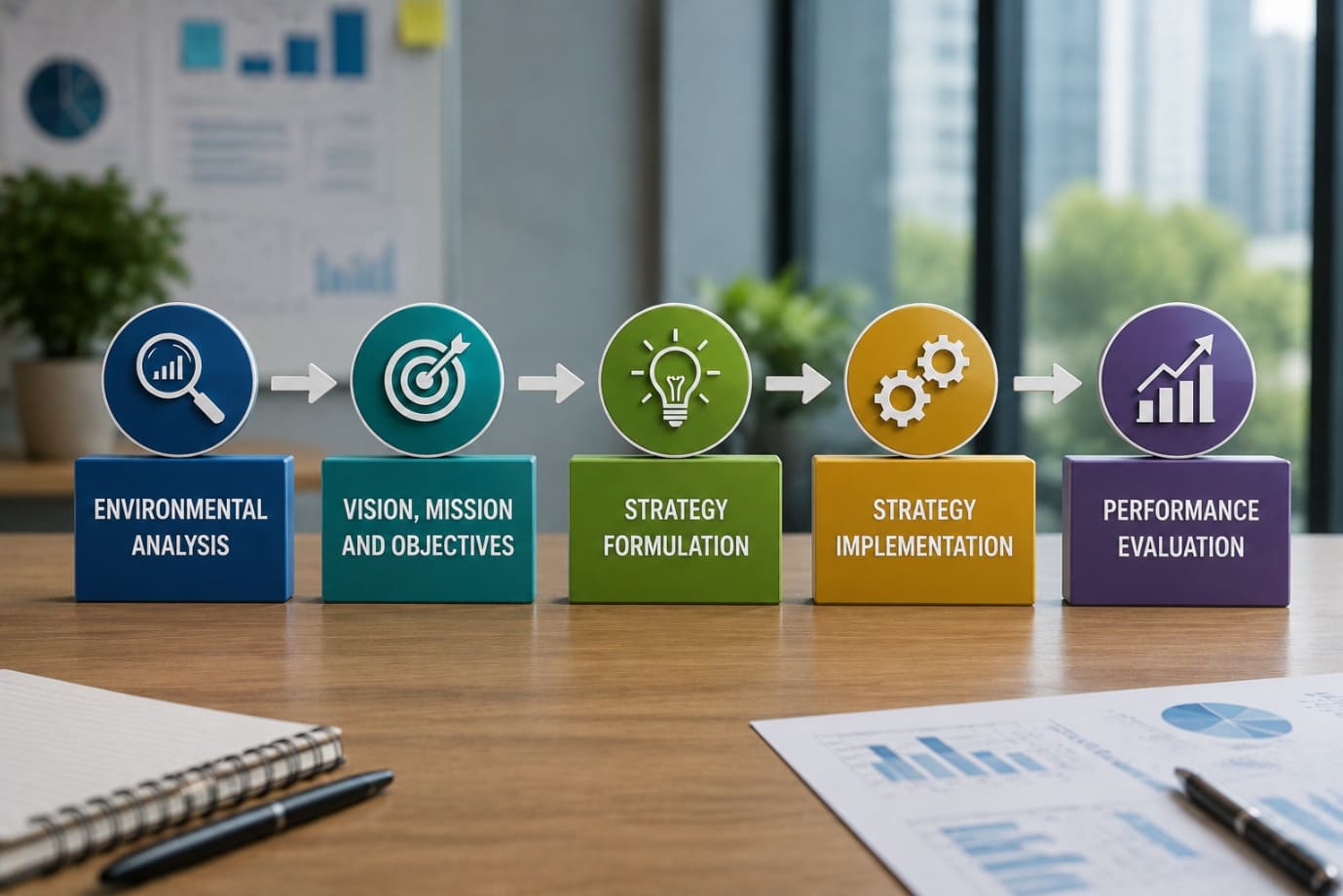
⮞ Environmental Analysis
The first step is understanding the business environment. Organizations assess their internal strengths and weaknesses while identifying external opportunities and threats. Popular tools such as SWOT analysis, PEST analysis, industry analysis, competitor benchmarking and Porter’s Five Forces model in strategic management help businesses evaluate market conditions. Many organizations also use value chain analysis to improve efficiency and strengthen their competitive position.
⮞ Vision, Mission and Objectives
After the analysis, organizations define their vision, mission and long-term objectives. This stage focuses on strategic goal setting, ensuring that business goals align with the overall organizational strategy. Clear objectives provide direction, improve management and help every department work toward common goals.
⮞ Strategy Formulation
It is the process of selecting the best approach to achieve business objectives. Organizations evaluate growth opportunities, cost leadership, differentiation, diversification and market expansion to create effective business development strategies. This process of formulating strategy supports both corporate level and business level strategy, ensuring long-term competitiveness.
⮞ Strategy Implementation
A strategy is valuable only when it is executed effectively. Strategy implementation focuses on translating plans into action through strong leadership, proper resource allocation, an effective organizational structure, employee engagement and change management. Successful strategic implementation ensures that every function contributes to organizational success.
⮞ Performance Evaluation
The final stage measures whether the strategy is delivering the desired results. Organizations track KPIs, use the Balanced Scorecard, conduct operational reviews and perform regular strategy evaluation to identify improvement opportunities. This continuous review strengthens strategic planning and management, improves the operational strategy and demonstrates the importance of strategic management. By following this cycle consistently, organizations can maximize its benefits and achieve sustainable business success.
Strategic Management Frameworks Every Business Leader Should Know
An effective strategic management framework helps organizations make informed decisions, solve business challenges and achieve long-term success. These frameworks provide a structured approach to strategic planning, formulation and decision making, enabling businesses to align their organizational strategy with changing market conditions. Choosing the right framework depends on an organization’s goals, industry and competitive environment.
⮞ SWOT Analysis
SWOT analysis in strategic management helps businesses evaluate their Strengths, Weaknesses, Opportunities and Threats before making important decisions. For example, a manufacturing company may identify strong production capabilities as a strength while recognizing rising raw material costs as a threat. This analysis supports better strategy formulation and reduces business risks.
⮞ Porter's Five Forces
The Porter’s Five Forces model in strategic management helps organizations understand the level of competition within an industry. It evaluates factors such as competitive rivalry, supplier power, buyer power, the threat of new entrants and substitute products. This framework enables businesses to develop a stronger business strategy and maintain a competitive advantage. For detailed information, you can go through our dedicated blog on Porter’s 5 Forces Analysis.
⮞ Balanced Scorecard
The Balanced Scorecard is a performance management tool that tracks progress beyond financial results. It measures key performance indicators (KPIs) across financial performance, customer satisfaction, internal processes and learning and growth, helping organizations monitor strategy implementation and overall business performance.
⮞ Value Chain Analysis
Value chain analysis in strategic management identifies activities that create value for customers while improving operational efficiency. By optimizing each stage of the value chain, organizations can reduce costs, enhance quality and strengthen their competitive position.
⮞ Blue Ocean Strategy
The Blue Ocean Strategy encourages businesses to create uncontested market spaces instead of competing in crowded markets. It supports innovation and opens new opportunities for growth through unique products, services or business models.
⮞ OKRs (Objectives and Key Results)
OKRs help organizations align strategic goal setting with measurable outcomes. They connect business objectives with daily execution, ensuring teams remain focused on priorities. When integrated into strategic management, OKRs improve accountability, support strategic implementation and help leaders track progress toward long-term goals.
Strategic Management in Manufacturing Organizations
In the manufacturing sector, long-term success depends on much more than efficient production. Companies must continuously adapt to changing customer demands, technological advancements and market competition while maintaining profitability. This is where strategic management plays a vital role. By combining effective planning with disciplined execution, manufacturers can align their operations with long-term business objectives and create a sustainable competitive advantage.
Key areas where strategic management creates value in manufacturing include:
- Lean Manufacturing to eliminate waste, improve efficiency and maximize value.
- Supply Chain Optimization to improve inventory management, reduce disruptions and strengthen supplier relationships. You can also read our dedicated blog on Types of Supply Chain Management.
- Capacity Planning to balance production capabilities with market demand and future growth.
- Digital Manufacturing by integrating smart technologies and automation into production processes.
- Industry 4.0 adoption through IoT, AI, data analytics and connected manufacturing systems. Also read our comprehensive blog on Industry 5.0.
- Operational Excellence by streamlining processes and improving overall performance.
- Cost Reduction through better resource utilization and process optimization.
- Productivity Improvement by enhancing workforce efficiency and equipment performance.
- Quality Enhancement through continuous monitoring, standardization and quality management practices.
By integrating strategy formulation, implementation and continuous evaluation, manufacturers can align daily operations with long-term business goals. This strengthens management, improves competitiveness and reinforces its importance in achieving sustainable business success.
Benefits of Strategic Management
In today’s competitive business environment, organizations need more than short-term planning to achieve lasting success. Strategic management provides a structured approach that helps businesses make informed decisions, optimize resources and adapt to changing market conditions. By integrating strategic planning, execution and continuous improvement, organizations can strengthen their overall performance and achieve sustainable growth. The benefits of strategic management extend across every level of an organization, from leadership to daily operations.
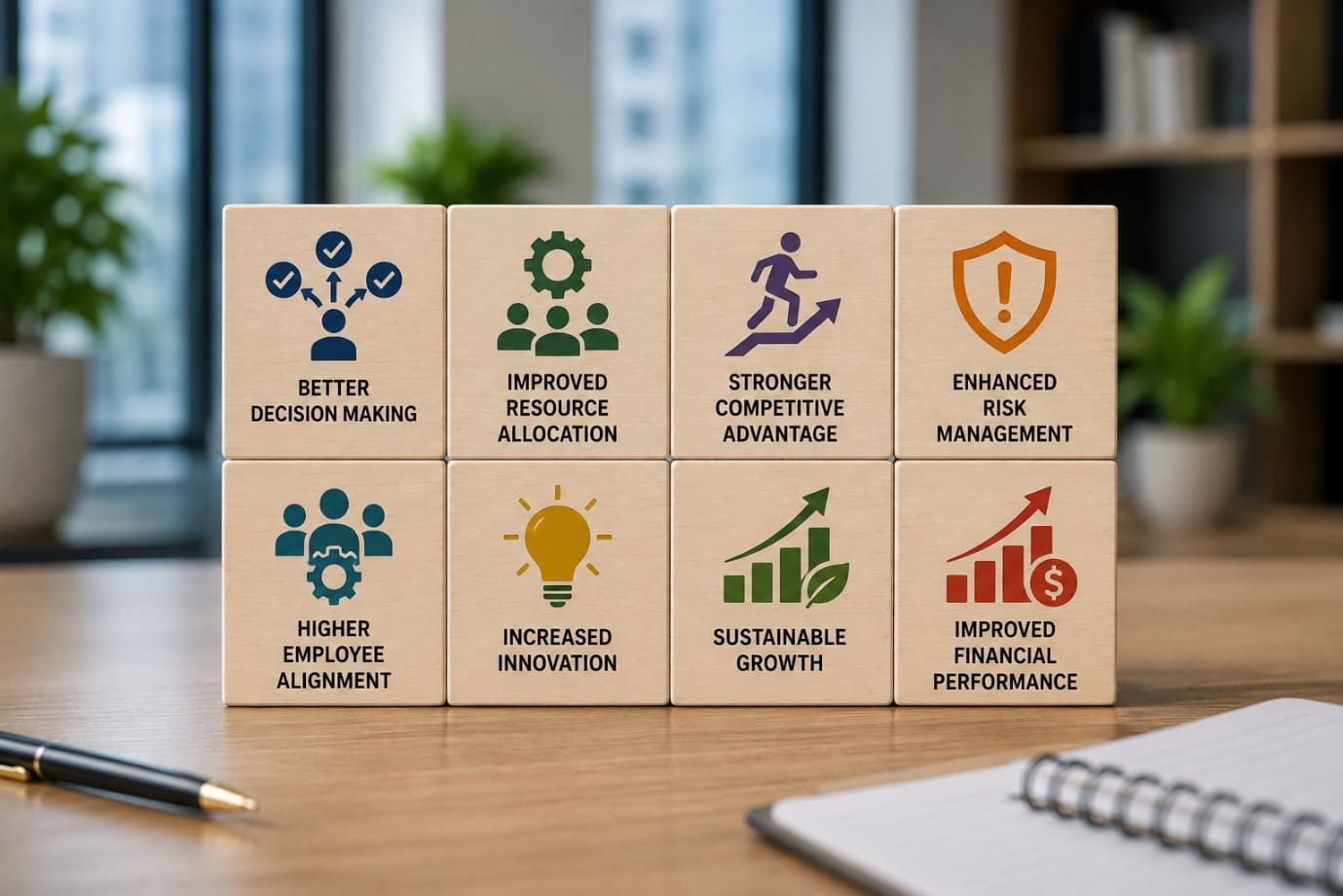
Some of the key benefits include:
- Better Decision Making: Effective strategic decision making enables leaders to evaluate opportunities, reduce uncertainty, and make decisions that support long-term business objectives.
- Improved Resource Allocation: Through proper strategy formulation and planning, businesses can allocate financial, human and operational resources more efficiently.
- Stronger Competitive Advantage: A well-defined business level strategy helps organizations differentiate themselves, improve customer value and stay ahead of competitors.
- Enhanced Risk Management: The strategic management process encourages businesses to identify potential risks early and develop proactive solutions. You can also go through our comprehensive blog on Risk Management.
- Higher Employee Alignment: Clear goal setting ensures that employees understand organizational priorities and work toward common objectives.
- Increased Innovation: Effective management and strategy encourage organizations to embrace new technologies, improve processes and develop innovative products and services.
- Sustainable Growth: By aligning the organizational strategy with long-term business goals, companies create a strong foundation for consistent growth and expansion.
- Improved Financial Performance: Better planning, efficient resource utilization and successful strategy implementation contribute to higher profitability and long-term value creation. .
The importance of strategic management lies in its ability to connect vision with execution. Organizations that adopt a strong strategic management framework are better equipped to improve performance, respond to market changes and achieve long-term business success.
Common Challenges in Strategic Management
While strategic management helps organizations achieve long-term success, implementing it effectively can be challenging. Many businesses develop strong strategies but struggle to execute them due to internal and external obstacles. Identifying these challenges early allows organizations to strengthen their strategic management process and improve overall business performance.
Some common challenges include:
- Poor communication, leading to unclear goals and lack of alignment across teams.
- Resistance to change, where employees hesitate to adopt new processes or business strategies.
- Lack of leadership commitment, which can weaken strategy implementation and delay organizational progress.
- Inadequate data, making it difficult to support accurate decision making.
- Weak execution, where well-planned strategies fail because of poor coordination or accountability.
- Short-term thinking, causing businesses to focus on immediate results instead of sustainable growth.
- Resource constraints, including limited budgets, technology or skilled talent.
Organizations can overcome these challenges by strengthening strategic planning, promoting open communication, encouraging strategic leadership and aligning teams with the overall strategy. Regular strategy evaluation, measurable goals and continuous employee engagement also improve execution and accountability. By addressing these barriers proactively, businesses can maximize the benefits of strategic management and achieve long-term success.
Best Practices for Effective Strategic Management
A successful strategic management approach is not just about creating a strategy, it is about executing it consistently and adapting it as business conditions evolve. Organizations that follow proven best practices are better positioned to improve performance, strengthen competitiveness and achieve sustainable growth. By combining effective strategic planning with disciplined execution, businesses can turn long-term goals into measurable results.
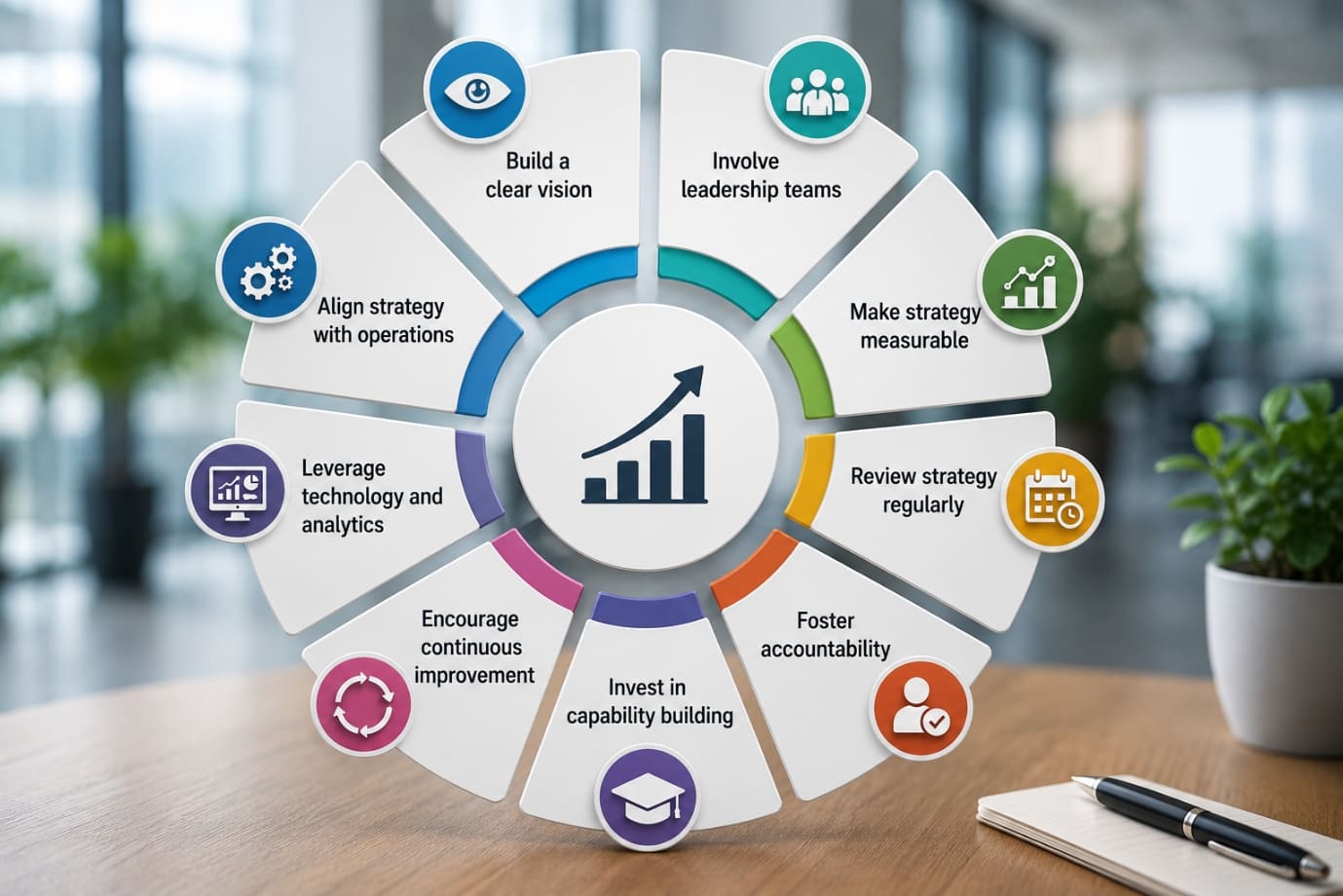
Here are some best practices for effective strategic management for business:
- Build a clear vision: Establish a strong organizational strategy with well-defined objectives that guide every business decision.
- Involve leadership teams: Encourage strategic leadership and collaboration across departments to ensure alignment during strategy formulation and execution.
- Make strategy measurable: Set clear KPIs and focus on strategic goal setting to track progress and support informed strategic decision making.
- Review strategy regularly: Conduct periodic strategy evaluation to identify gaps, respond to market changes and keep the process relevant.
- Foster accountability: Clearly define roles and responsibilities so every team contributes to successful strategy implementation.
- Invest in capability building: Develop employee skills, leadership capabilities and organizational competencies to support long-term growth.
- Encourage continuous improvement: Create a culture where innovation, learning and process optimization become part of everyday operations.
- Leverage technology and analytics: Use digital tools, business intelligence and data-driven insights to improve decision-making and business performance.
- Align strategy with operations: Ensure that every operational and functional level strategy supports broader business objectives and long-term goals.
The importance of strategic management lies in its ability to connect vision with execution. Organizations that embrace these best practices strengthen management and strategy, improve adaptability and maximize the long-term benefits of strategic management in an increasingly competitive business environment.
The Role of Leadership in Strategic Management
Effective leadership in strategic management is the driving force behind every successful business strategy. While strategic planning helps define the direction and strategy formulation creates the roadmap, it is strong leadership that ensures those plans are successfully executed. Leaders play a vital role in guiding teams, making informed strategic decisions and aligning the organization with its long-term vision. Without committed leadership, even the most well-designed strategies can fail during strategy implementation.
Strong leadership contributes to business success by focusing on the following areas:
- Strategic Leadership: Leaders establish a clear vision, communicate the organizational strategy and inspire teams to work toward common business goals.
- Decision-Making: Effective strategic decision making helps organizations respond to market changes, minimize risks and seize growth opportunities.
- Building the Right Culture: Leaders foster a culture of accountability, collaboration and continuous learning that supports long-term strategy and growth.
- Employee Engagement: Engaged employees understand business priorities, contribute innovative ideas and actively support strategic implementation.
- Driving Innovation: Leadership encourages creativity, embraces new technologies and supports continuous improvement to strengthen competitiveness.
- Cross-Functional Collaboration: Successful strategic management requires every department to work together, ensuring that business objectives are aligned across operations, finance, HR, sales and supply chain.
The importance of strategic management is realized only when leaders remain committed to execution. By promoting collaboration, accountability and continuous communication, they transform strategy into measurable results and ensure that strategic management delivers sustainable long-term success.
FAQs
A. Strategic management is the continuous process of planning, implementing, monitoring and improving business strategies to achieve long-term organizational goals. The importance of strategic management lies in its ability to align business objectives with available resources, improve decision-making and help organizations adapt to changing market conditions while achieving sustainable growth.
A. The strategic management process consists of five key stages: environmental analysis, vision and objective setting, strategy formulation, strategy implementation and performance evaluation. Following these stages helps organizations make informed decisions, measure progress and continuously improve their business performance.
A. Strategic planning focuses on defining an organization’s vision, goals, and future direction, while strategic management goes beyond planning by executing strategies, monitoring performance and adapting to changing business conditions. In simple terms, planning defines the roadmap, whereas management ensures the journey is completed successfully.
A. The four levels of strategic management are corporate level strategy, business level strategy, functional level strategy and operational strategy. Each level focuses on different aspects of the business, but together they ensure that organizational goals are effectively translated into daily operations and long-term business success.
A. The major benefits of strategic management include better decision-making, efficient resource allocation, stronger competitive advantage, improved risk management, higher employee alignment, increased innovation, sustainable business growth and improved financial performance. These benefits help organizations remain competitive in a dynamic business environment.
Conclusion
Strategic management is not a one-time initiative or a document created during annual planning, it is an ongoing discipline that helps organizations achieve sustainable success. It combines strategic planning, strategy formulation, strategy implementation, performance measurement and continuous improvement into a structured approach for long-term business growth. As markets continue to evolve, businesses that consistently review their strategies, make informed strategic decisions and adapt to changing conditions are better positioned to stay competitive and resilient.
The true importance of strategic management lies in its ability to connect vision with execution. From defining an organizational strategy and setting clear objectives to strengthening management across every department, an effective strategic management process ensures that business goals are translated into measurable outcomes. Organizations that embrace continuous strategy evaluation, encourage strategic leadership and align every operational strategy with long-term objectives are more likely to achieve lasting growth.
For manufacturing and industrial businesses, strategic management delivers even greater value when it bridges long-term business objectives with operational excellence, leadership capability and disciplined execution. By aligning business strategy and management with day-to-day operations, organizations can improve productivity, optimize resources and respond confidently to market changes. Whether it’s driving innovation, strengthening competitiveness or supporting business development strategies, a well-executed strategy creates a strong foundation for future success.
Ultimately, organizations that treat strategic management as a continuous journey rather than a one-time exercise are better equipped to capitalize on new opportunities, overcome challenges and build lasting value. With the right vision, execution and leadership, businesses can achieve sustainable growth and remain competitive in an ever-changing business landscape.
For more information regarding our services, explore our Homepage.