

Strategic Supply Chain Management
In today’s volatile global market, a weak supply chain can destroy even the strongest business.
Over the past few years, disruptions caused by the pandemic, geopolitical tensions, fluctuating demand patterns, and raw material shortages have exposed the fragility of conventional systems. Businesses that once relied on predictable flows and cost-focused models are now struggling to maintain consistency, efficiency, and customer satisfaction. These challenges have made it clear that traditional, reactive approaches are no longer sufficient.
A strategic supply chain is no longer a luxury—it is a necessity. Organizations must move beyond basic operations and embrace strategic supply chain management to anticipate risks, respond proactively, and build resilience. Instead of focusing solely on cost reduction, modern businesses are prioritizing agility, visibility, and long-term value creation. This shift requires a deeper integration of strategic sourcing in supply chain management, smarter supplier relationships, and data-driven decision-making.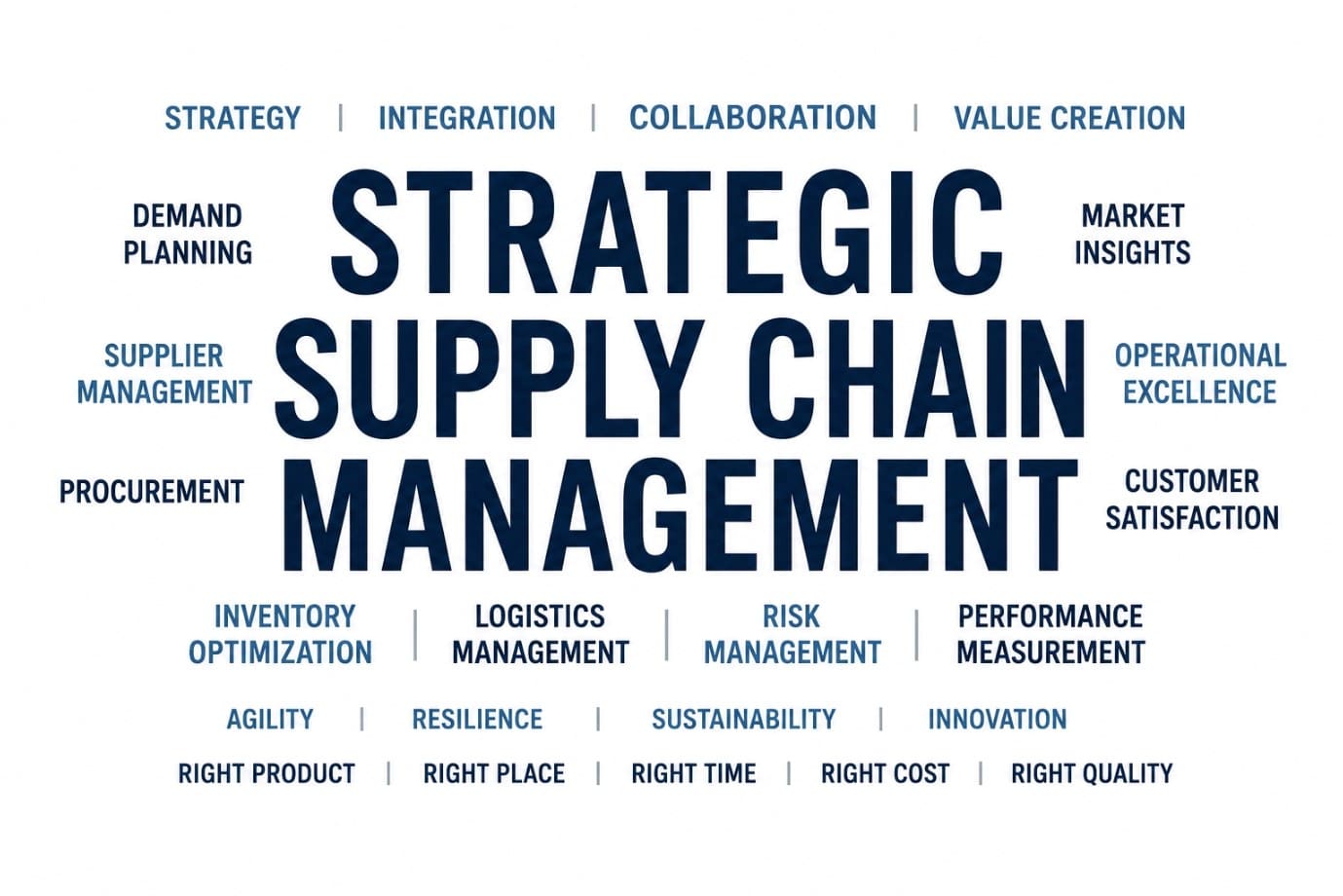
Moreover, effective supply chain strategic planning enables organizations to align their supply chain with overall business goals, ensuring sustainable growth even in uncertain environments. Companies that adopt a strategic mindset can not only withstand disruptions but also gain a competitive edge.
This is where strategic supply chain management emerges as a powerful solution—transforming supply chains from operational functions into strategic assets that drive performance, resilience, and long-term success.
What is Strategic Supply Chain Management?
It refers to the process of designing, planning, and managing supply chain activities with a long-term, goal-oriented perspective. In simple terms, it is about transforming a basic supply chain into a strategic supply chain that not only delivers products but also drives business growth and resilience. From a technical standpoint, strategic scm integrates procurement, production, logistics, and distribution with data-driven decision-making and organizational strategy
Traditional vs Strategic Supply Chain
- Traditional Supply Chain
- Focuses on short-term execution and cost reduction
- Reactive approach to disruptions
- Limited visibility across operations
- Minimal alignment with business strategy
- Strategic Supply Chain
- Built on long-term vision and adaptability
- Proactive risk management and forecasting
- End-to-end visibility and integration
- Strong alignment with organizational goals
Key Elements of Strategic Supply Chain Management
- Long-Term Planning: Emphasizes supply chain strategic planning to anticipate future demand, risks, and opportunities
- Business Alignment: Ensures the strategic supply chain supports overall company objectives such as growth, scalability, and profitability
- Smart Procurement: Uses strategic sourcing in supply chain management to build reliable supplier networks and reduce dependency risks
- Data-Driven Decisions: Leverages analytics and technology for better forecasting and efficiency
In essence, strategic supply chain management goes beyond daily operations. It converts the supply chain into a competitive advantage by aligning execution with long-term strategy, making strategic scm a critical driver of sustainable success.
Also Read: Types of Supply Chain Management
Key Components of a Strategic Supply Chain
Building a high-performing strategic supply chain requires a structured approach that integrates planning, execution, and continuous improvement. Effective strategic supply chain management ensures that every component works in alignment with business goals, enabling organizations to achieve efficiency, resilience, and scalability. Below are the key components that define a successful strategic scm framework: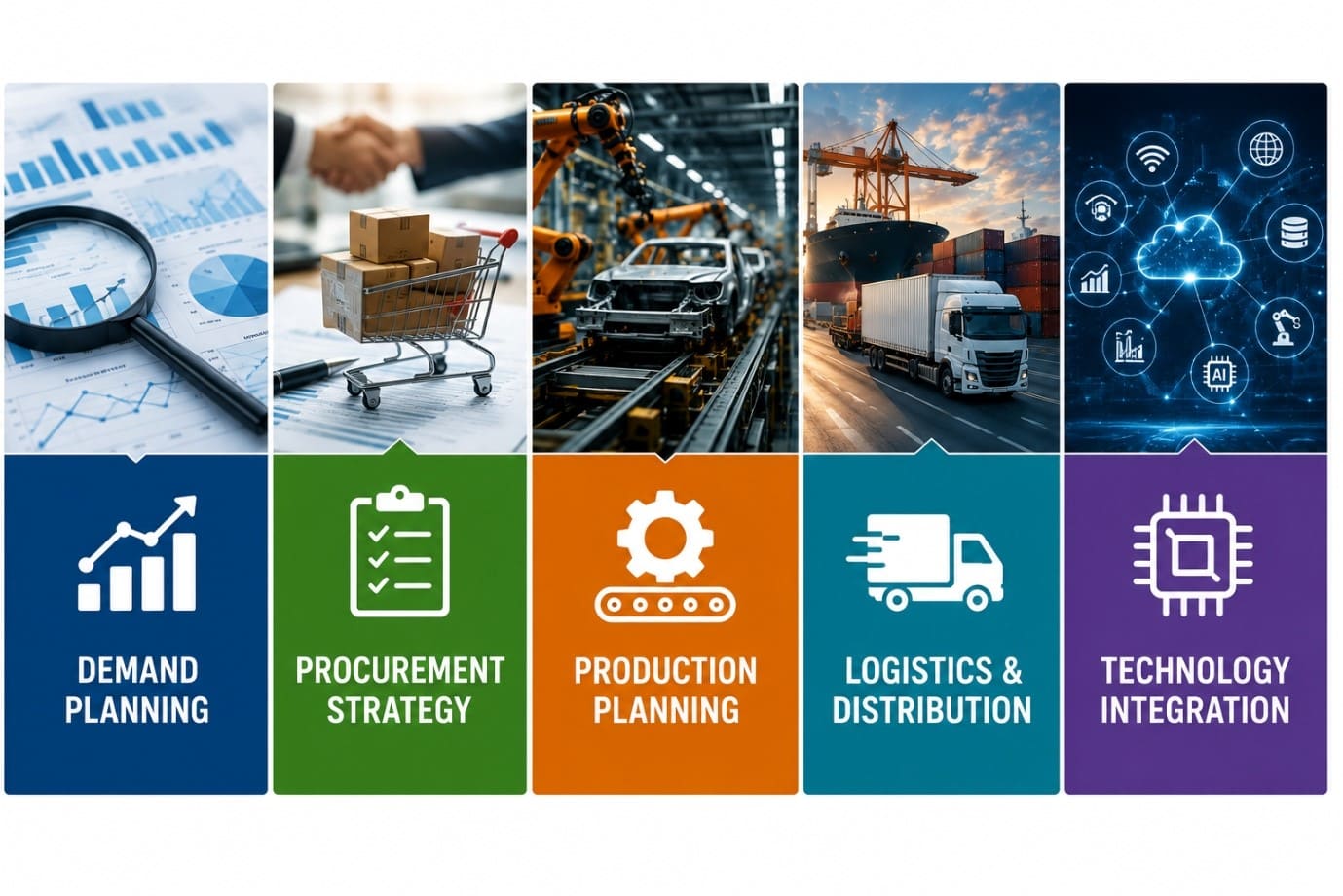
⮞ Demand Planning
Accurate demand planning is the foundation of any strategic supply chain. It involves forecasting customer demand using historical data, market trends, and advanced analytics.
- Improves forecasting accuracy
- Enables data-driven decision-making
- Reduces overstocking and stockouts
With strong supply chain strategic planning, businesses can anticipate fluctuations and respond proactively. For detailed information, you can read our dedicated blog on Demand Planning in Supply Chain Management.
⮞ Procurement Strategy
Efficient production planning aligns manufacturing capabilities with demand. In strategic chain management, this involves:
- Implementing lean manufacturing principles
- Optimizing capacity utilization
- Minimizing waste and downtime
This ensures that operations remain efficient while supporting long-term growth.
⮞ Production Planning
Procurement plays a critical role in strategic sourcing in supply chain management. It focuses on selecting the right vendors while balancing cost, quality, and reliability.
- Strategic vendor selection and evaluation
- Cost optimization without compromising quality
- Risk diversification through multiple suppliers
A well-defined strategic procurement and supply chain management approach strengthens supplier relationships and ensures continuity. For more details, you can also read our comprehensive blog on Product Planning and Management.
⮞ Logistics & Distribution
Logistics is a key driver of efficiency in strategic scm. It focuses on delivering products quickly and cost-effectively.
- Optimized transportation strategies
- Improved warehousing and inventory management
- Faster and reliable distribution networks
These elements enhance customer satisfaction and operational performance. For more information regarding operations in supply chain, you can go through our in-depth blog on Operational Supply Chain Management.
⮞ Technology Integratixon
Modern strategic supply chain management relies heavily on technology.
- ERP systems for end-to-end visibility
- AI and IoT for predictive insights
- Automation for improved efficiency
By integrating technology, businesses can elevate strategic sourcing and supply chain management, enabling smarter decisions and greater agility.
Together, these components form the backbone of a robust strategic supply chain, ensuring that businesses remain competitive in an increasingly complex global environment.
Why Strategic Supply Chain Management Matters
In an increasingly complex and unpredictable business environment, adopting strategic supply chain management is essential for organizations aiming to stay competitive and resilient. A well-structured strategic supply chain goes beyond operational efficiency—it becomes a key driver of business success. By integrating strategic scm principles, companies can unlock multiple benefits that directly impact their bottom line and long-term growth.
- Cost Reduction: One of the primary advantages of strategic supply chain management is the ability to reduce operational costs. Through strategic sourcing, businesses can negotiate better contracts, optimize supplier selection, and minimize waste. Additionally, efficient strategic procurement helps control inventory costs and reduce unnecessary expenditures.
- Increased Efficiency: A strong strategic supply chain enhances coordination across all functions—from procurement to distribution. With effective planning, companies can streamline processes, eliminate bottlenecks, and improve overall productivity.
- Risk Mitigation: Global disruptions have highlighted the importance of resilience. Strategic sourcing and supply chain management enable businesses to diversify suppliers, improve visibility, and proactively manage risks, ensuring continuity even during uncertainties. You can also go through our dedicated blog on Risk Management for detailed information.
- Faster Delivery: Optimized logistics and better planning within strategic scm lead to faster and more reliable delivery. This not only improves customer satisfaction but also strengthens brand reputation.
- Competitive Advantage: Ultimately, strategic supply chain management transforms the supply chain into a strategic asset. Companies that invest in strategic supply chain practices can respond quickly to market changes, innovate faster, and outperform competitors in a dynamic global landscape.
Adopting strategic supply chain management enables businesses to reduce risks, improve efficiency, and stay ahead in a competitive market.
Common Supply Chain Challenges
Despite increasing awareness, many organizations still struggle to build an effective strategic supply chain due to persistent operational and structural challenges. In both India and the global market, these issues can significantly impact performance, profitability, and customer satisfaction, highlighting the need for robust strategic supply chain management.
- Demand Volatility: Unpredictable demand patterns make planning difficult. Without proper supply chain strategic planning, businesses either overstock or run into shortages, leading to increased costs and missed opportunities.
- Supplier Dependency: Over-reliance on limited suppliers is a major risk. A lack of diversification in strategic sourcing can result in disruptions when suppliers fail to deliver, causing production delays and financial losses.
- Poor Visibility: Limited real-time insights across the supply chain hinder decision-making. Without strong strategic scm practices, businesses struggle to track inventory, shipments, and supplier performance, leading to inefficiencies and delays.
- Inefficient Logistics: Inadequate infrastructure and poor planning often result in high transportation costs and delayed deliveries. Weak execution in strategic chain management directly impacts delivery timelines and customer experience. Get clarity by reading our dedicated blog on Which Logistics is Right for Your Business- 2PL, 3PL, 4PL or 5PL.
- Lack of Technology Adoption: Many companies still rely on outdated systems. Without integrating tools that support strategic sourcing in supply chain management, organizations miss out on automation, analytics, and predictive capabilities.
- The Consequences: These challenges lead to:
- Delivery delays
- Increased operational losses
- Reduced customer satisfaction
By strengthening strategic procurement in supply chain management, businesses can overcome these barriers and build a more resilient and efficient strategic supply chain management framework.
Strategic Framework for Supply Chain Optimization
To build a resilient and high-performing strategic supply chain, organizations must adopt a structured and data-driven approach. An effective framework for strategic supply chain management not only improves efficiency but also aligns operations with long-term business objectives. Below is a step-by-step framework that defines successful strategic scm implementation: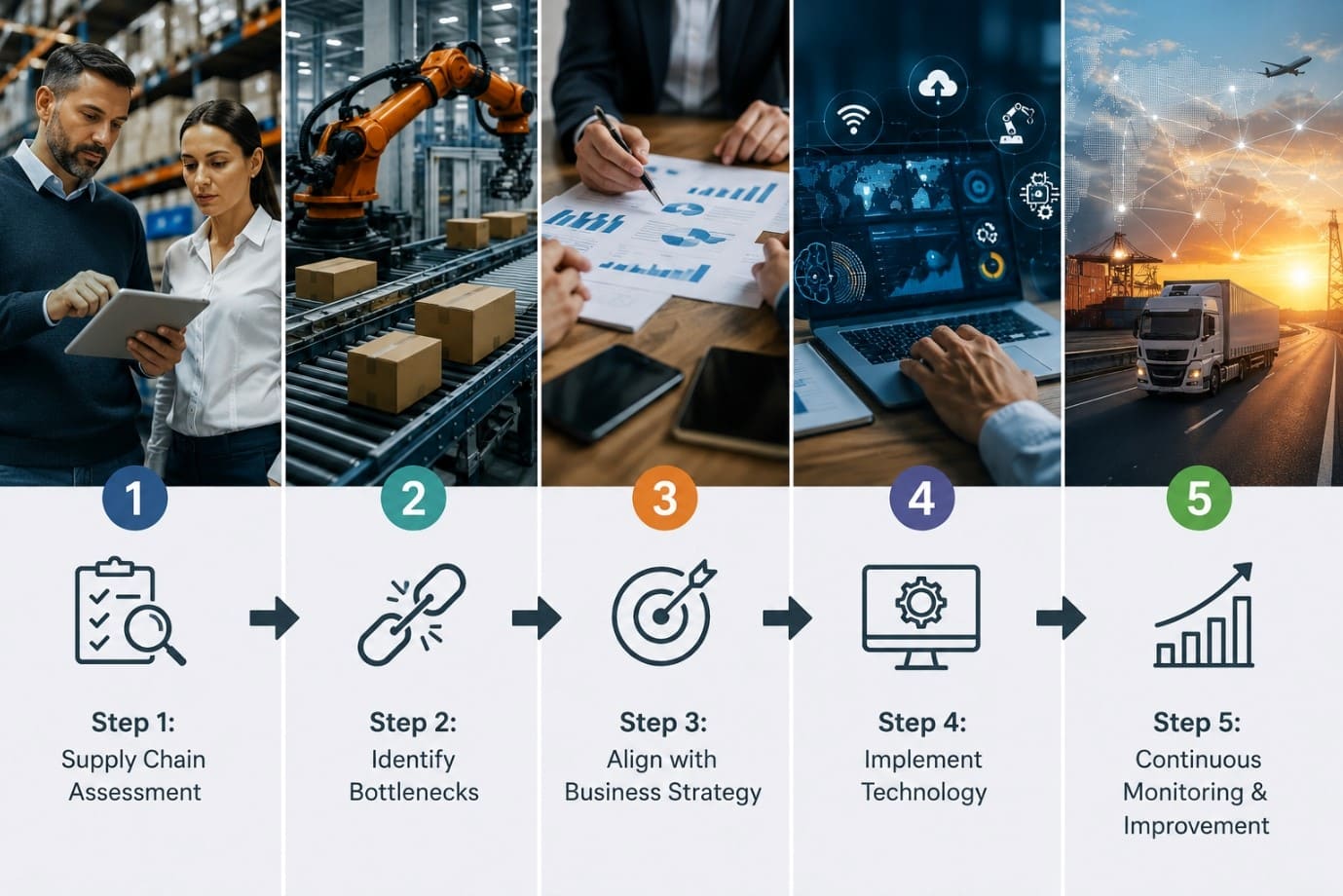
⮞ Step 1: Supply Chain Assessment
The foundation of any strategic supply chain begins with a comprehensive audit of existing processes. This includes evaluating procurement, production, inventory, and logistics systems.
- Identify inefficiencies and cost leakages
- Assess supplier performance and risks
- Evaluate current tools and technologies
A detailed assessment enables better supply chain strategic planning and sets the stage for transformation.
⮞ Step 2: Identify Bottlenecks
Once the assessment is complete, the next step in strategic chain management is identifying bottlenecks using data analysis.
- Analyze delays in production and delivery
- Detect inventory imbalances
- Identify supplier or logistics constraints
Leveraging analytics in strategic sourcing in supply chain management helps pinpoint critical issues that impact performance.
⮞ Step 3: Align with Business Strategy
A successful strategic supply chain management approach must align with overall business goals. Whether the focus is on growth, cost leadership, or speed, the supply chain should support these priorities.
- Balance cost vs service levels
- Align procurement and production with demand
- Strengthen strategic sourcing and supply chain management practices
This ensures that the strategic supply chain becomes a driver of business success rather than just a support function.
⮞ Step 4: Implement Technology
Digital transformation is a key pillar of modern strategic scm.
- Implement ERP systems for visibility
- Use AI and IoT for predictive insights
- Automate repetitive processes
Technology enhances strategic procurement and supply chain management, enabling faster and smarter decision-making.
⮞ Step 5: Continuous Monitoring & Improvement
Optimization is an ongoing process in strategic supply chain management.
- Track KPIs such as lead time, cost, and service levels
- Conduct regular performance reviews
- Continuously refine strategies
With consistent monitoring, businesses can strengthen their strategic supply chain, adapt to changes, and maintain a competitive edge.
By following this structured framework, organizations can transform their operations into a robust strategic scm model, ensuring efficiency, resilience, and long-term growth.
Role of Industry 4.0 in Supply Chains
The emergence of Industry 4.0 is transforming the way businesses design and manage their strategic supply chain. By integrating advanced technologies, organizations can move from reactive operations to intelligent, data-driven systems. This evolution is a critical enabler of modern strategic supply chain management, allowing companies to achieve higher efficiency, visibility, and agility.
- Smart Factories & Automation: Smart factories are at the core of strategic scm, where machines, systems, and processes are interconnected. Automation reduces manual intervention, minimizes errors, and improves production speed. This enhances overall strategic chain management by ensuring consistent and optimized operations.
- Real-Time Tracking & Visibility: With the help of IoT (Internet of Things), businesses can track inventory, shipments, and supplier activities in real time. This level of transparency strengthens supply chain strategic planning, enabling quicker decisions and improved coordination across the entire value chain.
- Predictive Analytics & AI: Artificial Intelligence (AI) and advanced analytics play a crucial role in forecasting demand, identifying risks, and optimizing resources. In strategic sourcing in supply chain management, predictive insights help businesses select reliable suppliers and anticipate disruptions before they occur.
- Integrated Digital Ecosystem: Industry 4.0 enables seamless integration across procurement, production, and logistics. This strengthens strategic sourcing and supply chain management and enhances collaboration between stakeholders. Additionally, digital tools improve strategic procurement by streamlining workflows and reducing inefficiencies.
- Future-Ready Supply Chains: By embracing Industry 4.0, businesses can build a future-ready strategic supply chain that is resilient, adaptive, and scalable. Companies that invest in these technologies today will lead tomorrow, making strategic supply chain management a key pillar of long-term success.
How Consulting Firms Add Value to Supply Chain via Strategies
In today’s complex business environment, many organizations struggle to build and sustain an efficient strategic supply chain on their own. This is where experienced consulting firms play a critical role. By bringing industry expertise, data-driven insights, and proven methodologies, they help businesses implement effective strategic supply chain management practices that deliver measurable results.
Consulting firms offer end-to-end transformation by analyzing existing operations, identifying inefficiencies, and designing customized solutions. Through advanced strategic scm approaches, they streamline workflows, optimize inventory, and enhance coordination across procurement, production, and distribution. This leads to improved operational efficiency and reduced costs.
A key area of impact is strategic sourcing in supply chain management, where consultants help organizations build reliable supplier networks, reduce risks, and negotiate better value. Additionally, they focus on process optimization and factory efficiency improvement by implementing lean practices, digital tools, and performance monitoring systems.
By aligning supply chain operations with broader business goals, consulting firms enable companies to transform their strategic supply chain into a competitive advantage. Their expertise ensures faster implementation, reduced risks, and sustainable long-term growth.
FAQs
A. Strategic supply chain management refers to the long-term planning and optimization of supply chain activities to align with business goals. It is important because it improves efficiency, reduces risks, and helps businesses stay competitive in a dynamic market.
A. A strategic supply chain focuses on long-term planning, flexibility, and alignment with business objectives, whereas traditional supply chains are more reactive and focused on short-term cost reduction.
A. Implementing strategic scm helps businesses achieve cost reduction, improved efficiency, faster delivery, and better risk management, ultimately leading to stronger operational performance.
A. Supply chain strategic planning enables businesses to forecast demand, allocate resources effectively, and align operations with long-term goals, resulting in improved productivity and profitability.
A. Technology such as AI, IoT, and ERP systems enhances strategic supply chain management by enabling real-time tracking, predictive analytics, and improved decision-making across the supply chain.
Conclusion
In an increasingly dynamic and unpredictable business landscape, building a resilient and efficient strategic supply chain is no longer optional—it is a necessity. Organizations that embrace strategic supply chain management move beyond reactive operations and create systems that are agile, data-driven, and aligned with long-term business goals. By integrating strong strategic scm practices, companies can optimize resources, reduce risks, and respond effectively to market disruptions.
A well-designed approach to supply chain strategic planning ensures that every element—from procurement to distribution—works in harmony with the overall business strategy. Additionally, adopting advanced methods like strategic sourcing in supply chain management allows organizations to strengthen supplier relationships, enhance visibility, and drive continuous improvement.
Ultimately, a robust strategic supply chain becomes a powerful competitive advantage. It enables businesses to deliver faster, operate more efficiently, and maintain consistency even in uncertain conditions. Companies that invest in building and refining their strategic supply chain management capabilities are better positioned to outperform competitors and achieve sustainable growth.
In a rapidly evolving market, businesses that invest in strategic supply chains today will lead tomorrow.
For more information, go to our Homepage.